Home
Class 12
PHYSICS
A solid spherical ball is released from ...

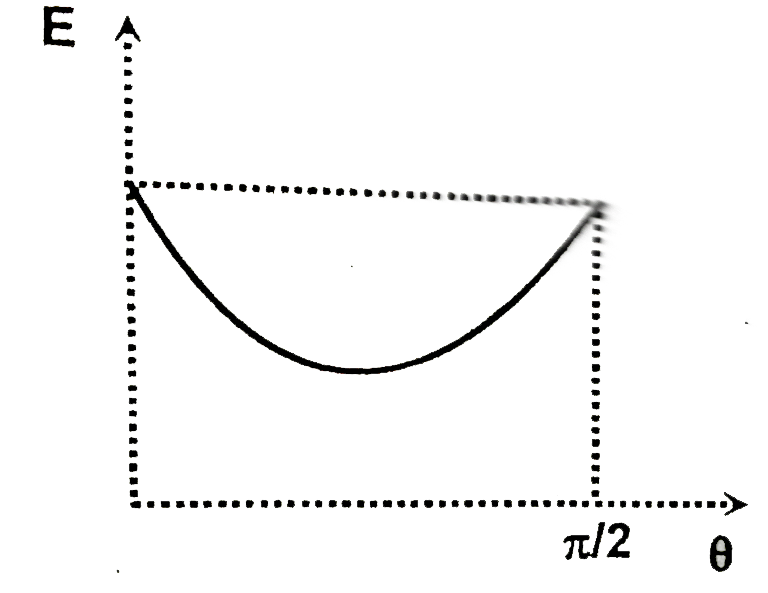
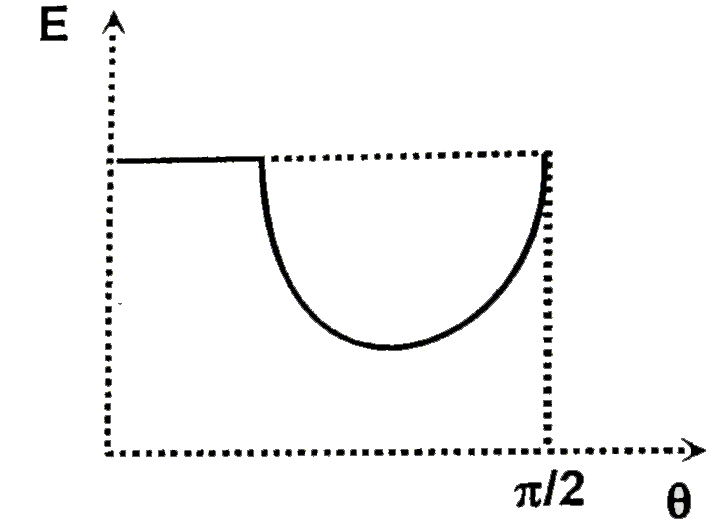
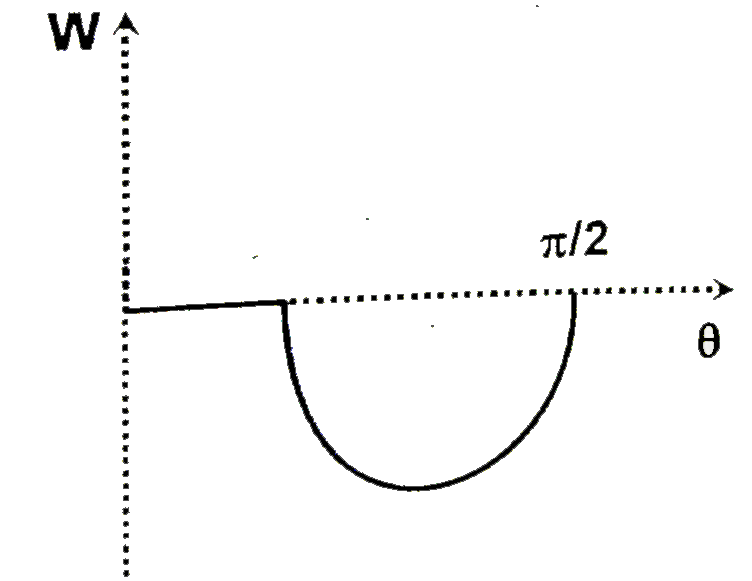
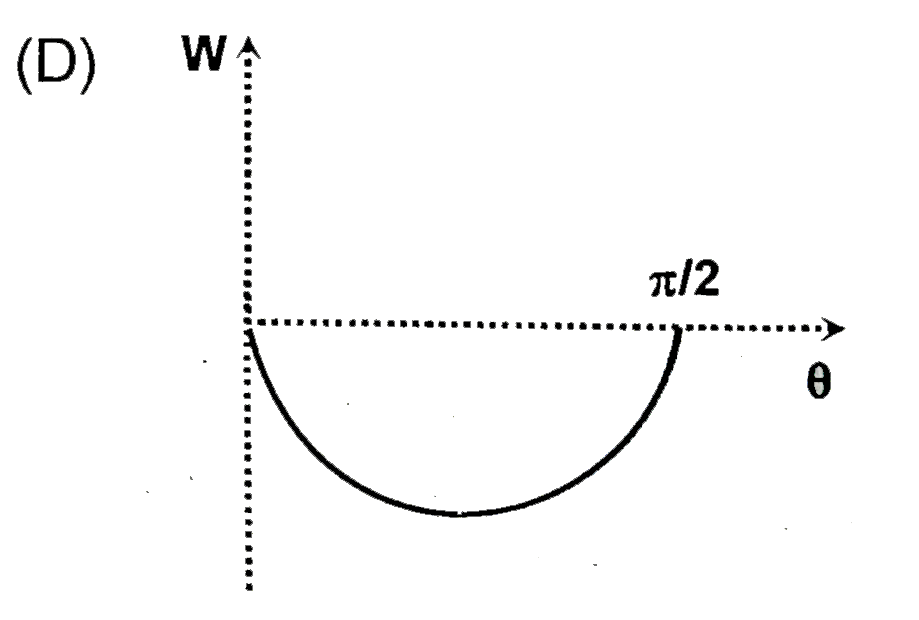
A solid spherical ball is released from rest on an incline of inclination angle `theta` (which can be varied ) but through a fixed vertical height `h`. The coefficient of static and kinetic friction are both equal to `mu`. If `E` represents the total kinetic energy of the ball at the bottom of the incline as a function of the angle of inclination `theta`. `W` represents the work done by friction for the whole time of motion as a function of the angle of inclination `theta`. Choose of correct graph (s)

A

B

C

D

Text Solution

AI Generated Solution

The correct Answer is:

To solve the problem, we need to analyze the motion of a solid spherical ball released from rest on an incline. We will derive expressions for the total kinetic energy \( E \) at the bottom of the incline and the work done by friction \( W \) as functions of the angle of inclination \( \theta \). ### Step 1: Analyze Forces Acting on the Ball When the ball is on the incline, the forces acting on it are: - The weight of the ball \( mg \), which can be resolved into two components: - Parallel to the incline: \( mg \sin \theta \) - Perpendicular to the incline: \( mg \cos \theta \) - The normal force \( N \) acting perpendicular to the incline. - The frictional force \( f \), which opposes the motion and is given by \( f = \mu N \). ### Step 2: Condition for Motion The ball will start moving when the component of gravitational force down the incline exceeds the frictional force: \[ mg \sin \theta > \mu mg \cos \theta \] This simplifies to: \[ \tan \theta > \mu \] Thus, the ball will not move for \( \theta < \tan^{-1}(\mu) \). ### Step 3: Net Force and Acceleration Once the ball starts moving, the net force acting on the ball along the incline can be expressed as: \[ F_{\text{net}} = mg \sin \theta - \mu mg \cos \theta \] Using Newton's second law, we have: \[ ma = mg \sin \theta - \mu mg \cos \theta \] Thus, the acceleration \( a \) of the ball is: \[ a = g \sin \theta - \mu g \cos \theta \] ### Step 4: Work Done by Gravity and Friction The work done by gravity when the ball moves a distance \( s \) down the incline is: \[ W_{\text{gravity}} = mg h \] Where \( h \) is the fixed vertical height. The work done by friction is: \[ W_{\text{friction}} = -f \cdot s = -\mu mg \cos \theta \cdot s \] ### Step 5: Kinetic Energy at the Bottom of the Incline Using the work-energy theorem: \[ W_{\text{gravity}} + W_{\text{friction}} = \Delta KE \] Since the initial kinetic energy is zero (the ball starts from rest), we have: \[ mg h - \mu mg \cos \theta \cdot s = \frac{1}{2} mv^2 \] Where \( v \) is the final velocity of the ball at the bottom of the incline. ### Step 6: Relating Distance \( s \) to Height \( h \) From geometry, we have: \[ h = s \sin \theta \] Thus, we can express \( s \) as: \[ s = \frac{h}{\sin \theta} \] ### Step 7: Total Kinetic Energy \( E \) Substituting \( s \) into the kinetic energy equation: \[ E = mg h - \mu mg \cos \theta \cdot \frac{h}{\sin \theta} \] This simplifies to: \[ E = mg h \left(1 - \frac{\mu \cos \theta}{\sin \theta}\right) \] \[ E = mg h \left(1 - \mu \cot \theta\right) \] ### Step 8: Work Done by Friction \( W \) The work done by friction can also be expressed as: \[ W = -\mu mg \cos \theta \cdot \frac{h}{\sin \theta} \] This simplifies to: \[ W = -\mu mg h \cot \theta \] ### Conclusion - The total kinetic energy \( E \) as a function of \( \theta \) is given by: \[ E = mg h \left(1 - \mu \cot \theta\right) \] - The work done by friction \( W \) as a function of \( \theta \) is given by: \[ W = -\mu mg h \cot \theta \]

To solve the problem, we need to analyze the motion of a solid spherical ball released from rest on an incline. We will derive expressions for the total kinetic energy \( E \) at the bottom of the incline and the work done by friction \( W \) as functions of the angle of inclination \( \theta \). ### Step 1: Analyze Forces Acting on the Ball When the ball is on the incline, the forces acting on it are: - The weight of the ball \( mg \), which can be resolved into two components: - Parallel to the incline: \( mg \sin \theta \) - Perpendicular to the incline: \( mg \cos \theta \) - The normal force \( N \) acting perpendicular to the incline. ...
Promotional Banner

Similar Questions

Explore conceptually related problems

A solid ball is realeased from rest down inclines of various inclination angle theta but through a fixed vertical height h. The coefficient of static and kinetic friction are both equal to mu . Which of the following graph best represents the total kinetic energy K of the ball at the bottom of the incline as a function of the angle theta of the incline?

A solid sphere is in pure rolling motion on an inclined surface having inclination theta

In the previous question the smallest kinetic energy at the bottom of the incline will be achieved by

A solid cylinder is rolling down a rough inclined plane of inclination theta . Then

A particle is released from the top of an incline of height h. Does the kinetic energy of the particle at the bottom of the incline depend on the angle of incline? Do you ned any more information to anwer this question in Yes or No?

A ball collides with an inclined plane of inclination theta after falling through a distance h. if it moves horizontal just after the impact, the coefficient of restitution is

A block has been placed on an inclined plane . The slope angle of theta of the plane is such that the block slides down the plane at a constant speed . The coefficient of kinetic friction is equal to :

A block has been placed on an inclined plane . The slope angle of theta of the plane is such that the block slides down the plane at a constant speed . The coefficient of kinetic friction is equal to :

What is the minimum coefficient of friction for a solid sphere to roll without slipping on an inclined plane of inclination theta ?

A block is released from rest from point on a rough inclined place of inclination 37^(@). The coefficient of friction is 0.5.
