Home
Class 12
PHYSICS
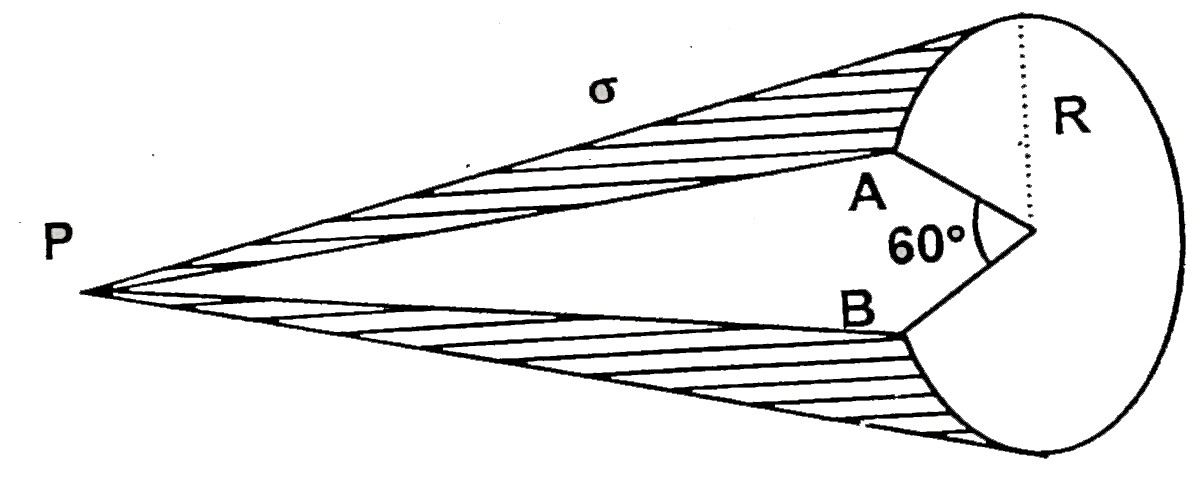
A non-conducting hollow cone has charge ...

A non-conducting hollow cone has charge density `sigma` A path `ABP` is cut and removed from the cone. The potential due to the remaining portion of the cone at point `'P'` is

A

`5/6 (sigmaR)/(epsilon_(0))`

B

`5/24 (sigmaR)/(epsilon_(0))`

C

`5/3 (sigmaR)/(epsilon_(0))`

D

`5/12 (sigma R)/(epsilon_(0))`

Text Solution

Verified by Experts

The correct Answer is:
D

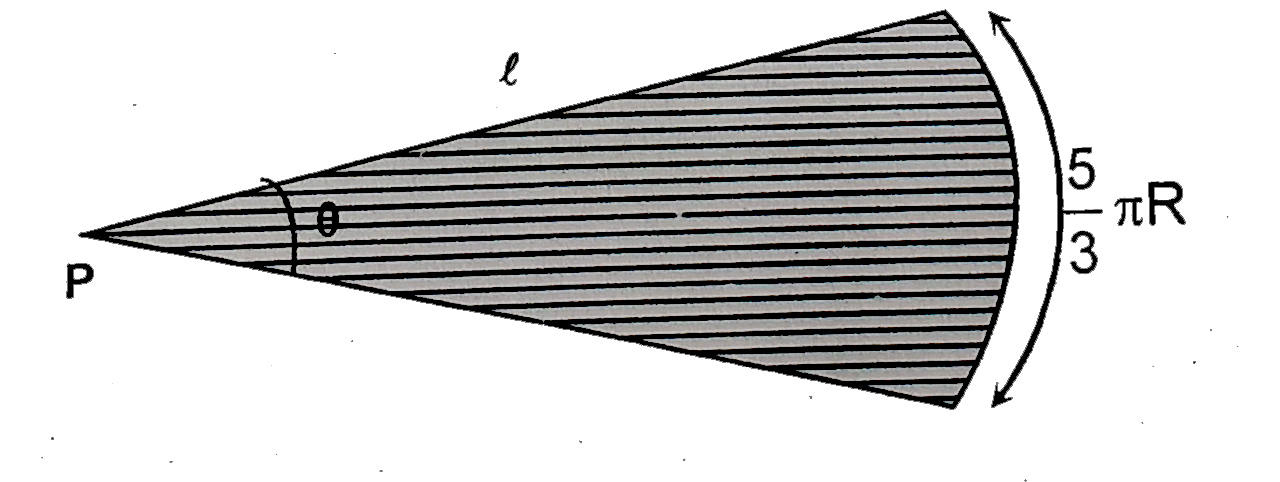
Potential due to circular non conducting disc, `V_(c)=(sigmar)/(2epsilon_(0))` (where `r` is radius of disc)
So `v_(P)=((theta)/(2pi))((sigma.l)/(2epsilon_(0)))`
`=((sigmal)/(2epsilon_(0)))(5/3 (piR)/((l)))(1/(2pi)=(5sigmaR)/(12 epsilon_(0))`
Promotional Banner

Similar Questions

Explore conceptually related problems

An infinite conducting sheet has surface charge density sigma . The distance between two points is r. The potential difference (V_A - V_B) between these point is

An infinitely large non-conducting plane of uniform surface charge density sigma has circular aperture of certain radius carved out from it. The electric field at a point which is at a distance 'a' from the centre of the aperture (perpendicular to the plane) is (sigma)/(2 sqrt(2) in_(0)) . Find the radius of aperture :

Three non-conducting large parallel plates have surface charge densities sigma, -2 sigma and 4 sigma respectively as shown in the figure. The electric field at the point P is

A solid non conducting sphere has charge density pCm^(-3) Electric field at distance x from its centre is ______ [x lt R]

A non-conducting semi circular disc (as shown in figure) has a uniform surface charge density sigma . The ratio of electric field to electric potential at the centre of the disc will be

Two uniformly charged non-conducting hemispherical shells each having uniform charge density sigma and radius R from a complete sphere (not stuck together) and surround a concentric spherical conducting shell of radius R/2. If hemispherical parts are in equilibrium then minimum surface charge density of inner conducting shell is :

An infinite thin non - conducting sheet has uniform surface charge density sigma . Find the potential difference V_(A)-V_(B) between points A and B as shown in the figure. The line AB makes an angle of 37^(@) with the normal to the sheet. (sin 37^(@)=(3)/(5))

In front of a uniformly charged infinite non-conducting sheet of surface charge density sigma , a point charge q_(0) is shifted slowly from a distance a to b (b gt a) . If work done by external agent is W, then find out relation between the given parameters.

A point charge q'q is placed at distance 'a' from the centre of an uncharged thin spherical conducting shell of radius R=2a. A point 'P' is located at a distance 4a from the centre of the conducting shell as shown. The electric potential due to induced charge on the inner surface of the conducting shell at point 'P' is

Figure shown a charged conductor resting on an insulating stand. If at the point P the charge density is sigma , the potential is V and the electric field strength is E , what are the values of these quantities at point Q ?

