Home
Class 12
PHYSICS
Two identical pates P(1) and P(2) of cro...

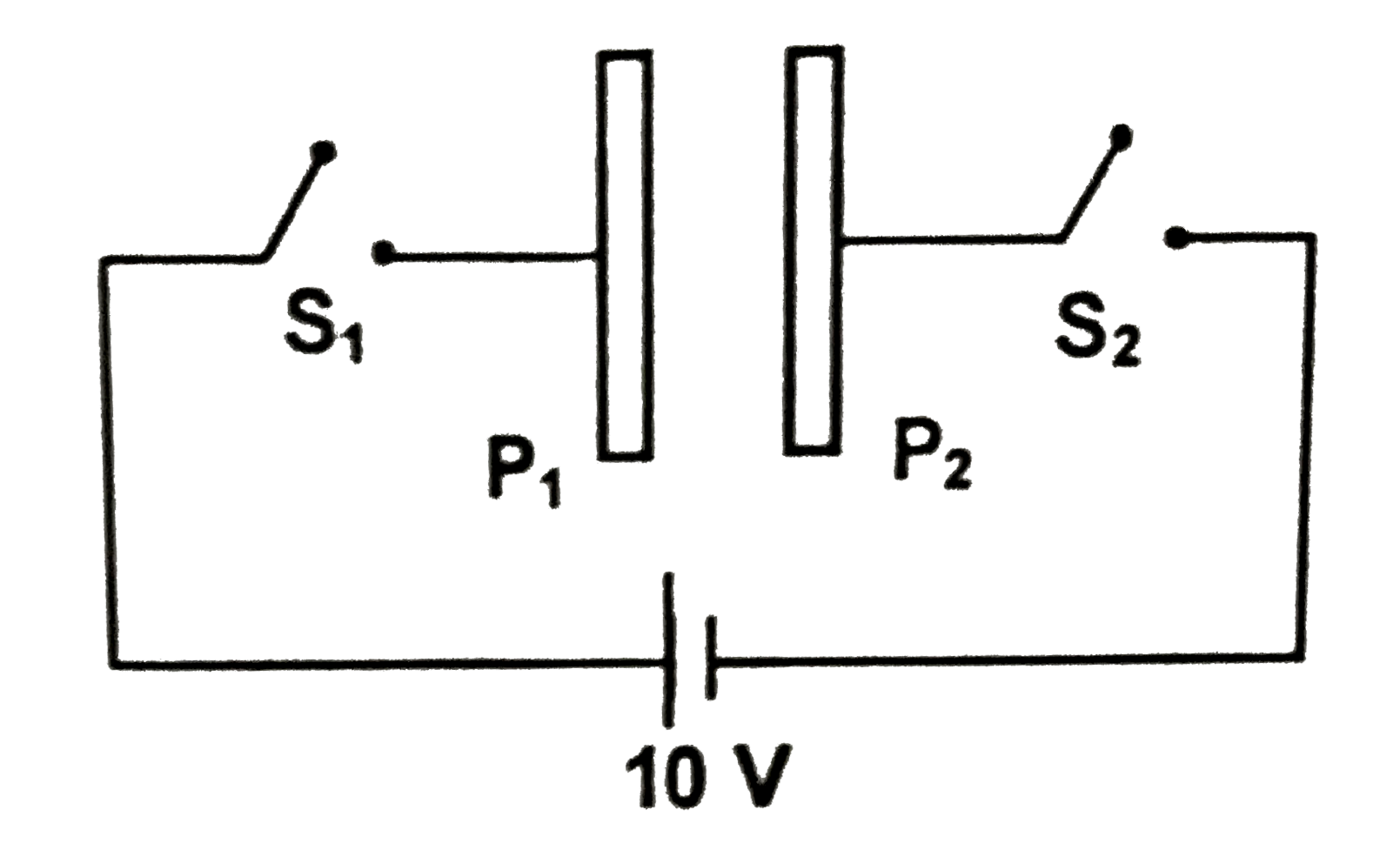
Two identical pates `P_(1)` and `P_(2)` of cross sectional area `A` are separated at a very small disance, `d`, where `(epsilon_(0)A)/d=2-SI` unit. Initially charge on the plate `P_(1)` is `-10C` and charge on the plate `P_(2)` is `+30C`. Now plate `P_(1)` and `P_(2)` are connected to positive and negative terminals of battery of potential difference 10 Volts with the help of switches `S_(1)` and `S_(2)` respectively. Choose the correct option (s)

A

The work done by the battery is `200J`

B

The net charge on the plate `P_(2)` is `-10C`

C

The charge on the left side of the plate `P_(1)` is `10C`

D

The charge on the right side of the plate `P_(2)` is `20C`

Text Solution

Verified by Experts

The correct Answer is:
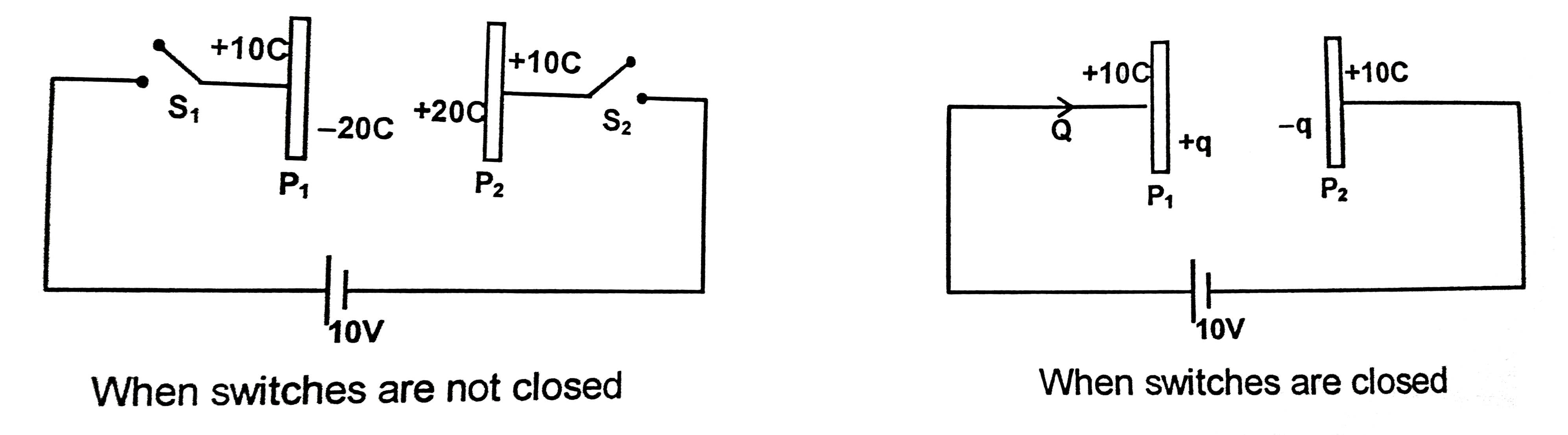
B, C


When switches are not closed
`q/(aepsilon_(0)xxd=10`
`impliesq=10xx(Aepsilon_(0))/d=20C`
`Q=20+20=40C`
`W_(B)=(20+20)10=400J`
Promotional Banner

Similar Questions

Explore conceptually related problems

Charges Q_0 and 2Q_0 are given to parallel plates A and B, respectively, and they are separated by a small distance. The capacitance of the given arrangement is C. Now, plates A and B are connected to positive and negative terminals of battery of potential difference V = 2Q_0//C respectively, as shown, then the work done by the battery is

In the above question, if plates P_1 and P_2 are connected by a thin conducting wire, then the amount of heat produced will be

Two identical capacitor C_(1) and C_(2) are connected in series with a battery. They are fully charged. Now a dielectric slab is inserted between the plates of C_(2) . The potential across C_(1) will :

Four large identical metallic plates are placed as shown in the Figure. Plate 2 is given a charge Q. All other plates are neutral. Now plates 1 and 4 are earthed. Area of each plate is A. (a) Find charge appearing on right side of plate 3. (b) Find potential difference between plates 1 and 2.

Two identical conducting very large plates P_1 and P_2 having charges +4Q and +6Q are placed very closed to each other at separation d. The plate area of either face of the plate is A. The potential difference between plates P_1 and P_2 is

Three identical metallic plates, each of area A, are kept at small separations as shown. Initially, charge Q, 3Q and 3Q are given to the plates A, B and c, respectively. Now, both the switches S_(1) and S_(2) are closed simultaneously. Then Charge flown through S_(1) and S_(2) are

Two capacitros are fully charged by a battery as shown in the figure. If the capacitors are disconnected from battery and plate 1 is connected to plate 4 & plate 2 to plate 3, then find the potential difference (in volts) across capacitors finally.

Five identical plates each of area a are joined as shown in the figure. The distance between the plates is d. the plates are connected to a potential difference of V volt. The charge on plates 1 and 4 will be

A parallel-plate capacitor has plates of unequal area . The larger plates is connected to the positive terminal of the battery and the smaller plate to its nagative terminal. Let Q+ and Q-be the charges appearing on the positive and negative plates respectively

A capacitor of 5 muF is charged to a potential of 100 V . Now, this charged capacitor is connected to a battery of 100 V with the posiitive terminal of the battery connected to to the negative plate of the capacitor . For the given situation, mark the correct statement(s).

