Home
Class 12
PHYSICS
A conducting rod of length 'l'=2sqrt(5) ...

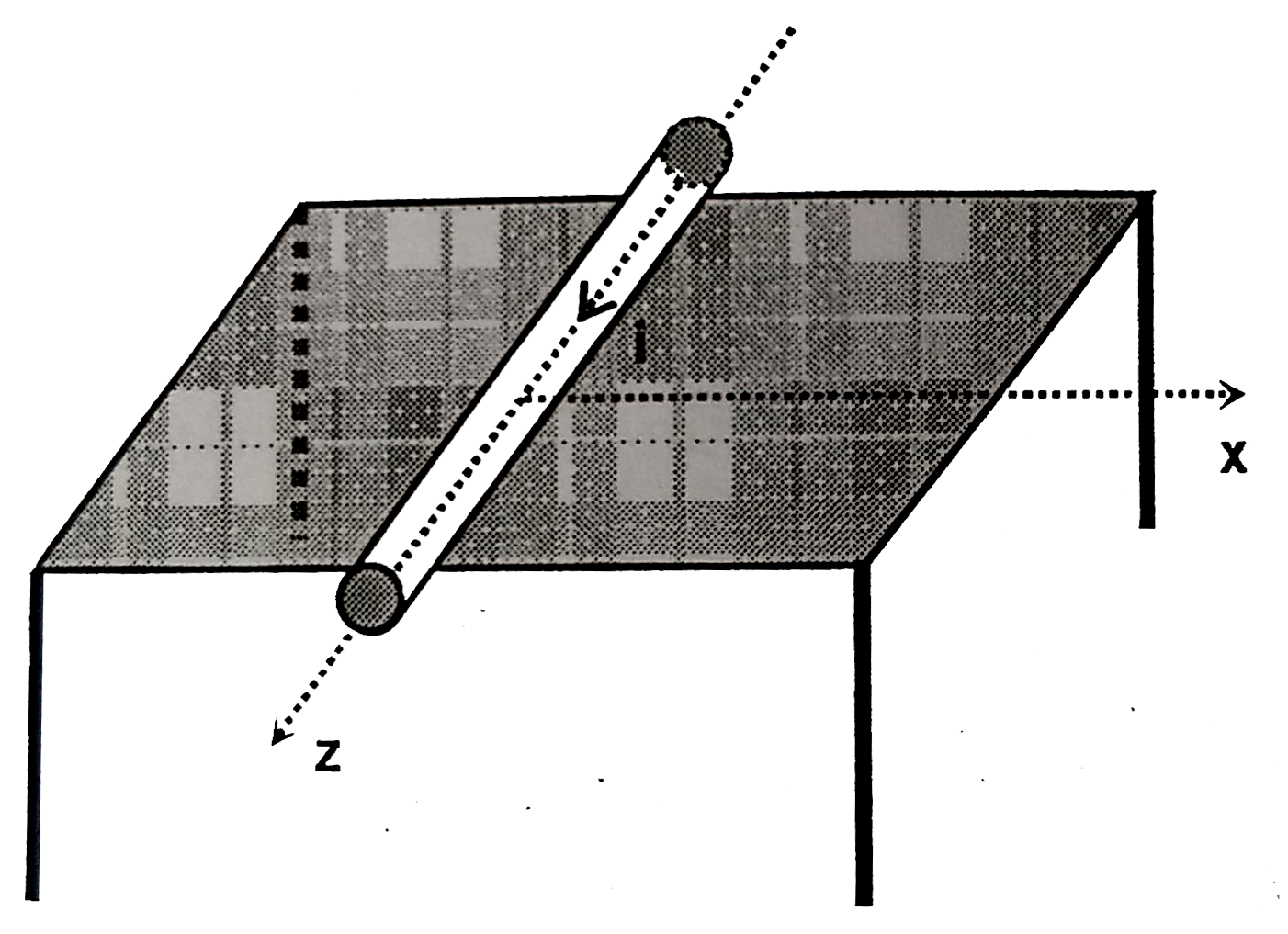
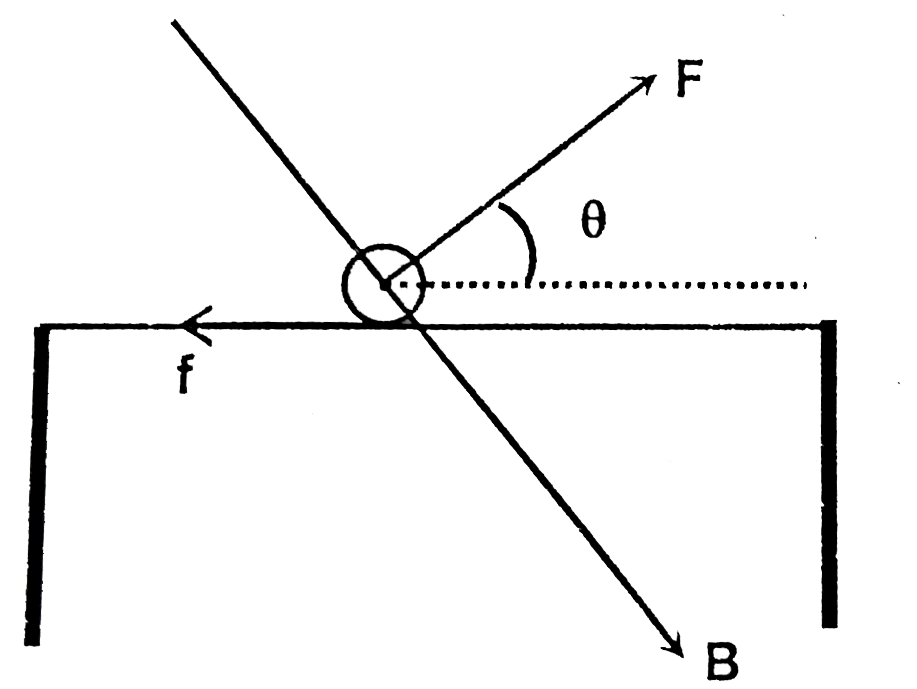
A conducting rod of length `'l'=2sqrt(5)` meter and mass `'m'=4kg` lies on the horizontal table. Coefficient of friction between the rod and the table is `'mu'=(1/2)`. If the current in the conductor si 2 ampere, then find the minimum magnitude of magnetic field strength (in Tesla) such that conducting rod just starts to translate along `x` -axis (take `g=10m//sec^(2)`) [neglect the radius of rod]

Text Solution

Verified by Experts

The correct Answer is:
2

`F_("min")=(mumg)/(sqrt(1+mu^(2)))`
`il B_("min")=(mumg)/(sqrt(1+mu^(2)))`
`B_("min")=2` Tesla
Promotional Banner

Similar Questions

Explore conceptually related problems

A conductor (rod) of mass m, length l carrying a current i is subjected to a magnetic field of induction B. If the coefficients of friction between the conducting rod and rail is mu, find the value of I if the rod starts sliding.

A uniform rod of length l and mass 2 m rests on a smooth horizontal table. A point mass m moving horizontally at right angles to the rod with velocity v collides with one end of the rod and sticks it. Then

A uniform rod of length l and mass 2 m rests on a smooth horizontal table. A point mass m moving horizontally at right angles to the rod with velocity v collides with one end of the rod and sticks it. Then

If the coefficient of friction between M and the inclined surfaces is mu = 1//sqrt(3) find the minimum mass m of the rod so that the of mass M = 10 kg remain stationary on the inclined plane

One fourth length of a uniform rod of length 2l and mass m is place don a horizontal table and the rod is held horizontal. The rod is released from rest. Find the normal reaction on the rod as soon as the rod is released.

A uniform rod of length l and mass 2m rests on a smooth horizontal table. A point mass m moving horizontally at right angles to the rod with initial velocity v collides with one end of the rod and sticks to it. Determine the position of the point on the rod which remains stationary immediately after collision.

In the figure, a conducting rod of length l=1 meter and mass m = 1 kg moves with initial velocity u = 5 m//s . On a fixed horizontal frame containing inductor L = 2 H and resistance R = 1 W . PQ and MN are smooth, conducting wires. There is a uniform magnetic field of strength B = 1T . Initial there is no current in the inductor. Find the total charge in coulomb, flown through the inductor by the time velocity of rod becomes v_(f) = 1 m//s and the rod has travelled a distance x = 3 meter.

A copper rod of mass m rests on two horizontal rails distance L apart and carries a current of I from one rail to the other. The coefficient of static friction between rod and rails is mu_(s) What are the (a) magnitude and (b) angle (relative to the vertical) of the smallest magnetic field that puts the rod on the verge of sliding?

A uniform rod of mass M and length L lies flat on a frictionless horizantal surface. Two forces F and 2F are applied along the length of the rod as shown. The tension in the rod at point P is

A conducting wire of length l and mass m can slide without friction on two parallel rails and is connected to capacitance C . Whole system lies in a magnetic field B and a constant force F is applied to the rod. Then

