Home
Class 12
PHYSICS
A non conducting solid sphere of mass m ...

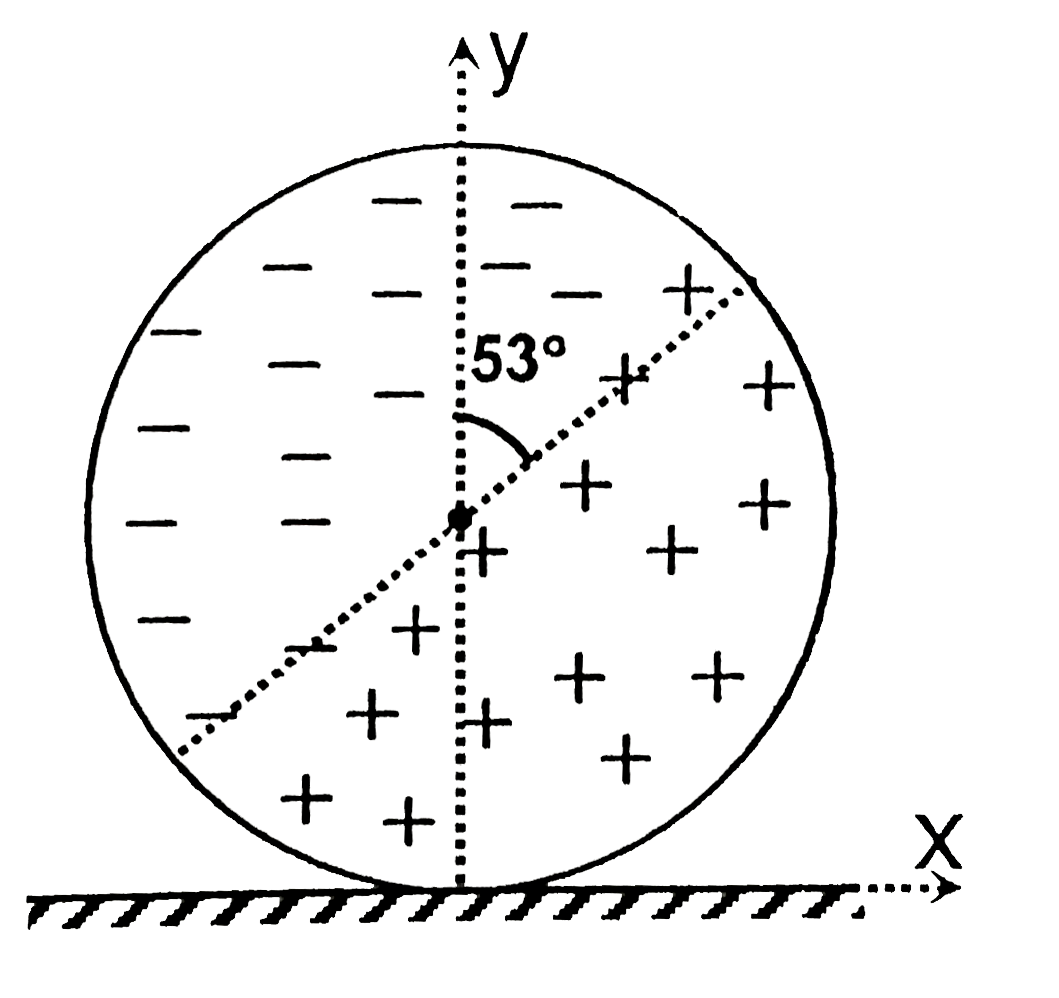
A non conducting solid sphere of mass `m` and radius `R` having uniform charge density `+rho` and `-rho` as shown in figure. It is then placed on a rough non conducting horizontal plane. At `t=0` a uniform electric field `vecE=E_(0)hati N//C` is switched on and the solid sphere starts rolling with sliding. The magnitude of frictional force at `t=0` is `(2rhopiR^(3)E_(0))/K`. Find the value of `K`

Text Solution

Verified by Experts

The correct Answer is:

7

`tau_(Q)=PEsin53^(@)`
`=(rho2/3 pi R^(3))((3R)/4)E_(0) 4/5`
`=2/5 rhopiR^(4)E_(0)=(7/5 mR^(2) alpha)`
`a_(cm)=R alpha=2/7 (rhopiR^(3)E_(0))/m`
`f=ma_(cm)=2/7 rhopi R^(3)E_(0)`
Promotional Banner

Similar Questions

Explore conceptually related problems

A nonconducting ring of mass m and radius R, with charge per unit length lambda is shown in fig. It is then placed on a rough nonconducting horizontal plane. At time t=0, a uniform electric field vecE =E_(0)hati is switched on and the ring starts rolling without sliding. Determine the friction force (magnitude and direction ) acting on the ring.

A solid sphere having radius R and uniform charge density rho has a cavity of radius R/2 as shown in figure.Find the value of |E_A /E_B|

A solid sphere having uniform charge density rho and radius R is shown in figure. A spherical cavity ofradius (R)/(2) is made in it. What is the potential at point O?

A non-conducting solid sphere of radius R, has a uniform charge density. The graph representing variation of magnitude of electric field (E) as a function of distance (x) from the centre of the sphere is

A disc having uniform surface charge density in upper part +rho and -rho in lower half placed on rough horizontal surface as shown in figure. A uniform electric field is set up as shown if mass of disc is M and its radius is R as well sufficient friction is present to prevent slipping. The acceleration of disc is

A uniform solid sphere of mass m and radius 'R' is imparted an initial velocity v_(0) and angular omega_(0) = (2v_(0))/(R ) and then placed on a rough inclined plane of inclination 'theta' and coefficient of friction mu = 2 tan theta as shown. The time after which the sphere will start rolling without slipping is

A solid sphere of mass M and radius R is in pure rolling as shown in figure. The angular momentum of the sphere about the origin is (linear velocity of centre of mass is v_0 , in positive x-direction)

Two non-conducting spheres of radii R_1 and R_2 and carrying uniform volume charge densities +rho and -rho , respectively, are placed such that they partially overlap, as shown in the figure. At all points in the overlapping region

Consider a sphere of radius R which carries a uniform charge density rho . If a sphere of radius R/2 is carved out of it,as shown, the ratio (vecE_(A))/(vecE_(B)) of magnitude of electric field vecE_(a) and vecE_(B) , respectively, at points A and B due to the remaining portion is:

A solid sphere of radius 'R' has a cavity of radius (R)/(2) . The solid part has a uniform charge density 'rho' and cavity has no charge. Find the electric potential at point 'A'. Also find the electric field (only magnetude) at point 'C' inside the cavity

