Home
Class 12
CHEMISTRY
Identify the final product in the given ...

Identify the final product in the given reaction:
`Ph-CH_(2)COOH underset((ii) :COH)overset((i)P_("red")+Br_(2))to X overset(H^(+),Delta)(to) Y`

A

A) `Ph-CH_(2)-underset(O)underset(||)(C)-O-CH_(2)-Ph`

B

C

C) `Ph-CH_(2)-underset(O) underset(||)(C)-O-underset(O) underset(||)(C)-CH_(2)Ph`

D

Text Solution

AI Generated Solution

The correct Answer is:

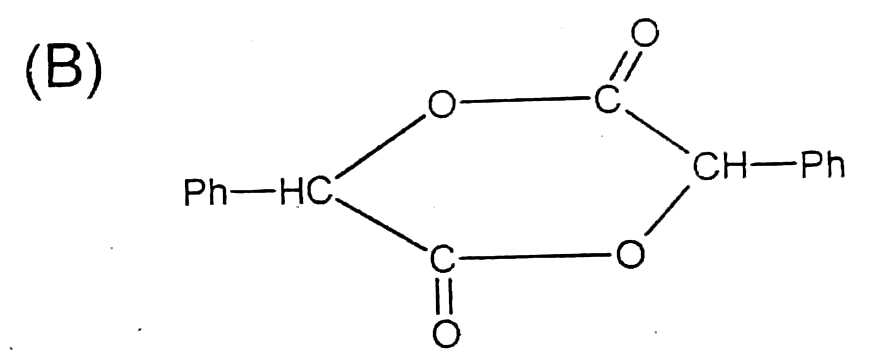
To identify the final product in the given reaction, we will follow the steps outlined in the video transcript. Let's break it down step by step. ### Step 1: Identify the starting material The starting material is `Ph-CH2COOH`, which is benzoic acid with a benzene ring (Ph) attached to a methylene group (CH2) and a carboxylic acid (COOH). ### Step 2: Reaction with Red Phosphorus and Br2 The first part of the reaction involves treating `Ph-CH2COOH` with red phosphorus and bromine (Br2). This reaction leads to the substitution of hydrogen atoms in the methylene group with bromine atoms. **Reaction:** \[ \text{Ph-CH}_2\text{COOH} + \text{Br}_2 \xrightarrow{\text{P (red)}} \text{Ph-CHBr-COBr} + \text{H}_2\text{O} \] Here, two bromine atoms replace one hydrogen atom from the methylene group and one hydroxyl group (OH) from the carboxylic acid, forming a dibrominated compound. ### Step 3: Reaction with COH (Formaldehyde) Next, the product `Ph-CHBr-COBr` is reacted with formaldehyde (COH). During this reaction, the bromine atoms are replaced by hydroxyl groups (OH). **Reaction:** \[ \text{Ph-CHBr-COBr} + \text{COH} \rightarrow \text{Ph-CH(OH)-COO}^- + \text{Br}^- \] In this step, the bromine atoms are replaced by hydroxyl groups, leading to the formation of a compound with a carboxylate ion. ### Step 4: Protonation and Heating The resulting compound undergoes protonation and heating. This process typically leads to the formation of a cyclic structure or a ring. **Final Reaction:** Upon heating and protonation: \[ \text{Ph-CH(OH)-COO}^- \xrightarrow{H^+, \Delta} \text{Cyclic structure} \] The final product is a cyclic compound formed from two molecules of the intermediate compound. ### Final Product The final product Y is a cyclic compound formed from the reaction of two molecules of the intermediate product after protonation and heating. ### Summary of the Final Product The final product is a cyclic structure that can be represented as: \[ \text{Ph-CH=CHO-CH=CO-Ph} \]

To identify the final product in the given reaction, we will follow the steps outlined in the video transcript. Let's break it down step by step. ### Step 1: Identify the starting material The starting material is `Ph-CH2COOH`, which is benzoic acid with a benzene ring (Ph) attached to a methylene group (CH2) and a carboxylic acid (COOH). ### Step 2: Reaction with Red Phosphorus and Br2 The first part of the reaction involves treating `Ph-CH2COOH` with red phosphorus and bromine (Br2). This reaction leads to the substitution of hydrogen atoms in the methylene group with bromine atoms. ...
Promotional Banner

Similar Questions

Explore conceptually related problems

Write the products of the following reactions: CH_(3)CO_(2)Hunderset((b)H_(2)O)overset((a)Br_(2),"red P")to

Identify final product In the following reaction CH_(3)-underset(OH)underset(|)(C)H-COOH overset(Delta)to product

Identify the major product in the following reactions : C_(6)H_(5)-CH_(2)-underset(Br)underset( |)overset(H)overset(|)C-CH_(3) underset(Delta)overset(Alc.KOH)to ? overset(HBr)to ?

Identify the final product in that follow sequence of reactions. CH_(2)=CH_(2)overset(Br_(2))rarr(X)overset(KCN)rarr (Y) overset(H_(3)O^(+))rarr (Z)

Ph-CH=CH-CHO overset((i) CH_(3)CH_(2)MgBr)to overset((ii) H_(3)O^(o+))to(X) overset(Cu,Delta)to(Y)

The final product (Y) of the following reaction is: C_(2) H_(4) overset(Br_(2))(rarr) " X " overset(Ph_(3)"SnH")(rarr) Y

Product C in the reaction C_(2)H_(5)Br underset(("aqueous"))overset(NaOH)to A overset(Na) to B overset(CH_(3)I)toC will be

Identify the product (P) : Ph-C-=CH underset(Zn-H_(2)O)overset(O_(3))toP

The product of the reaction is CH_(3)-CH_(2)-overset(O)overset(||)(C)-OAgoverset(Br_(2))underset(Delta)(to) Major product
