Home
Class 12
PHYSICS
All the surfaces are frictionless and sy...

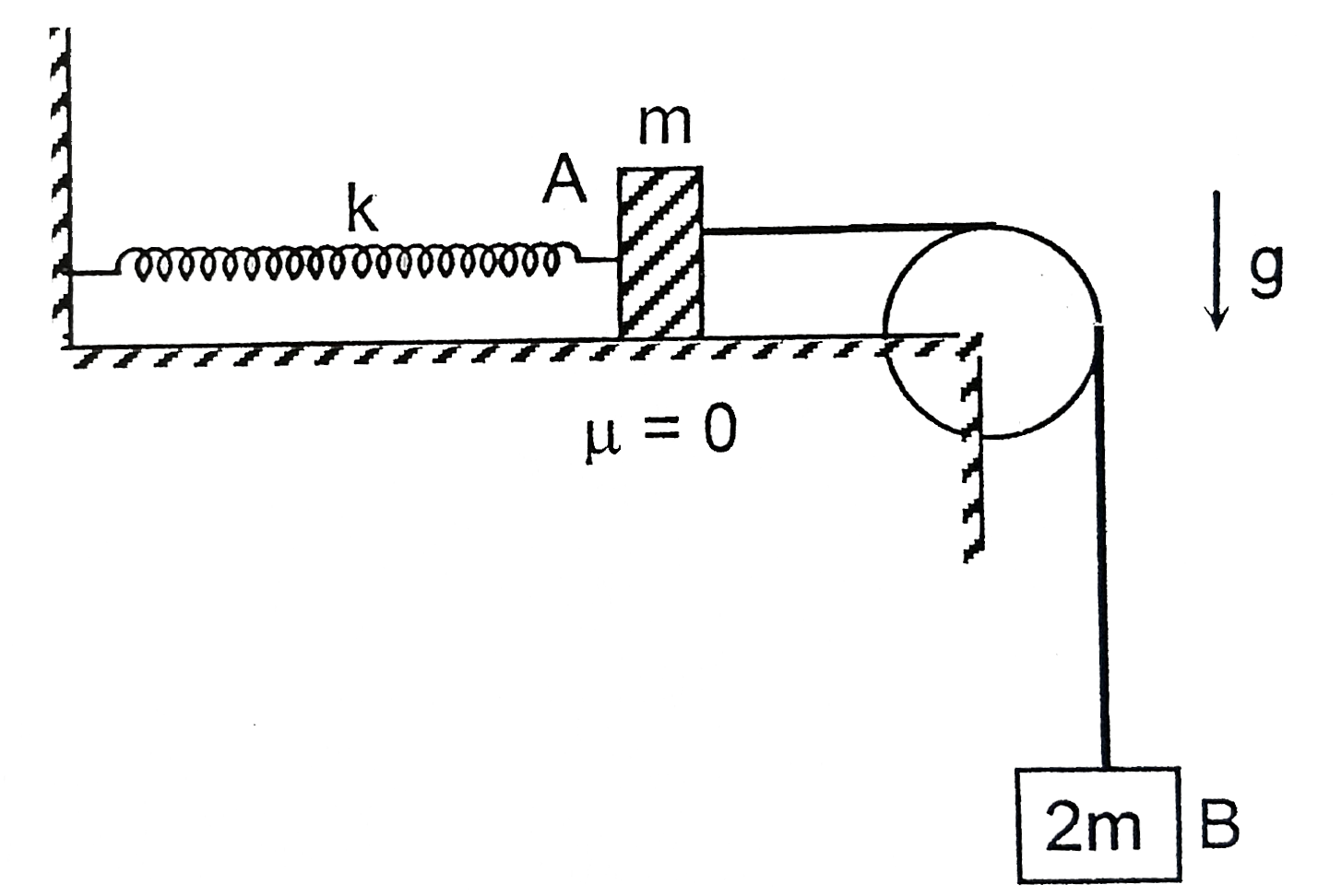
All the surfaces are frictionless and system is released from test when ideal spring of stiffness `k` is in its relaxed state. Choose the correct statement.

A

The magnitude of maximum acceleration of particle `B` is `g/3`

B

The magnitude of maximum acceleration of particle `B` is `(2g)/3`

C

The maximum speed of particle `A` is `2gsqrt(m/(3k))`

D

The maximum speed of particle `A` is `gsqrt(m/(3k))`

Text Solution

Verified by Experts

The correct Answer is:
B, C

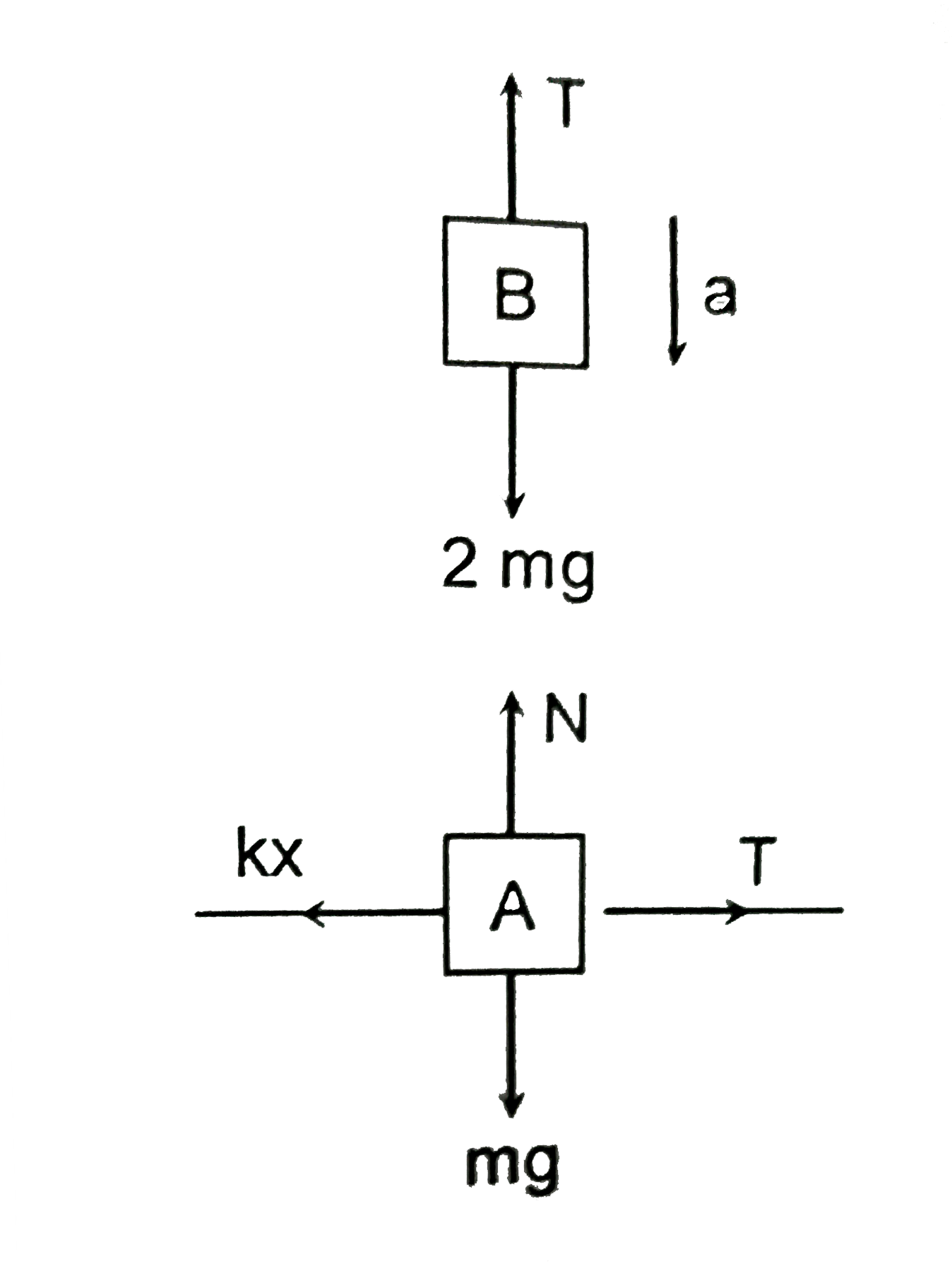
Consider the system at any time `t` when each block is moving with speed `v` and spring has an extension `x`.
`implies 2mg-T=2ma`……(1)
`impliesT-kx=ma`…(2)
From equation (1) & (2) we write

`(2g)/3-k/(3m)x=aimplies(d^(2)x)/(dt^(2))+(kx)/(3m)-(2g)/3=0`
`implies(d^(2)x)/(dt^(2))+k/(3m)[x-(2mg)/k]=0impliesx_(0)=(2mg)/k`
Amplitude of motion `=x_(0)-0=(2mg)/k`
`a_("max")=omega^(2)A=k/(3m)xx(2mg)/k=(2g)/3`
`v_("max")=omegaA=(2mg)/k sqrt(k/(3m))=2g sqrt(m/(3k))`
Second Method:
Using COME, we can write
`2mgx=(3mv^(2))/2+(kx^(2))/2`
For extreme position `v=0impliesx=0, (4mg)/k`
`Aimplies` Amplitude of motion `=(2mg)/k`
For maximum velocity `(d^(2)x)/(dt^(2))=0impliesx=(2mg)/kimplies` Equilibrium position
`implies 2mgxx(2mg)/k=(3mv_("max")^(2))+k(4m^(2)g^(2))/(2k)`
`implies(4m^(2)g^(2))/(2k)=(3mv_("max")^(2))/2impliesv_("max")^(2)=4g^(2)(m/(3k))`
`impliesv_("max")=2g sqrt(m/(3k))`
`a_("max")=|(2g)/3-k/(3m)x(4mg)/k|=(2g)/3`
Promotional Banner

Similar Questions

Explore conceptually related problems

A block of mass 'M' is placed on the top of a wedge of mass '4M'. All the surfaces are frictionless. The system is released from rest. The distance moved by the wedge at the instant, the block reaches the bottom will be

A block of mass M is placed on the top of a bigger block of mass 10 M as shown in figure. All the surfaces are frictionless. The system is released from rest, then the distance moved by the bigger block at the instant the smaller block reaches the ground :

A vertical spring is fixed to one of its end and a massless plank pland fitted to other end, A block is released from a height (h) as shown, spring is in relaxed position then choose the correct statement. .

A block of mass m is placed on the top of bigger wedge M . All the surfaces are frictionless. The system is released from rest. Find the distance moved by smaller block (w.r.t. triangular wedge) when bigger wedge travel distance X on plane surface

In the adjoining figure, block A is of mass (m) and block B is of mass 2m. The spring has force constant k. All the surfaces are smooth and the system is released form rest with spring unstretched. Find the maximum extension in the spring and acceleration of block B at time of maximum extension .

Consider the condition shown in the figure. Pulley is massless and frictionless, springs are massless. Both the blocks are released with the springs in their natural lengths. Choose the correct options.

An ideal gas undergoes isothermal process from some initial state i to final state f . Choose the correct alternatives.

A block suspended from a spring is released when the spring is unstretched. Then choose the correct options.

Two identical blocks each of mass 1kg are joined together with a compressed spring. When the system is released the two blocks appear to be moving with unequal speeds in the opposite directions as shown in fig. Choose the correct statement -

All surfaces shown in figure are smooth. System is released from rest. x and y comonents of acceleration of COM are

