Home
Class 12
PHYSICS
In the photoelectric effect experiment, ...

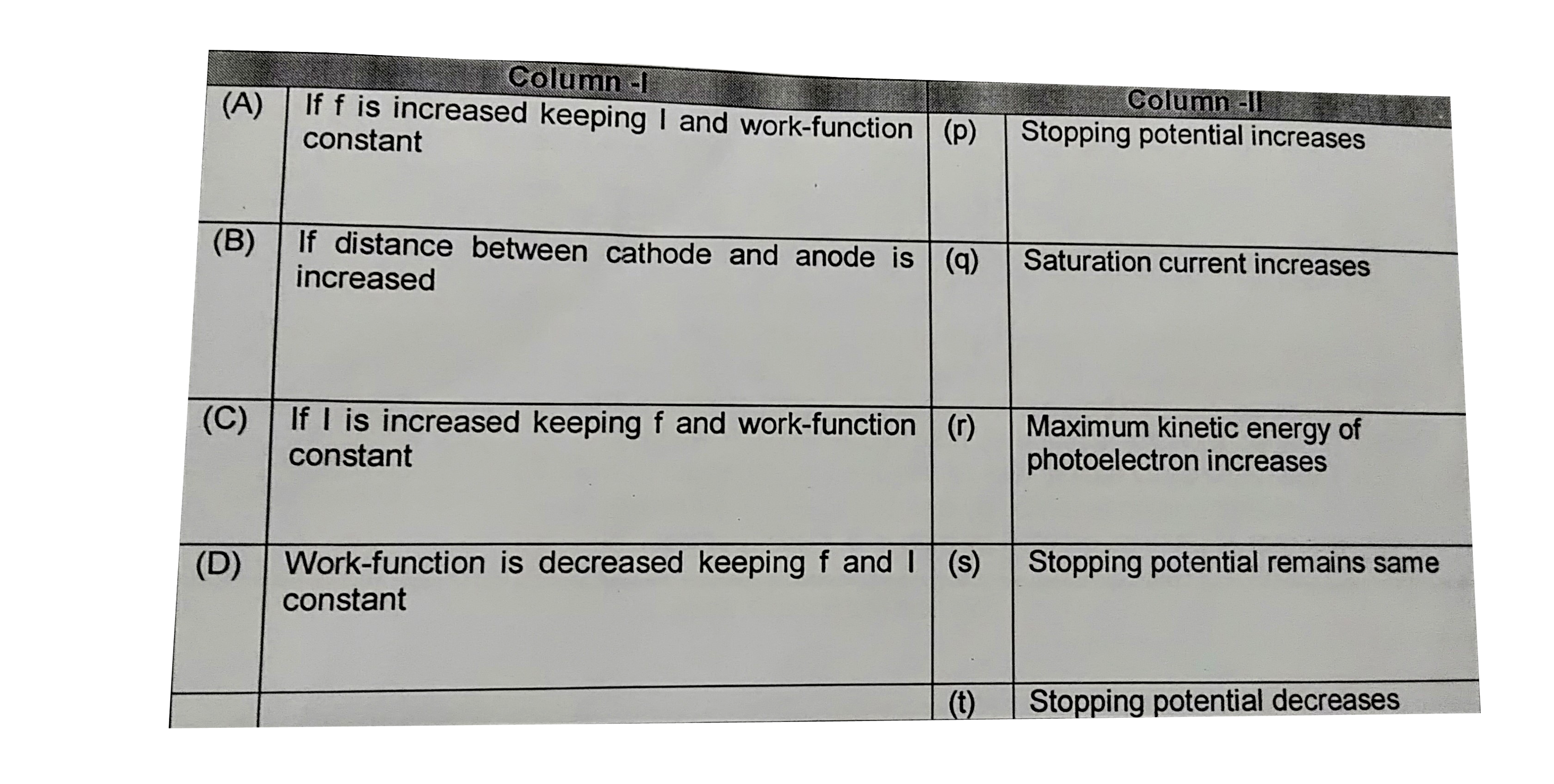
In the photoelectric effect experiment, if `f` is the frequency of radiation incident on the metal surface and `I` is the intensity of the intensity radiations, then match the following columns:

Text Solution

Verified by Experts

The correct Answer is:

A, B, C, D

Use `K_("max")=hv-phi`
Promotional Banner

Similar Questions

Explore conceptually related problems

The metal that shows photoelectric emission at lowest frequency radiation is

The photoelectric threshold of a certain metal is 3000A . If the radiation of 2000A is incident on the metal

In photoelectric effect the slope of stop of stopping potential versus frequency of incident light for a given surface will be

In a photoelectric experiment, if both the intensity and frequency of the incident light are doubled, then the saturation photoelectric current

In photoelectric effect , if a week intensity radiation instead of strong intensity of suitable frequency is used then

In a photoelectric effect experiment, the graph of stopping potential V versus reciprocal of wavelength obtained is shown in the figure. As the intensity of incident radiation is increased :

In a photoelectric experiment, the wavelength of the incident light is decreased from 6000A to 4000A . While the intensity of radiations remains the same,

Intensity of light incident on a photo sensitive surface is doubled. Then

A photoelectric cell is connected to a source of variable potential difference, connected across it and the photoelectric current resulting (muA) is plotted against the applied potential difference (V). The graph in the broken line represents one for a given frequency and intensity of the incident radiation . If the frequency is increased and the intensity is reduced, which of the following graphs of unbroken line represents the new situation?

What is the photoelectric effect? With the help of suitable graph show the variation of photocurrent with (i) the intensity of incident radiation. (ii) the voltage applied between cathode and anode. (iii) the frequency of incident radiation.
