Home
Class 12
PHYSICS
Consider a wave sent down a string in th...

Consider a wave sent down a string in the positive direction whose equation is given is
`y=y_(0)sin[omega(t-x/v)]`
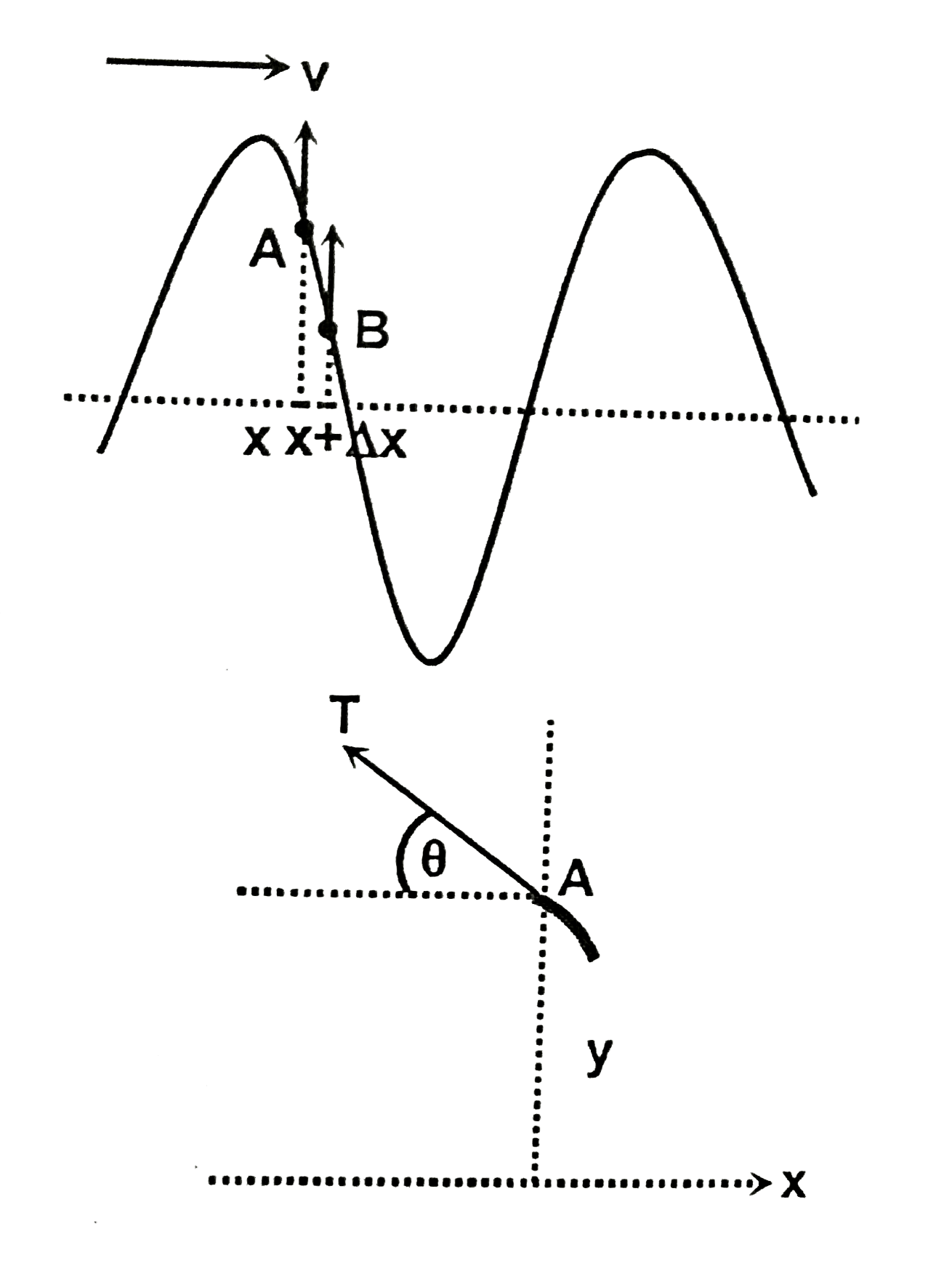
The wave is propagated along because each string segment pulls upward and downward on the segment adjacent to it a slightly larger value of `x` and, as a result does work upon the string segment to which wave is travelling.
For example, the portion of string at point `A` is going upward, and will pull the portion at point `B` upward as well. In fact, at any point along the string, each segment of the string is pulling on the segment just adjacent and to its right, causing the wagve to propagate. It is by this process that the energy is sent along the string.
Now we try to calculate how much energy is propagated down the string per second
`T_(y)=tsintheta~~TtanthetaimpliesT_(y)=-T(dely)/(delx)`
(The negative sign appears because as shown in the figure II, the slope is negative) the force will act through a distance
`dy=v_(y)dt=(dely)/(delt) dt`
Therefore work done by force in time `dt` is
`dW=T_(y)dy=-T((dely)/(delx))((dely)/(delt))dtimpliesdW=(omega^(2)y_(0)^(2)T)/vcos^(2)[omega(t-x/V)]dt`.....(A)

How much average power is transmitted dawn a string having density `mu=5xx10^(-4)kg//m` and `T=5N` by a `200Hz` vibration of amplitude of `0.20cm`

A

`0.08` Watt

B

`0.16` Watt

C

`0.32` Watt

D

`0.64` Watt

Text Solution

Verified by Experts

The correct Answer is:

B

Since the work done will be same at any place along the string in one cycle so choose `x=0`, for convenience. Then work done in a cycle `=(omega^(2)y_(0)^(2)T)/v int_(0)^(2pi//omega) cos^(2) omegat dt=(piomegay_(0)^(2)T)/v`
Average power `=` work done per unit time `=("work done in a cycle")/("Time period")=((piomega_(0)^(2)T).v)/((2pi)/omega)=(omega^(2)y_(0)^(2)T)/(2V)`
Average power `=2pi^(2)f^(2)y_(0)^(2)T sqrt((mu)/T)=2pi^(2)f^(2)y_(0)^(2)sqrt(muT)`
`=2xx10xx200xx200xx0.2xx0.2xx10^(-4)sqrt(5xx10^(-4)xx5)=160xx10^(-3)` Watt `=0.16` Watt.
Promotional Banner

Similar Questions

Explore conceptually related problems

Consider a wave sent down a string in the positive direction whose equation is given is y=y_(0)sin[omega(t-x/v)] The wave is propagated along because each string segment pulls upward and downward on the segment adjacent to it a slightly larger value of x and, as a result does work upon the string segment to which wave is travelling. For example, the portion of string at point A is going upward, and will pull the portion at point B upward as well. In fact, at any point along the string, each segment of the string is pulling on the segment just adjacent and to its right, causing the wagve to propagate. It is by this process that the energy is sent along the string. Now we try to calculate how much energy is propagated down the stirng per second T_(y)=tsintheta~~TtanthetaimpliesT_(y)=-T(dely)/(delx) (The negative sign appears because as shown in the figure II, the slope is negative) the force will act through a distance dy=v_(y)dt=(dely)/(delt) dt Therefore work done by force in time dt is dW=T_(y)dy=-T((dely)/(delx))((dely)/(delt))dtimpliesdW=(omega^(2)y_(0)^(2)T)/vcos^(2)[omega(t-x/V)]dt .....(A) The average power transmitted down the string (i.e. the average energy transfer or sent down it per second) is

A transverse wave is travelling on a string. The equation of the wave

In a stationary wave along a string the strain is

A wave propagates in a string in the positive x-direction with velocity v. The shape of the string at t=t_0 is given by f(x,t_0)=A sin ((x^2)/(a^2)) . Then the wave equation at any instant t is given by

Stationary waves are produced in 10 m long stretched string. If the string vibrates in 5 segments and wave velocity 20 m/s then the frequency is :-

A wave is travelling along a string. At an instant shape of the string is as shown in the enclosed figure. At this instant, point A is moving upwards. Which of the following statements are correct?

A harmonic wave is travelling along +ve x-axis, on a stretched string. If wavelength of the wave gets doubled, then

A travelling wave in a stretched string is described by the equation y = A sin (kx - omegat) the maximum particle velocity is

Assertion: In a string wave, during reflection from fix boundary, the reflected wave is inverted. Reason: The force on string by clamp is in downward direction while string is pulling the clamp is upward direction.

A wave y = a sin (omegat - kx) on a string meets with another wave producing a node at x = 0 . Then the equation of the unknown wave is
