Home
Class 12
PHYSICS
A charged point particle having positive...

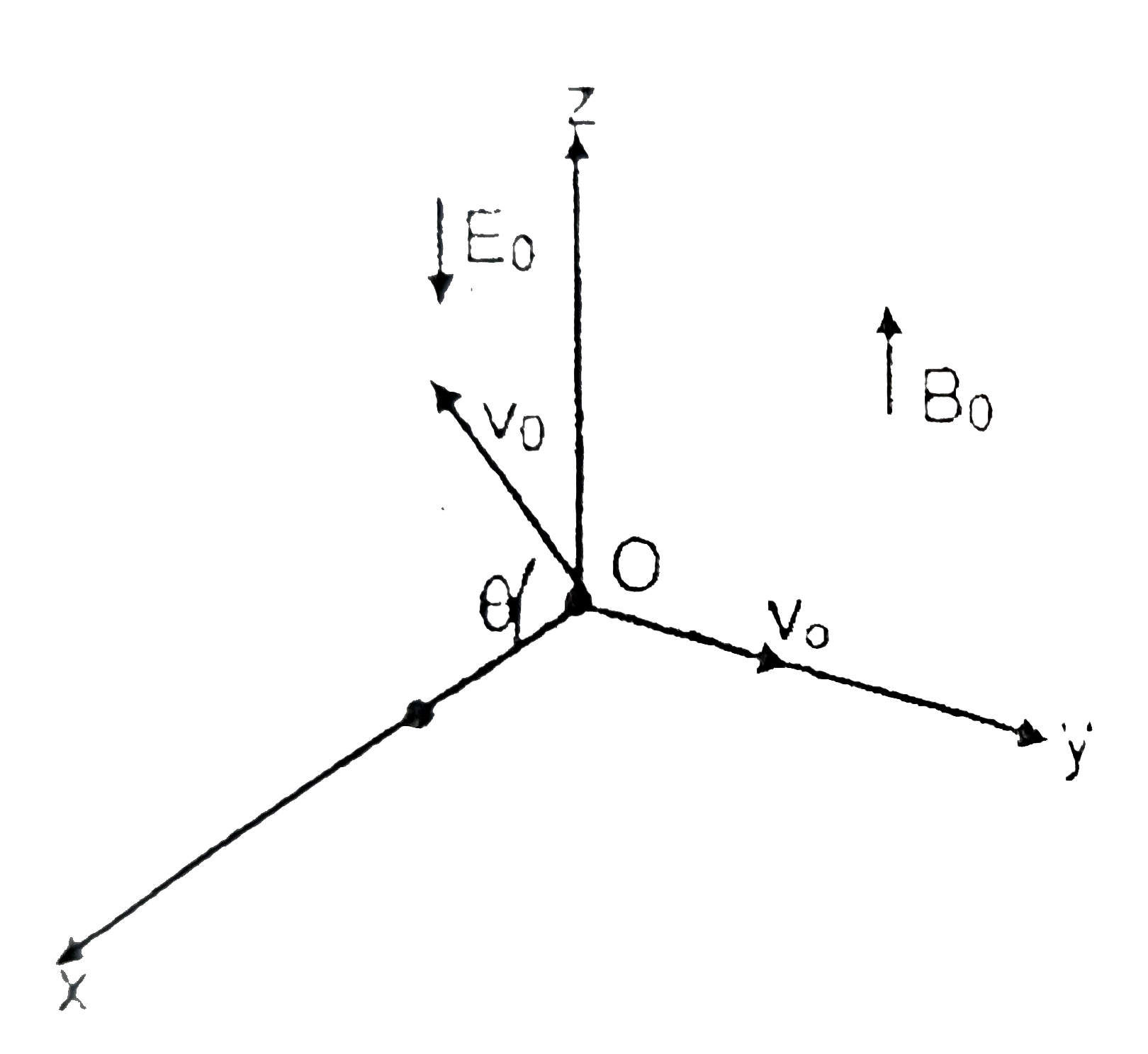
A charged point particle having positive charge `q`, mass `m` is projected in `x-z` plane with a speed `v_(0)` at an angle `theta` with the `x-"axis"` , while another identical particle is projected simultaneously along the `y-"axis"` from the origin (see figure) with an equal speed `v_(0)`.
An electric field `vecE= -E_(0)hatk` exists in the `x-z` plane, while a magnetic field `vecB=B_(0)hatk` exists in the region `y gt 0` (`F_(0)`, `B_(0) gt 0`). It is observed that both the particles collide after some time. Assume that the space is gravity free.
(`i`) Find the time after which the particles collide and the coordinates of the point of collision.
(`ii`) Find the velocity `v_(0)` and the angle `theta` in terms of the other variables.
(`iii`) What is the maximum value of the `z-` coordinate of the first particle ?

Text Solution

Verified by Experts
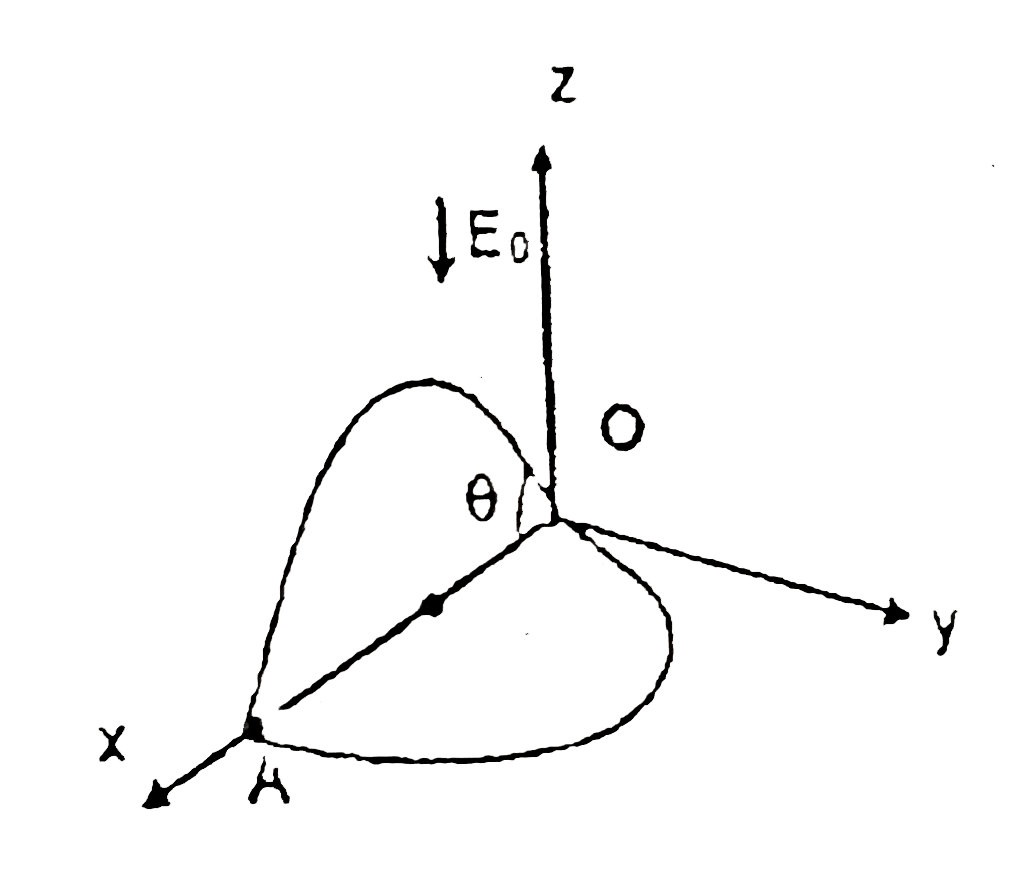
The acceleration on the charge `q`, projected along the `x-z` palne is along the `-z` direction.
`a=(qE_(0))/(m)`
The second particle moves on the `x-y` plane in a circle of radius `R` (say) such that :
`2R=(2v_(0)^(2))/(a)sintheta costheta`.......(`i`)
Also, `R=(mv_(0))/(qB_(0))`.....(`ii`)
`T=(2v_(0)sintheta)/(a)`......(`iii`)
& `T=(pim)/(qB_(0))`.....(`iv`)
where `T` is the time required for the collision to occur
By solving, `v_(0)sintheta costheta=(E_(0))/(B_(0))`
Also, `v_(0)sintheta=(pi)/(2)(E_(0))/(B_(0))`
`rArr costheta=(2)/(pi)` , `theta=cos^(-1)((2)/(pi))`, `v_(0)=(E_(0)//B_(0))/((2)/(pi)sqrt(1-2^(2)//pi^(2)))`
The maximum value of the `Z`-coordinate of the first particle is
`H=(v_(0)^(2)sin^(2)theta)/(2a)=(pi^(2))/(8)(mE_(0))/(qB_(0)^(2))`
Promotional Banner

Similar Questions

Explore conceptually related problems

A charged particle having charge 2q and mass m is projected from origin in X-Y plane with a velocity v inclined at an angle of 45^@ with positive X-axis in a region where a uniform magnetic field B unit exists along +z axis. The coordinates of the centre of the circular path of the particle are

A particle of charge q, mass starts moving from origin under the action of an electric field vecE=E_(0)hati and magnetic field vecB=B_(0)hatk . Its velocity at (x,0,0) is v_(0)(6hati+8hatj) . The value of is

A particle of mass m and having a positive charge q is projected from origin with speed v_(0) along the positive X-axis in a magnetic field B = -B_(0)hatK , where B_(0) is a positive constant. If the particle passes through (0,y,0), then y is equal to

A particle of charge q, mass starts moving from origin under the action of an electric field vecE=E_(0)hati and magnetic field vecB=B_(0)hatk . Its velocity at (x,0,0) is v_(0)(6hati+8hatj) . The value of x is

A particle of mass m and positive charge q is projected with a speed of v_0 in y–direction in the presence of electric and magnetic field are in x–direction. Find the instant of time at which the speed of particle becomes double the initial speed.

A particle of mass m and charge q is lying at the origin in a uniform magnetic field B directed along x-axis. At time t = 0, it is given a velocity v_0 , at an angle theta with the y-axis in the xy-plane. Find the coordinates of the particle after one revolution.

A particle of specific charge (charge/mass) alpha starts moving from the origin under the action of an electric field oversetrarrE = E_(0)hati and magnetic field oversetrarrB = B_(0)hatk Its velocity at (x_(0),y_(0).0) is (4hati +3hatj) The value of x_(0) is .

A particle of charge q_(0) and of mass m_(0) is projected along the y -axis at t=0 from origin with a velocity V_(0) . If a uniform electric field E_(0) also exist along the x -axis, then the time at which debroglie wavelength of the particle becomes half of the initial value is:

A particle of charge per unit mass alpha is released from origin with a velocity vecv=v_(0)hati uniform magnetic field vecB=-B_(0)hatk . If the particle passes through (0,y,0) , then y is equal to

A charge particle of mass m and charge q is projected with velocity v along y-axis at t=0. Find the velocity vector and position vector of the particle vec v (t) and vec r (t) in relation with time.

