Home
Class 12
PHYSICS
A small ball of mass 100 g is attached t...

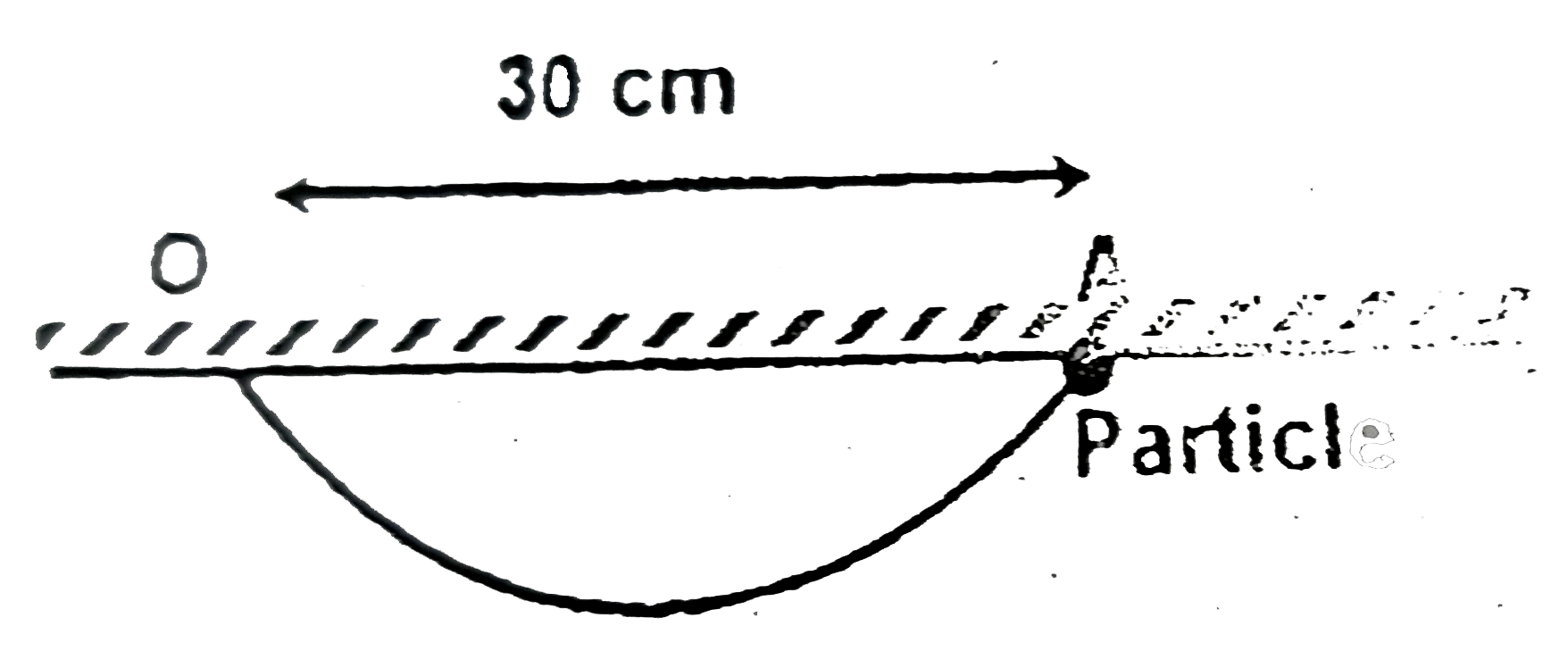
A small ball of mass `100 g` is attached to a light and inextensible string of length `50 cm`. The string is tied to a support `O` and the mass `m` released from point `A` which is `a'` a horizontal distance of `30cm` from the support. Calculate the speed of the ball is its lowest point of the trajectory.

Text Solution

Verified by Experts

`mgxx0.4=(1)/(2)mv^(2)`
`v=2sqrt(2)m//s`
(from conservation of mechanical energy just before the string becomes taut during the application of impulse, velocity along perpendicular to the string remain same. So after impulse velocity of the ball equal to `(6sqrt(2))/(5)m//s`
again from conservation of mechanical energy
`(1)/(2)m((6sqrt(2))/(5))^(2)+mg(0.1)=(1)/(2)mv_(f)^(2)`
Now velocity at the bottommost point `v_("final")=2.2m//s`
Promotional Banner

Similar Questions

Explore conceptually related problems

A particle of mass 1 kg is attached to a string of length 5 m . The string is attached to a fixed point O . It is released from theposition as shown in Fig. Calculate a. the impulse developed in the string when it becorries taut, b. the velocity of the particle just after the string becomes taut, c. the impulse developed in this string PQ at this instant.

A small ball of mass m is released from rest from the position shown . All contact surface are smooth . The speed of the ball when it reaches its lowest position is

A small ball of mass m is released from rest from the position shown . All contact surface are smooth . The speed of the ball when it reaches its lowest position is

A particle of mass 200g is attached to an ideal string of length 1.30 m whose upper end is fixed to ceiling. The particle is made to revolve in a horizontal circle of radius 50 cm. The tension in the string is (g = 10 m/s^2)

A ball of mass m is released from A inside a smooth wedge of mass m as shown in figure. What is the speed of the wedge when the ball reaches point B?

A bob of mass m attached to an inextensible string of length I is suspended from a vertical support. The bob rotates in a horizontal circle with an angular speed omega red/s about the vertical. About the point of suspension:

A bob hangs from a rigid support by an inextensible string of length l . If it is displaced through a distance l (from the lowest position) keeping the string straight and then released. The speed of the bob at the lowest position is

A small ball is suspended from a fixed point 'O' by means of a light and inextensible string of length 'l'. The ball is first taken aside such that string becomes horizontal and then released from rest. At the borrom it collides with a fixed obstacle. The co-efficient of restitution is 'e'. Find the maximum angular deflection of the string after n^(th) collision.

A ball of mass 1kg is suspended by an inextensible string 1m long attached to a point O of a smooth horizontal bar resting on fixed smooth supports A and B. The ball is released from rest from the position when the string makes an angle 30^@ with the vertical. The mass of the bar is 4kg . The displacement of bar when ball reaches the other extreme position (in m) is

A ball of mass 0.01 kg is suspended from a fixed point O by means of a light and inextensible string of length 10m. The ball is first taken aside such that string becomes horizontal and then released from reast. At the lowermost point of its path, it hits a stationary small block of mass 1.205kg lying on a rough horizontal surface. After striking the block, the ball rebounds and comes to rest when the string makes an angle of 30^@) with the horizontal . Due to the impact the block moves through a distance of 0.5m on the horizontal surface. Find the coefficient of friction between the block and the surface.
