Home
Class 12
PHYSICS
A car of mass m is initially at rest on ...

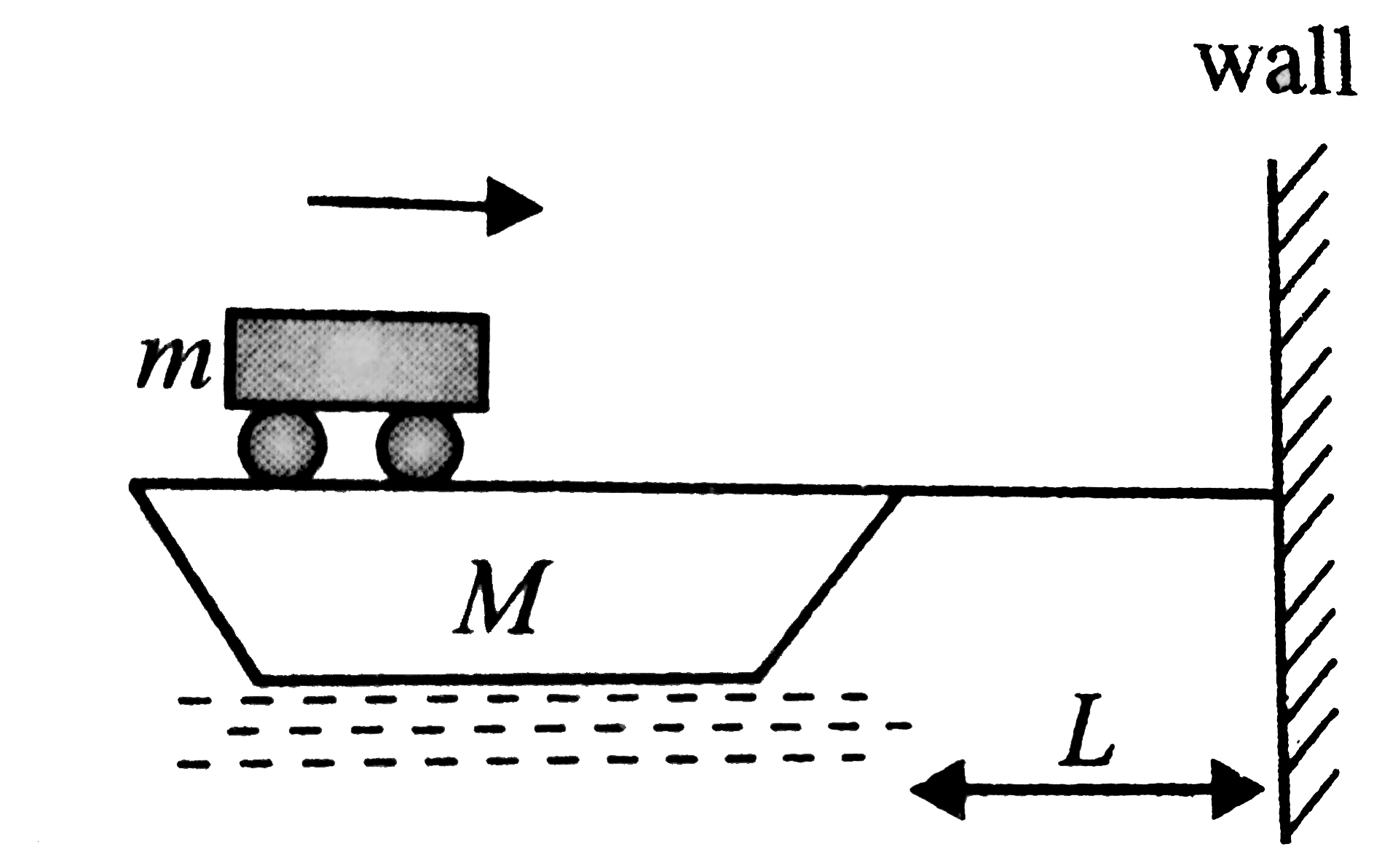
A car of mass `m` is initially at rest on the boat of mass `M` tied to the wall of dock through a massless, inextensible string. The car accelerates from rest to velocity `v_(0)` in times to. At `t = t_(0)` the car applies brake and comes to rest relative to the boat in negligible time. Neglect friction between the boat and water: the time `'t'` at which boat will strike the wall is

Text Solution

Verified by Experts

`A` the car `C` accelerates to a velocity `v_(0)` relative to the double-boat system, the two boats accelerate to the left.
`V_(C )("to right")+v_(A)("to left")=v_(0)`
`Mv_(C )=2Mv_(A)`
Solving, we find `v_(A)=(mv_(0))/(m+2M)`, `v_(C )=(2Mv_(0))/(m+2M)`
After the car brakes to a stop, the tension in the string connecting `A`, `B` becomes zero. Applying We find the velocity of `A`(to right) :
`v'_(A)=(mMv_(0))/((m+M)(2+2M))`
Promotional Banner

Similar Questions

Explore conceptually related problems

A body of mass m accelerates uniformly from rest to v_1 in time t_1 . As a function of time t, the instantaneous power delivered to the body is

A body of mass m , accelerates uniformly from rest to V_(1) in time t_(1) . The instantaneous power delivered to the body as a function of time t is.

An object of mass m, initially at rest under the action of a constant force F attains a velocity v in time t. Then, the average power supplied to mass is

A block of mass m at rest is acted upon by a force F for a time t. The kinetic energy of block after time t is

A train accelerates from rest at a constant rate a for time t_(1) and then it retards at the constant rate b for time t_(2) then comes to rest. Find the ratio t_(1) / t_(2) .

A car starting from rest acquires a velocity 180 m s^(-1) in 0.05 h. Find the acceleration.

A car accelerates from rest at a constant rate of 2 m s^(-2) for some time. The it retatds at a constant rate of 4 m s^(-2) and comes to rest. It remains in motion for 6 s .

A man of mass m walks from end A to the other end B of a boat of mass M and length l. The coefficient of friction between the man and the boat is mu an neglect any resistive force between the boat and the water.

A car accelerates from rest at a constant rate 'alpha' for some time after which it decelerates at a constant rate beta to come to rest. If the total time elapsed is t, the maximum velocity acquired by the car is given by :

A car accelerates from rest at a constant rate alpha for some time, after which it decelerates at a constant rate beta, to come to rest. If the total time elapsed is t seconds. Then evalute the maximum velocity aquired by the car is
