Home
Class 12
PHYSICS
A block of mass m=1kg is attached to a f...

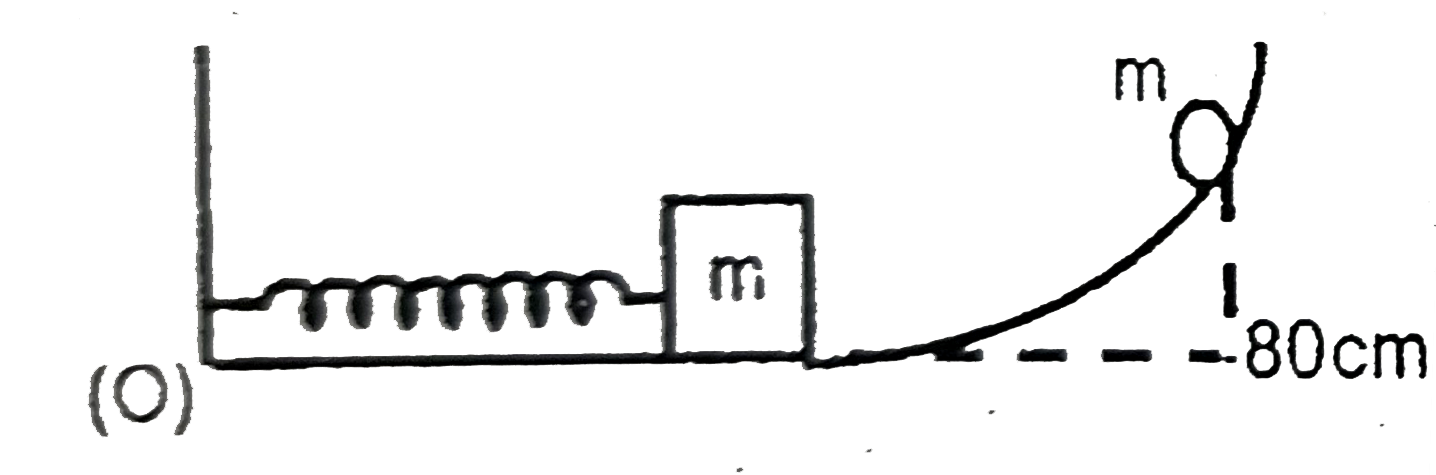
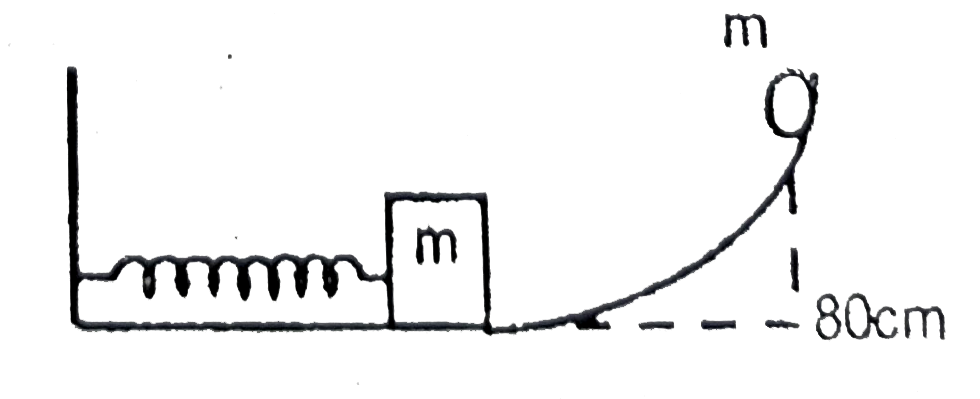
A block of mass `m=1kg` is attached to a free end of a spring whose one end is fixed with as shown in the figure. The block is performing simple harmonic motion. The position of the block from `O` is given by `x=2+(1)/(sqrt(2))sin2t`, where `x` is in meter and `t` is in second. A particle of same mass is released from the circular path at a height `h=80cm`. then particle collidic and stricks to the block. The collision takes place when velocity of the block is zero and spring is elongated. Find
(`i`) Time period of new `SHM`.
(`ii`) Maximum velocity of the system

Text Solution

Verified by Experts
`x=2+(1)/(sqrt(2))sin2t`
`rArr 2=sqrt((k)/(m)) rArr k=4N//m`
`omegaL=(1)/(omegaC)`
Just before collision, velocity of the shell,
`2omegaL=(1)/(2omegaC')`
Now , `P_(i)=P_(r)`
`0+mx4=(m+m)xv_(0)rArrv_(0)=2m//s`
Using conservation of energy,
`:. C'=(1)/(4omega^(2)L)=(LC)/(4L)=(C )/(4)kx^(2)+ :. (DeltaC)/(C )=(3)/(4)(2m)(2)^(2)`
`=(1)/(f_(1))=((1.5-1))/(R )+((4)/(3)-1)(-(1)/(R )-(1)/(R ))+((1.5-1)/(R ))=(1)/(R )-(2)/(3R)=(1)/(3R)(2m)v'^(2)`
`=(1)/(f_(2))=((1.5-1))/(R )+((4)/(3)-1)(-(1)/(R ))+((1.5-1)/(R ))=(1)/(R )-(1)/(3R)=(2)/(3R)`
Promotional Banner

Similar Questions

Explore conceptually related problems

A block of mass m compresses a spring iof stifffness k through a distacne l//2 as shown in the figure .If the block is not fixed to the spring the period of motion of the block is

Position-time relationship of a particle executing simple harmonic motion is given by equation x=2sin(50pit+(2pi)/(3)) where x is in meters and time t is in seconds. What is the position of particle at t=1s ?

A block of mass m, lying on a smooth horizontal surface, is attached to a spring (of negligible mass) of spring constant k. The other end of the spring is fixed, as shown in the figure. The block is initally at rest in its equilibrium position. If now the block is pulled withe a constant force F, the maximum speed of the block is :

A block of M is suspended from a vertical spring of mass m as shown in the figure. When block is pulled down and released the mass oscillates with maximum velocity v .

A block of mass m is attached to two unstretched springs of spring constants k_1 and k_2 as shown in figure. The block is displaced towards right through a distance x and is released. Find the speed of the block as it passes through the mean position shown.

A block of mass m is attached to two unstretched springs of springs constant k_(1) and k_(2) as shown in figure. The block is displaced towards right through a distance x and is released. Find the speed of the block as it passes through the mean position shown.

A block of mass m is attached to two unstretched springs of spring constant k , each as shown. The block is displaced towards right through a distance x and is released The speed of the block as it passes through the mean position will be

A block of mass m is attached with a spring in vertical plane as shown in the figure. If initially spring is in its natural length and the block is released from rest, then maximum extension in the spring will be

A block of mass 5 kg is released from rest when compression in spring is 2m . Block is not attached with spring and natural length of the spring in 4m . Maximum height of block from ground is :(g=10m//s^(2))

A block of mass 1 kg is released from the top of a wedge of mass 2 kg. Height of wedge is 10 meter and all the surfaces are frictionless. Then

