Home
Class 12
PHYSICS
A charge q is placed at a height (h)/(4)...

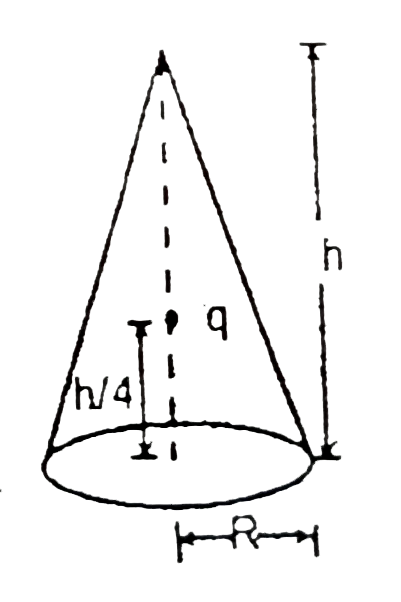
A charge `q` is placed at a height `(h)/(4)` from the base of a cone of height `h` and radius `R` as shown in figure. Calculate the flux linked with the curved surface of the cone.

Text Solution

Verified by Experts
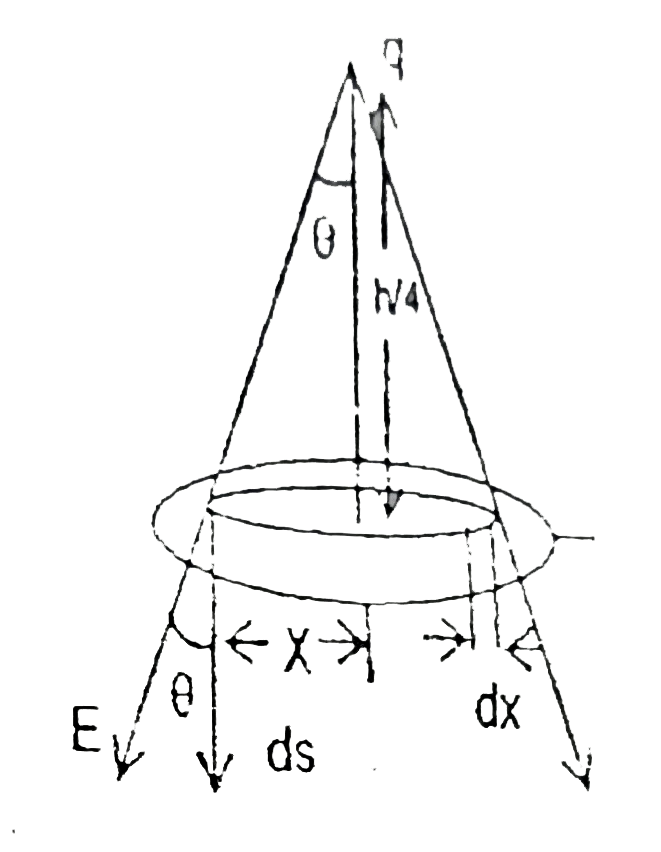
`phi=phi_(c )+phi_(p)=q//epsilon_(0)`
`phi to` total flux linked
`phi_(c ) to ` flux linked with curved surface
`phi_(p) to` flux linked with plane surface
`phi_(p)=(q)/(2)(1-cosphi)=(q)/(2)(1-(h//4)/(sqrt(R^(2)+(h^(2))/(16))))`
`:. phi_(C )=(q)/(epsilon_(0))-phi_(p)`
`rArr phi_(c )=(q)/(epsilon_(0))((1)/(2)+(h)/(2sqrt(16R^(2)+h^(2))))`
Promotional Banner

Similar Questions

Explore conceptually related problems

If a charge q is placed at the centre of a hemispherical body as shown below then the flux linked with the curved surface is

Arrangements of charges are shown in the figure. Flux linked with the closed surface P and Q respectively are ……….and ……….

The height of a cone is 16 cm and its base radius is 12 cm. Find the curved surface area and the total surface area of the cone

A uniform solid cone of height 40 cm is shown in figure. The distance of centre of mass of the cone from point B (centre of the base) is :

A cone of height 4 cm is melted and recast into a sphere of diameter 8 cm .Find the radius of the base of the cone.

The radius of base of a cone is r and height is h. Find its volume.

A cone of radius R and height H , is hanging inside a liquid of density rho by means of a string as shown in figure. The force due to the liquid acting on the slant surface of the cone is

The radius of a cone is 3cm and vertical height is 4cm. Find the area of the curved surface.

The radius of a cone is 3cm and vertical height is 4cm. Find the area of the curved surface.

A buoy is made in the form of hemisphere surmounted by a right cone whose circular base coincides with the plane surface of hemisphere. The radius of the base of the cone is 3.5 metres and its volume is two-third of the hemisphere. Calculate the height of the cone and the surface area of the buoy, correct to two places of decimal.

