Home
Class 12
PHYSICS
A metal plate of area 0.10 m^(2) is conn...

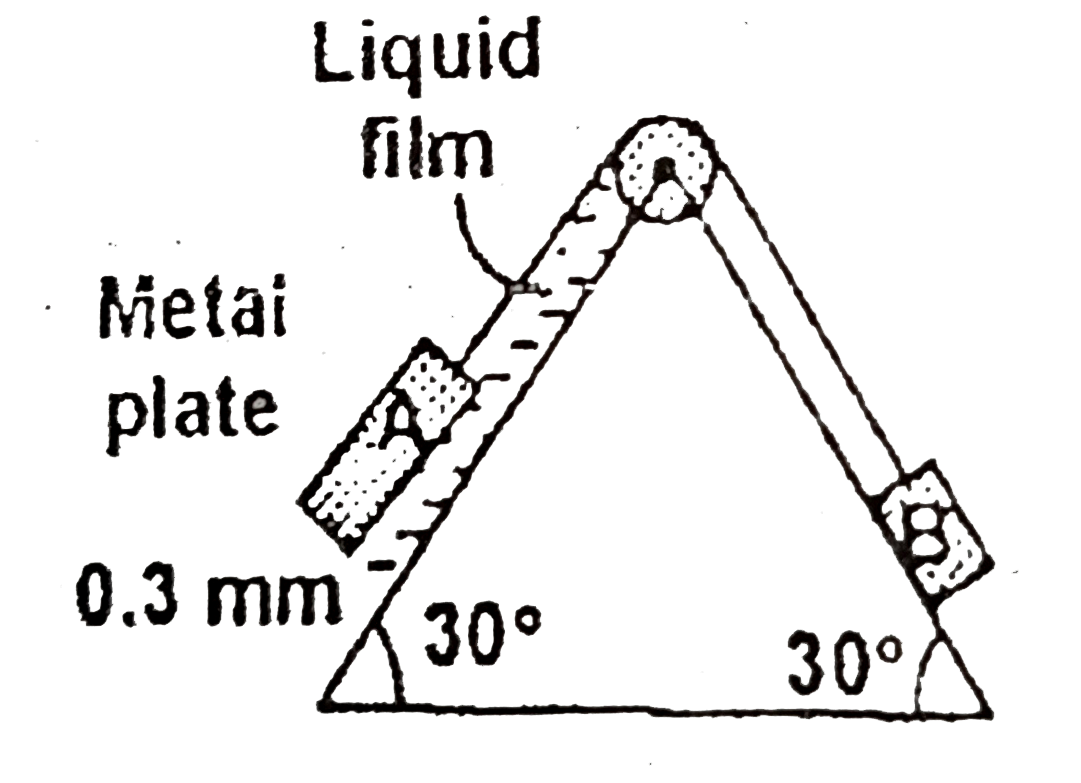
A metal plate of area `0.10 m^(2)` is connected to a `0.04 kg` mass via a string that passes over an ideal pulley (considered massless and frictionless) A liquid with a film of thickness of `0.3mm` is placed between the plate and the table. When system is released, the plate moves up with constant speed of `0.085 m//s`. Find the approximate value of coefficient of viscosity of the liquid. (mass of metal plate is `0.02 kg`, `g=9.8 m//s^(2)`)

A

`3.46xx10^(-3)Pa sec`

B

`3.46xx10^(-4)Pa sec`

C

`6.90xx10^(-3)Pa sec`

D

`6.90xx10^(-4)Pa sec`

Text Solution

Verified by Experts

`T=m_(2)gsin30^(@)`….(`i`)
`T=m_(1)gsin30^(@)+(etaAV)/(l)`….(`ii`)
From equation (`i`) and (`ii`) we can write
`(etaAV)/(l)=(m_(2)-m_(1))gsin30^(@)=mgsin30^(@)`
`eta=(mglsin30^(@))/(vA)=(0.02xx10xx0.3xx10^(-3))/(2xx0.085xx0.1)3.46xx10^(-3)PaS`
Promotional Banner

Similar Questions

Explore conceptually related problems

A metal plate of area 0.10m^(2) is connected to a 0.01 kg mass via a string that passes over an ideal pulley (considered to be friction-less), as shown in the figure. A liquid with a film thickness of 3.0 mm is placed between the plate and the table. When released the plate moves to the right with a constant speed of 0.085ms^(-1) . Find the coefficient of viscosity of the liquid.

A metal block of area 0.10 m^(2) is connected to a 0.02 kg mass via a string. The string passes over an ideal pulley (considered massless and frictionless) as shown in figure. A liquid with a flim of thickness 0.15 mm is placed between the plate and the table. When released the plate movees to the right with a constant speed of 0.075 m s^(-1) . What is the coefficient of viscosity of the liquid?

A metal block of area 0.10 m^(2) is connected to a 0.01 kg mass via a string that passes over a massless and frictionless pulley as shoen in figure.A liquid with a film thickness of 0.3 mm is placed between the block and the table. When released the block moves to the right with a constant of 0.085 m s^(-1) . The cofficient of viscosity of the liquid is

A metal block of area 0.10 m^(2) placed at a table, is connected to a 0.010 kg mass via a string that passes over an ideal pulley. Th pulley is fixed at the edge of the table. A liquid with a film of thickness 0.30 mm is placed between the block and the table. If the coefficient of viscosity of the liquid is 3.45 xx 10^(-3) Pa s, with what constant velocity does the block move when released?

Aflat plate of area 0.05 m^(2) is separated from another large plate at rost by a liquid layer of uniform thickness 1mu m . The tangential force needed to move the smaller plate with a constant velocity of 10 cm s ^(-1) i s 20 N. Calculate the coefficent of viscosity of the liquid.

Two blocks of masses m and 2m are connected by a light string passing over a frictionless pulley. As shown in the figure, the mass m is placed on a smooth inclined plane of inclination 30° and 2m hangs vertically. If the system is released, the blocks move with an acceleration equal to :

A metal plate 0.04m^(2) in area is lying on a liquid layer of thickness 10^(-3)m and coefficient of viscosity 140 poise. Calculate the horizontal force needed to move the plate with a speed of 0.040 m/s.

A cubical block of side 10sqrt(10) cm is connected to a smooth and uniform disc of mass 20g through an ideal string as shown. The block is placed on a thin liquid layer of thickness 0.2 mm. if center of the disc move downward with constant speed of 2cm//sec after the system is released. If coefficient of viscosity of liquid is x/1000 Pa-sec. then find x (Take g=10m//s^(2) )

A metal plate of area 10^(3)" "cm^(2) rests on a layer o oil 6 mm thick. A tangential force of 10^(-2) N is appled on it to move it with a constant velocity of 6 cm s^(-1) . The coefficient of viscosity of the liquid is :-

In an atwood machine the two blocks have massess 1kg and 3kg . The pulley is massless and frictionless and string is light. The acceleration of the centre of mass (in m//s^(2) ) of this system is 0.5x . Find the value of x .

