Home
Class 12
PHYSICS
A non conducting infinite rod is placed ...

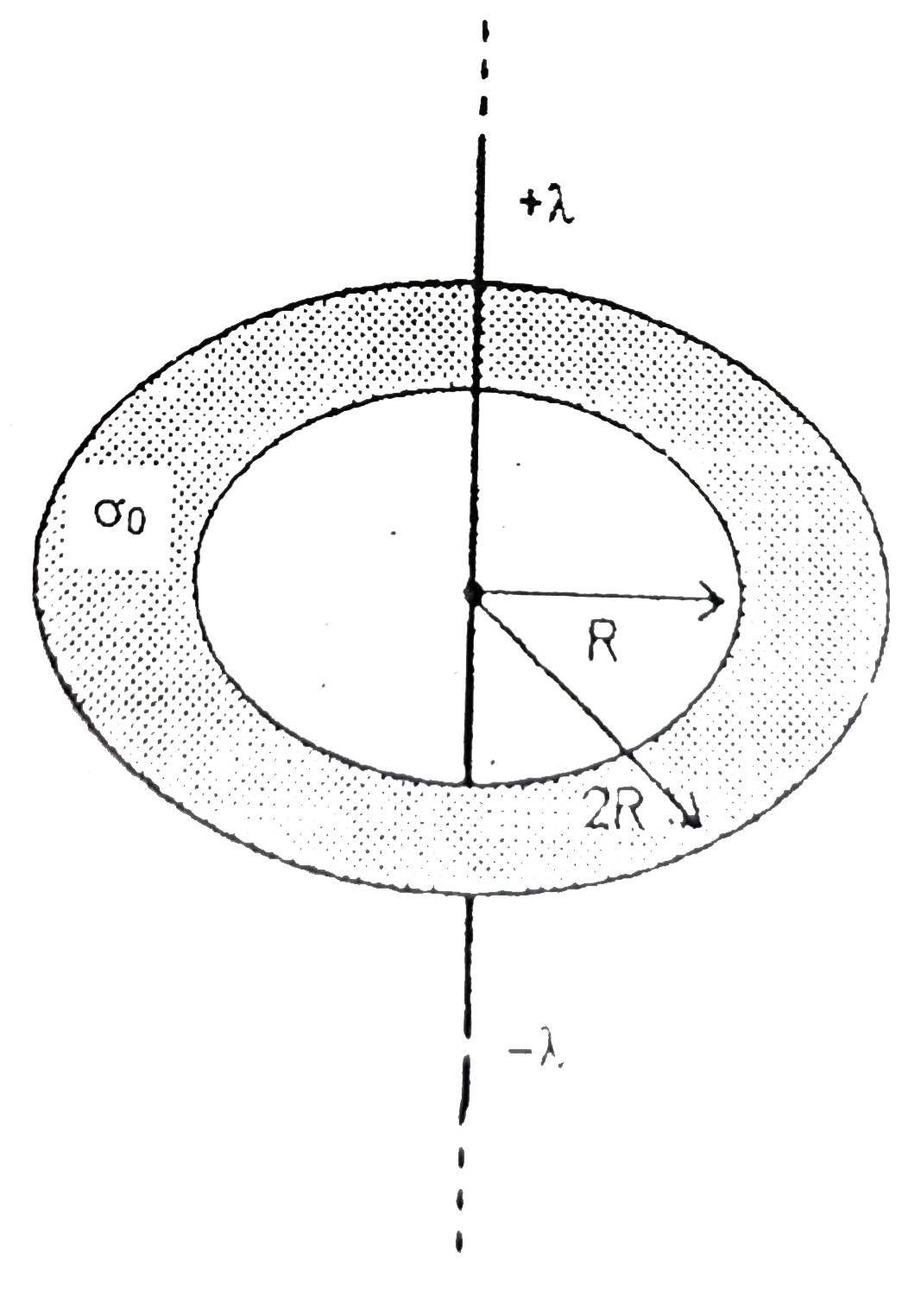
A non conducting infinite rod is placed along the `z-`axis the upper half of the rod (lying along `z ge 0`) is charged positively with a uniform linear charge density `+lambda`, while the lower half (`z lt 0`) is charged negatively with a uniform linear charge density `-lambda`. The origin is located at the junction of the positive and negative halves of the rod. A uniformly charged annular disc (surface charge density : `sigma_(0)`) of inner radius `R` and outer radius `2R` is placed in the `x-y` plane with its centre at the origin. find the force on the rod due to the disc.

A

`(2sigma_(0)lambdaR)/(epsilon_(0))`

B

`(sigma_(0)lambdaR)/(2epsilon_(0))`

C

`(sigma_(0)lambdaR)/(epsilon_(0))`

D

`(sigma_(0)lambdaR)/(3epsilon_(0))`

Text Solution

Verified by Experts

The force on the rod due to the annular disc is equal and opposite to that on the disc due to the rod. We take an annular strip of radius `r` and width `dr` and find the force acting on it
`dF=(sigma_(0)2pi r dr)(lambda)/(2pi epsilon_(0)r)=(lambda sigma_(0))/(epsilon_(0))dr`
`:. ` The force
`F=(sigma_(0)lambda)/(epsilon_(0)) int_(R )^(2R)dr=(sigma_(0)lambdaR)/(epsilon_(0))`
Promotional Banner

Similar Questions

Explore conceptually related problems

The dimensional formula of linear charge density lambda is

A half ring of radius r has a linear charge density lambda .The potential at the centre of the half ring is

If linear charge density of a wire as shown in the figure is lambda

What is the electric field intensity at any point on the axis of a charged rod of length 'L' and linear charge density lambda ? The point is separated from the nearer end by a.

Consider an infinite line charge having uniform linear charge density and passing through the axis of a cylinder is removed.

A wire AMB is placed along y-axis having linear charge density lambda C/m. The electric field intensity at point P is ( PM=0.1 m)

A non - conducting disc of radius R is uniformly charged with surface charge density sigma . A disc of radius (R )/(2) is cut from the disc, as shown in the figure. The electric potential at centre C of large disc will be

A rod of length l, has a uniform positive charge per unit length and a total charge Q. calculate the electric field at a point P located along the long axis of the rod and at a distance a from one end

Twelve infinite long wire of uniform linear charge density (lambda) are passing along the twelve edges of a cube. Find electric flux through any face of cube. ,

The electric field at distance .r. from infinte line of charge ("having linear charge density" lambda) is

