Home
Class 12
PHYSICS
Calculate the velocity with which the li...

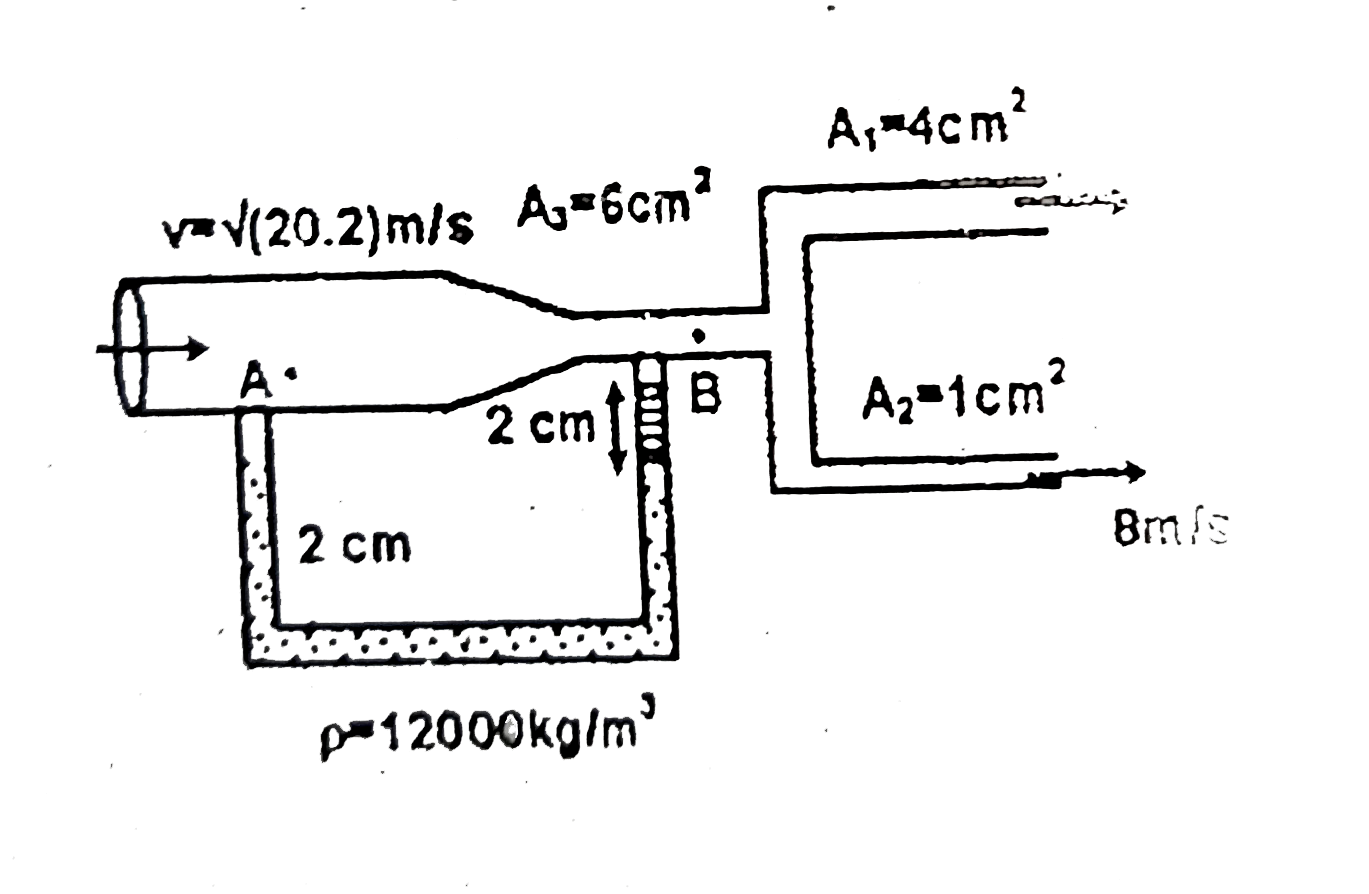
Calculate the velocity with which the liquid gushes out of the `4cm^(2)` outlet, if the liquid flowing in the tube is water and liquid in `U` tube has a specific gravity `12`. Velocity of liquid at point `A` is `sqrt(20.2)m//s`

A

`2.5 m//s`

B

`5.5 m//s`

C

`8 m//s`

D

`10 m//s`

Text Solution

Verified by Experts

`P_(A)+(1)/(2)rhov_(A)^(2)=P_(B)+(1)/(2)rhov_(B)^(2)`
`P_(A)-P_(B)=(1)/(2)rho(v_(B)^(2)-v_(A)^(2))`
`0.02xx12000xx10=(1)/(2)xx1000(v_(B)^(2)-20.2)`
`4.8=v_(B)^(2)-20.2rArrv_(B)=5m//s`
`rArr A_(3).v_(B)=A_(1)v_(1)+A_(2)v_(2)`
`rArr 30=4v_(1)+8`
`rArr 4v_(1)=22rArrv_(1)=(22)/(4)=5.5m//s`
Promotional Banner

Similar Questions

Explore conceptually related problems

The velocity of liquid flowing through a tube at certain distance from the axis of tube

In turbulent flow the velocity of the liquid molecules in contact with the walls of the tube.

A U-tube of uniform cross section (see figure) is partially filled with a liquid I. Another liquid II which does not mix with liquid I is poured into one side. It is found that the liquid levels of the two sides of the tube are the same, while the level of liquid I has risen by 2cm. If the specific gravity of liquid I is 1.1, the specific gravity of liquid II must be

The velocity of the liquid coming out of a small hole of a vessel containing two different liquids of densities 2rho and rho as shown in the figure is

The velocity of the liquid coming out of a small hole of a vessel containing two different liquids of densities 2rho and rho as shown in the figure is

Consider streamline flow of a liquid flowing through a tube as shown in the figure which of the following is correct regarding velcities of liquid at different points ?

Write down the expression for finding the velocity of sound in a liquid using a Kundts tube.

An incompressible liquid flows through a horizontal tube as shown in the figure. Then the velocity 'v' of the fluid is:

What is the specific gravity of a liquid if 260 mL of the liquid has the same mass as 390 mL of water?

A "flow calorimeter" is used to measure the specific heat of a liquid. Heat is added at a known rate to a stream of the liquid as it passes through the calorimeter at known rate, then a measurement of the resulting temperature difference between the in flow and the out flow points of the liquid stream enables us to compute the specific heat of the liquid. A liquid of density 0.85 g//cm^(3) flows through a calorimeter at the rate of 8.0 cm^(3)//s . heat is added by means of a 250 watt electric heating coil, and a temperature difference of 15^(@)C is established in steady state conditions between the in flow and out flow points. Q. Specific heat of the liquid is

