Home
Class 12
PHYSICS
A solid hemispherical uniformly charged ...

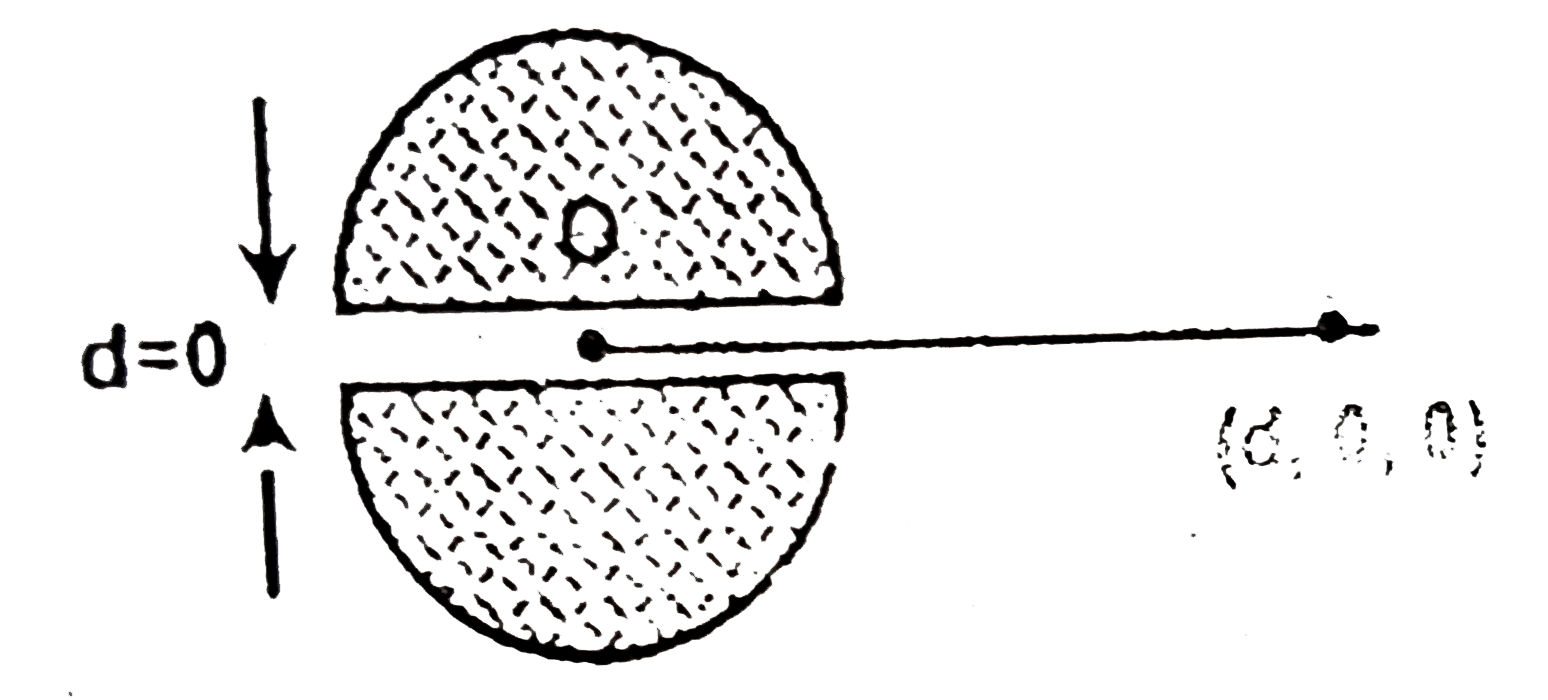
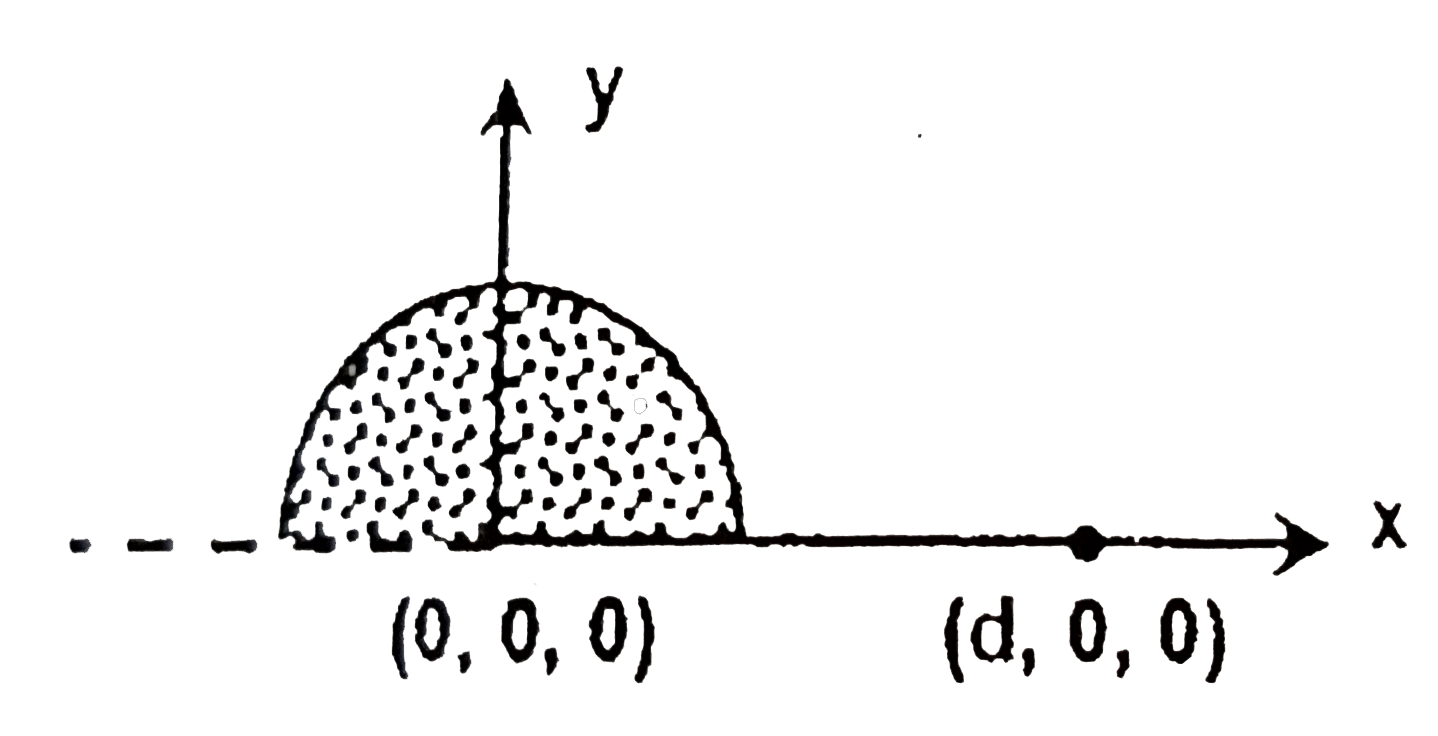
A solid hemispherical uniformly charged body having charge `Q` is kept symmetrically along the `y`-axis as shown in the figure. The net electric field at (`d`, `0`,`0`) is

A

`(1)/(4piepsilon_(0))(Q)/(d^(2))`

B

less then `(1)/(4piepsilon_(0))(Q)/(d^(2))`

C

` gt (1)/(4piepsilon_(0))(Q)/(d^(2))` and `lt (1)/(4piepsilon_(0))(2Q)/(d^(2))`

D

`(1)/(4piepsilon_(0))(2Q)/(d^(2))`

Text Solution

Verified by Experts

Due to solid hemispherical charge of `2Q` the field will be `(1)/(4piepsilon_(0))xx(2Q)/(d^(2))` along `x-`axis. So due to one hemisphere the component of field along `x-` direction will be `(1)/(4piepsilon_(0))xx(Q)/(d^(2))` . And hence the net field will be more than `(1)/(4piepsilon_(0))xx(2Q)/(d^(2))`
Promotional Banner

Similar Questions

Explore conceptually related problems

Four charges are arranged on y axis as shown in figure. Then the electric field at point P is proportional to:

A sperical shell is uniformly charged by a charge q. A point charge q_(0) is at its centre , then

Four charges are arranged at the corners of a square as shown in the figure. The direction of electric field at the centre of the square is along

A thin glass rod is bent into a semicircle of radius r. A charge +Q is uniformly distributed along the upper half, and a charge -Q is uniformly distributed along the lower half, as shown in fig. The electric field E at P, the center of the semicircle, is

A spherical portion has been removed from a solid sphere having a charge distributed uniformly in its volume as shown in the figure. The electric field inisde the emptied space is

A uniformly charged non-conducting spherical shell is given +q charge and a point charge -q is placed as shown. The electric field lines will be

Electric charge is uniformly distributed along a along straight wire of radius 1 mm . The charge per centimeter length of the wire is Q coulomb. Another cyclindrical surface of radius 50 cm and length 1 m symmetrically enclose the wire ask shown in figure. The total electric flux passing through the cyclindrical surface is

Six point charges are placed at the vertices of a hexagon of side 1 m as shown in figure. Net electric field at the centre of the hexagon is

Charge 2Q and -Q are placed as shown in figure. The point at which electric field intensity is zero will be somewhere

A wire of length L= 20 cm is bent into a semicircular arc and the two equal halves of the arc are uniformly charged with charges +Q and -Q as shown in the figure. The magnitude of the charge on each half is |Q| =10^(3) epsilon_(0) , where epsilon_(0) is the permittivity of free the space. The net electric field at the center O is