Home
Class 12
PHYSICS
The amound of work done in assembling a ...

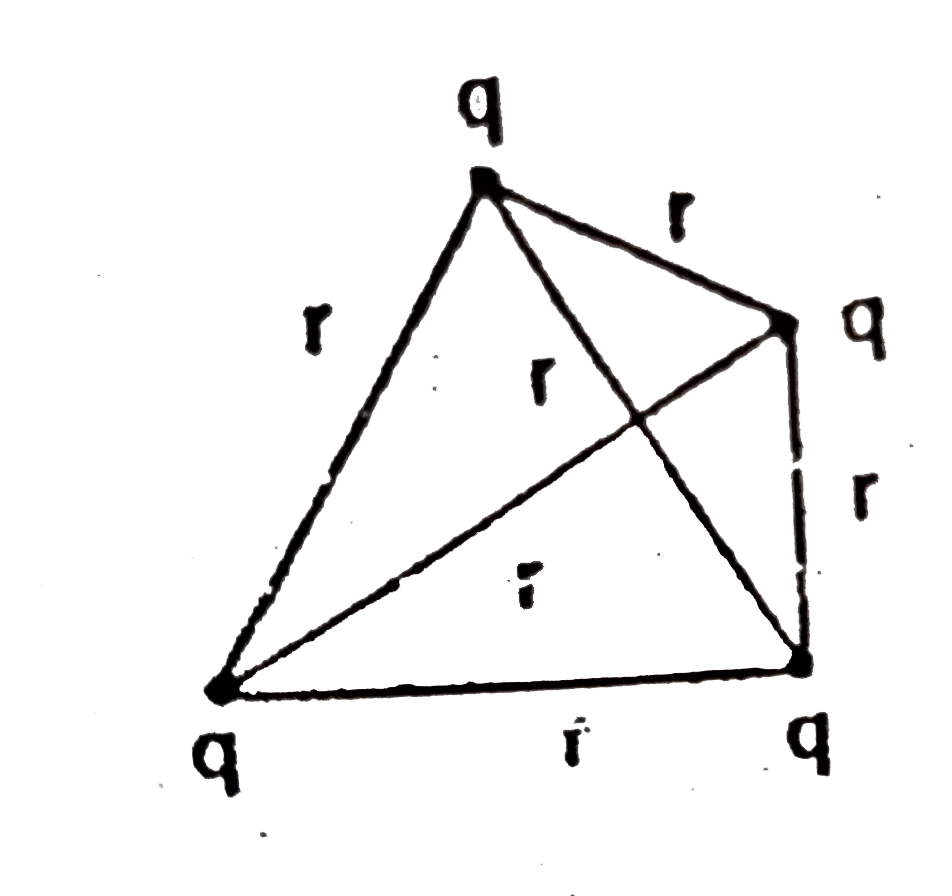
The amound of work done in assembling a system of maximum number of charges each of magnitude `q` so that each charge is equidistant from the other is equal to

A

`(q^(2))/(2piepsilon_(0)r)`

B

`(3q^(2))/(4piepsilon_(0)r)`

C

`(3q^(2))/(2piepsilon_(0)r)`

D

none of these

Text Solution

Verified by Experts

The arrangement possible is that of a pyramid
`E=6xx(1)/(4piepsilon_(0))xx(q^(2))/(r )=(3q^(2))/(2piepsilon_(0)r)`
Promotional Banner

Similar Questions

Explore conceptually related problems

equal chords are equidistant from each other

The work done to move a unit charge along an equipotential from P to Q

In a regular polygon of n sides, each corner is at a distance r from the centre. Identical charges each of magnitude q are placed at corners. The field at the centre is

a. A circle is drawn with center as a charge +q. What is the work done in moving a charge +q from B to C along the circumferebce of the circle ? B In the above question, if the charge +q is first taken from B to A and then from A to C, on which path is the magnitude of work greater?

The work done in bringing a unit positive charge from infinite distance to a point at distance x from a positive charge Q is W. Then the potential phi at that point is

Work done in moving a charge q coulomb on the surface of given charged conductor of potential V is

Consider the configuration of a system of four charges each of value (+q). Find the work done by external agent in changing the configuration of the system from (Fig. 3.44 A) to (Fig. 3.4B). a. ,

Point charge are placed at the verticas of a squre of side a as shown in fig. What should be the sign of charge q and magnitude of the ratio |q//Q| so that (i) net force on each Q is zero? (ii) net force on each q is zero? Is it possible that the entire system could be in electrostatic equilibrium?

The work done in carrying a charge q once round a circle of radius r with a charge Q at the centre is

Four equal point charges, each of magnitude +Q , are to be placed in equilibrium at the corners of a square. What should be the magnitude and sign of the point charge that should be placed at the center of the square to do this job?