Home
Class 12
PHYSICS
A force vecF=(3xy-5z)hatj+4zhatk is appl...

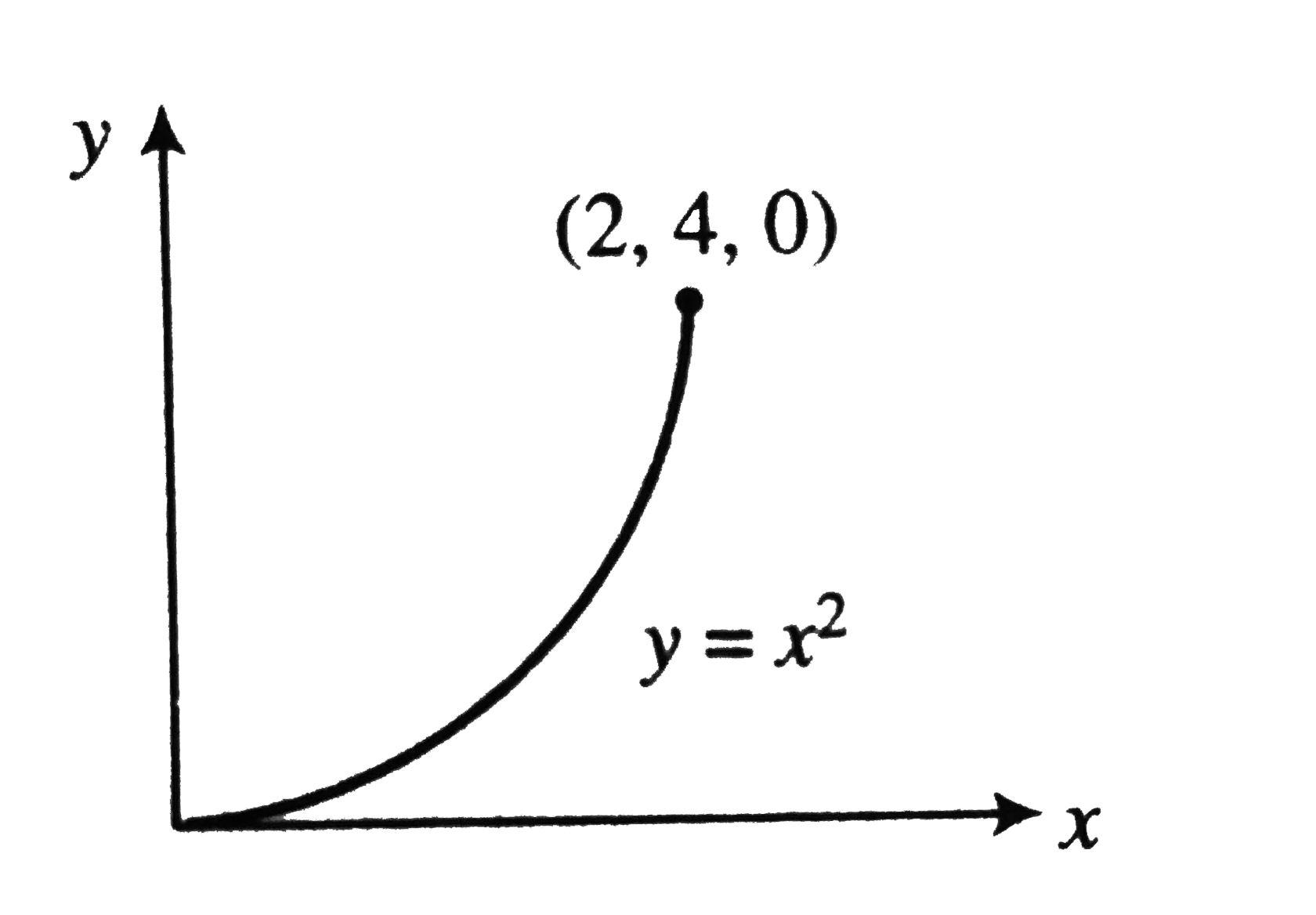
A force `vecF=(3xy-5z)hatj+4zhatk` is applied on a particle. The work done by the force when the particle moves from point `(0, 0, 0)` to point `(2, 4, 0)` as shown in figure.

A

`(280)/(5)`

B

`(140)/(5)`

C

`(232)/(5)`

D

`(192)/(5)`

Text Solution

Verified by Experts

The `z`-component of the force and the `x`-component of displacement are ieffective here.
`dW=F_(y)dy=3xy.dy` (`:'z=0`)
`=6x^(4)dx` (`:'y=x^(2)` )
Integrating between `x=0` and `x=2` gives the result.
Promotional Banner

Similar Questions

Explore conceptually related problems

A force of vecF=2xhati+2hatj+3z^2hatk N is acting on a particle. Find the work done by this force in displacing the body from (1, 2, 3)m to (3, 6, 1)m .

A force vecF = ( 3hati + 4hatj) N is acting on a particle. Work done by the force is zero, when particle is moving on the line 2y + Px = 2 , the value of P is

A force F is related to the position of a particle by the relation F=(10x^(2))N . Find the work done by the force when the particle moves from x=2m to x=4m .

A force vecF = (2xhati+ 3hatj + 3z^2hatk) is acting on the particle of mass 2kg which is displaces from point A(2,3,0) to point B(3,2,1) . the work done by the force on the particle will be

If force F=(2x+3x^(2))N is applied on a particle along x = axis, then find the work done by it during motion of particle from x = 0 to x = 2 m.

Shown that work done by a conservative force on a particle moving between two points is path independent.

Force acting on a particle moving in the x-y plane is vecF=(y^2hati+xhatj)N , x and y are in metre. As shown in figure, the particle moves from the origin O to point A (6m, 6m) . The figure shows three paths, OLA, OMA, and OA for the motion of the particle from O to A. Now consider another situation. A force vecF=(4hati+3hatj)N acts on a particle of mass 2kg . The particle under the action of this force moves from the origin to a point A (4m, -8m) . Initial speed of the particle, i.e., its speed at the origin is 2sqrt6ms^-1 . Figure shows three paths for the motion of the particle from O to A. Speed of the particle at A will be nearly

Force acting on a particle moving in the x-y plane is vecF=(y^2hati+xhatj)N , x and y are in metre. As shown in figure, the particle moves from the origin O to point A (6m, 6m) . The figure shows three paths, OLA, OMA, and OA for the motion of the particle from O to A. Now consider another situation. A force vecF=(4hati+3hatj)N acts on a particle of mass 2kg . The particle under the action of this force moves from the origin to a point A (4m, -8m) . Initial speed of the particle, i.e., its speed at the origin is 2sqrt6ms^-1 . Figure shows three paths for the motion of the particle from O to A. If the potential energy at O is 16J , the potential energy at A will be

A force bar F = (3hat i-4 hat j +b hat k)N is acting on the particle which is moving from point A ( 0-1, 1) m to the point B(2, 2 3) m If net work done by the force on the particle is zero then value of b is

A particle is subjected to a force F_(x) that varies withes position as shown in figure. Find the work done by the force on the body as it moves (a) from x =10.0 m to x =5.0 m , (b) from x =5.0 m to x =10.0 m , (c ) from x =10. 0 m to x =15.0 m , (d) what is the total work done by the force over the distance x =0 to x =15.0 ? .

