Home
Class 12
PHYSICS
Charge Q is uniformly distributed on the...

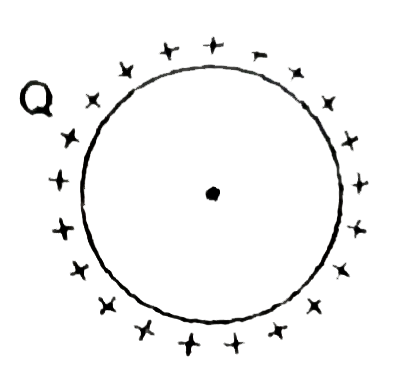
Charge `Q` is uniformly distributed on the rim of a thin insulating disc of mass `m` which is initially at rest and placed on a smooth horizontal surface. What will be the angular velocity of the disc if a magnetic field `B`, perpendicular to the plane of the disc is switched on ?

A

`QB//2m`

B

`QB//3m`

C

`2QB//3m`

D

`QB//m`

Text Solution

Verified by Experts

`DeltaQ` on a small element `=Q(Deltal)/(2pir)`
Torque on the disc `=(Q)/(2pi)ointE_(t)Deltal`
`omega=alphaDeltat=(Q)/(2pi)(-pir^(2)(DeltaB)/(Deltat))(2)/(mr^(2))Deltat=(2Q)/(2m)DeltaB=(QB)/(m)` (initially `B` was zero)
Promotional Banner

Similar Questions

Explore conceptually related problems

Charge Q is uniformly distributed on a thin insulating ring of mass m which is initially at rest. To what angular velocity will the ring be accelerated when a magnetic field B , perpendicular to the plane of the ring, is switched on ?

A uniform circular disc of mass m is set rolling on a smooth horizontal table with a uniform linear velocity v. Find the total K.E. of the disc.

A negatively charged disc is rotated clock-wise. What is the direction of the magnetic field at any point in the plane of the disc?

A disc of mass M and Radius R is rolling with an angular speed omega on the horizontal plane. The magnitude of angular momentum of the disc about origin is:

A point mass m collides with a disc of mass m and radius R resting on a rough horizontal surface as shown . Its collision is perfectly elastic. Find angular velocity of the disc after pure rolling starts

A disc of mass m and radius R is rolling on horizontal ground with linear velocity v. What is the angular momentum of the disc about an axis passing through bottommost point and perpendicular to the plane of motion ?

A disc of mass m has a charge Q distributed on its surface. It is rotating about an XX' with a angular velocity omega . The force acting on the disc is

A charge Q is uniformly distributed over the surface of non - conducting disc of radius R . The disc rotates about an axis perpendicular to its plane and passing through its centre with an angular to its plane and passing through its centre of the disc. If we keep both the amount of charge placed on the disc and its angular velocity to be constant and vary the radius of the disc then the variation of the magnetic induction at the centre of the disc will br represented by the figure:

A disc is given an initial angular velocity omega_(0) and placed on a rough horizontal surface as shown Fig. The quantities which will not depend on the coefficient of friction is/are

A disc shaped body (having a hole shown in the figure) of mass m=10kg and radius R=10/9m is performing pure rolling motion on a rough horizontal surface. In the figure point O is geometrical center of the disc and at this instant the centre of mass C of the disc is at same horizontal level with O . The radius of gyration of the disc about an axis pasing through C and perpendicular to the plane of the disc is R/2 and at the insant shown the angular velocity of the disc is omega=sqrt(g/R) rad/sec in clockwise sence. g is gravitation acceleration =10m//s^(2) . Find angular acceleation alpha ( in rad//s^(2) ) of the disc at this instant.

