Home
Class 12
PHYSICS
A particle is moving in x-y plane. At an...

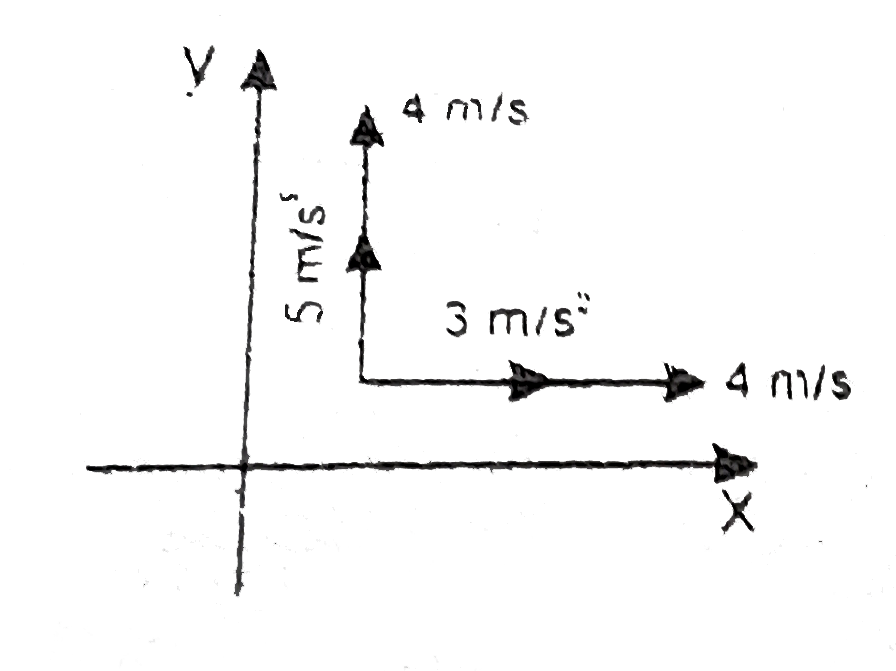
A particle is moving in x-y plane. At an instant, it has velocity `(4 hat (i) + 4 hat(j)) m//s` and acceleration `(3 hat(i) + 5 hat(j)) m//s^(2)` At that instant, the radius of curvature of its path will be :

A

`16sqrt(2) m`

B

`15 m`

C

`18 m`

D

None of these

Text Solution

Verified by Experts

Promotional Banner

Similar Questions

Explore conceptually related problems

A particle has initial velocity of (3hat(i)+4hat(j)) m//s and a acceleration of (4hat(i)-3hat(j)) m//s^(2) . Its speed after one second will be equal to :-

A particle has an initial velocity of 3hat(i) + 4 hat(j) and an acceleration of 0.4 hat(i) + 0.3 hat(j) . Its speed after 10s is :

A particle has an initial velocity of 3hat(i) + 4 hat(j) and an acceleration of 0.4 hat(i) + 0.3 hat(j) . Its speed after 10s is :

A particle has initial velocity (3 hat i+ 4 hat j) and has acceleration (0.4 hat i+ 0.3 hat j) . Its speed after 10 s is.

A particle is moving with a constant acceleration vec(a) = hat(i) - 2 hat(j) m//s^(2) and instantaneous velocity vec(v) = hat(i) + 2 hat(j) + 2 hat(k) m//s then rate of change of speed of particle 1 second after this instant will be :

A charged particle moving in a magnetic field vec(B) = hat(i) - hat(j) tesla, has an acceleration of 2 hat(i) + alpha hat(j) at some instant. Find the value of alpha

Find the angle between the vectors 2 hat(i) - hat(j) - hat(k) and 3 hat(i) + 4 hat(j) - hat(k) .

A particle is moving in x-y p1ane.At time t =0, particle is at (1m, 2m) and has velocity (4 hat i + 6 hat j) m//s. At t = 4s, particle reaches at (6m, 4m) and has velocity (2 hat i + 10 hat j) m//s. In the given time interval, find (a) average velocity, (b) average acceleration and (c) from the given data, can you find average speed?

A particle leaves the origin with initial velocity vec(v)_(0)=11hat(i)+14 hat(j) m//s . It undergoes a constant acceleration given by vec(a)=-22/5 hat(i)+2/15 hat(j) m//s^(2) . When does the particle cross the y-axis ?

Starting from origin at t=0, with initial velocity 5 hat(j) m//s , a particle moves in the x-y plane with a constant acceleration of (10 hat(i) - 5hat(j))m//s^(2) . Find the coordinates of the particle at the moment its y-coordinate is maximum.

