Home
Class 12
PHYSICS
A ball is thrown from point A making an ...

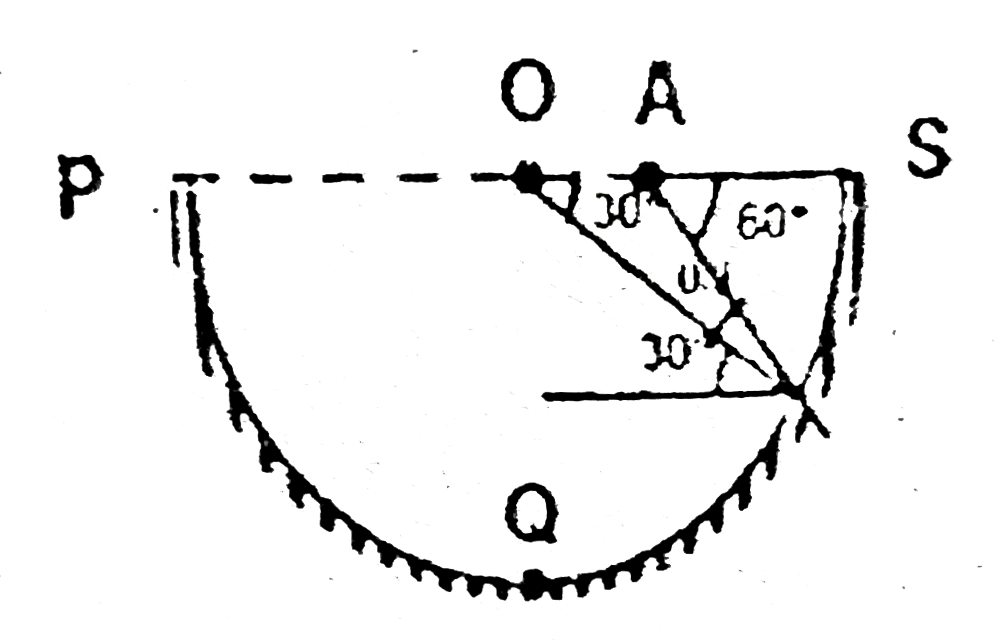
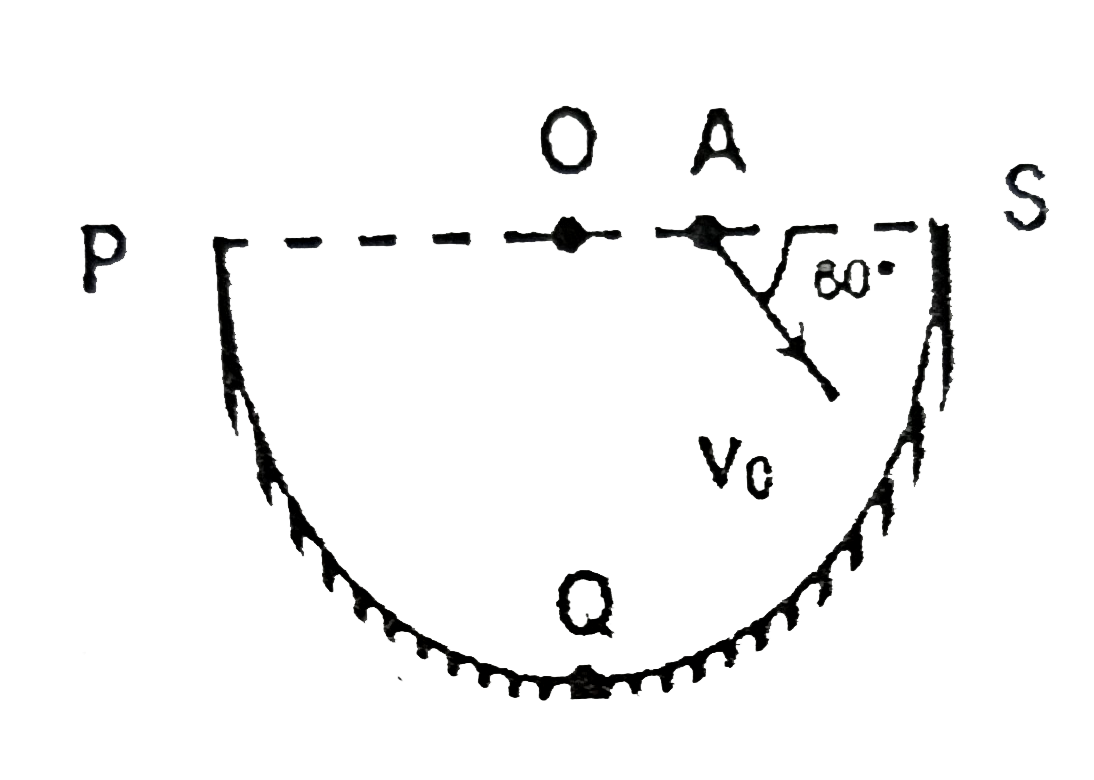
A ball is thrown from point `A` making an angle `60^(@)` with line `OAS` as shown in the figure, where `OA=(R )/(sqrt(3))` [`O` is the centre of spherical surface of `PQS`]. If after striking the hemi-spherical surface, the ball rebounds in direction parallel to `OA`. The coefficient of restitution between the ball and the surface is [Neglect the effect of gravity any type of frictional force]

A

`e=0.50`

B

`e=0.75`

C

`e=0.25`

D

None of these

Text Solution

Verified by Experts

`(R )/(sin120^(@))=(R//sqrt(3))/(sintheta)`
`rArr sintheta=1//2rArrtheta=30^(@)`
Hence `e=1`
Promotional Banner

Similar Questions

Explore conceptually related problems

A ball is dropped on a horizontal surface from height h. If it rebounds upto height (h)/(2) after first collision then coefficient of restitution between ball and surface is

A ball is projected from ground with a speed 70m//s at an angle 45^(@) with the vertical so that it strikes a vertical wall at horizontal distance (490)/(3)m from the point of projection. If the ball returns back to the poin tof projection without any collision with ground then find the coefficient of restitution between the ball and wall.

A particle of mass 0.1kg is launched at an angle of 53^(@) with the horizontal . The particle enters a fixed rough hollow tube whose length is slightly less than 12.5m and which is inclined at an angle of 37^(@) with the horizontal as shown in figure. It is known that the velocity of ball when it enters the tube is parallel to the axis of the tube. The coefficient of friction betweent the particle and tube inside the tube is mu=(3)/(8)[ Take g=10m//g^(2)] The distance from the point of projection where the particle will land on the horizontal plane after coming out from the tube is approximately equal to :

A track has two inclined surface AB and DC each of length 3 m and angle of inclination of 30^@ with the horizontal and a central horizontal part of length 4m shown in figure. A block of mass 0.2 kg slides from rest from point A. The inclined surfaces are frictionless. If the coefficient of friction between the block and the horizontal flat surface is 0.2, where will the block finally come to rest ? [in 10^(-1) m ]

A ball is projected from a point in a horizontal plane so as to strike a vertical wall at right angle A .after rebounding from the wall it strikes the horizontal plane once and returns to the point of projection just before second collision at horizontal surface. Find co-efficient of restitution for the two collisions, assuming it to be same for both the collision.

Figure shows a circular frications trck of radius R , centred at point O . A particle of mass M is released from point A (OA = R//2) . After collision with the track, the particle moves along on the track. Then the coefficient of restitution e is.

An insect crawls up a hemispherical surface as shown (see the figure) the coefficient offriction between the insect and the surface is 1/3. If the line joining the centre of the hemisperical surface to the insect makes an angle theta with the vertical, the maximum possible value of theta is given by

We have a disc of neglligible thickness and whose surface mass density varies as radial distance from centre as sigma=sigma_(0)(1+r/R) , where R is the radius of the disc. Specific heat of the material of the disc is C . Disc is given an angular velocity omega_(0) and placed on a horizontal rough surface such that the plane of the disc is parallel to the surface. Coefficient of friction between disc and suface is mu . The temperature of the disc is T_(0) . Answer the following question on the base of information provided in the above paragraph If the kinetic energy lost due to the friction between disc and surface is absorbed by the disc the moment heat is generated, by the mass lying at the point where the energy is lost. Assume that there is no radial heat flow in betwen disc particles. Rate of change in temperature at a point lying at r distance away from centre with time, before disc stops rotating, will be ( alpha -magnitude of angular acceleration of rod)

A small ball is projected from point P towards a vertical wall as shown in Fig. It hits the wall when its velocity is horizontal. Ball reaches point P after one bounce on the floor. The coefficient of restitution assuming it to be same for two collisions is n//2 . All surfaces are smooth. Find the value of n .

Consider an evacuated cylindrical chamber of height h having rigid conducting plates at the ends and an insulating curved surface as shown in the figure. A number of spherical balls made of a light weight and soft material and coated with a conducting material are placed on the bottom plate. The balls have a radius r lt lt h . Now, a high voltage source (HV) is connected across the conducting plates such that the bottom plate is at +V_0 and the top plate at -V_0 . Due to their conducting surface, the balls will get charged, will become equipotential with the plate and are repelled by it. The balls will eventually collide with the top plate, where the coefficient of restitution can be taken to be zero due to be soft nature of the material of the balls. The electric field in the chamber can be considered to be that of a parallel plate capacitor. Assume that there are no collisions between the balls and the interaction between them is negligible. (Ignore gravity) The average current in the steady state registered by the ammeter in the circuit will be