Home
Class 12
PHYSICS
A rod of mass m and length L is kept on ...

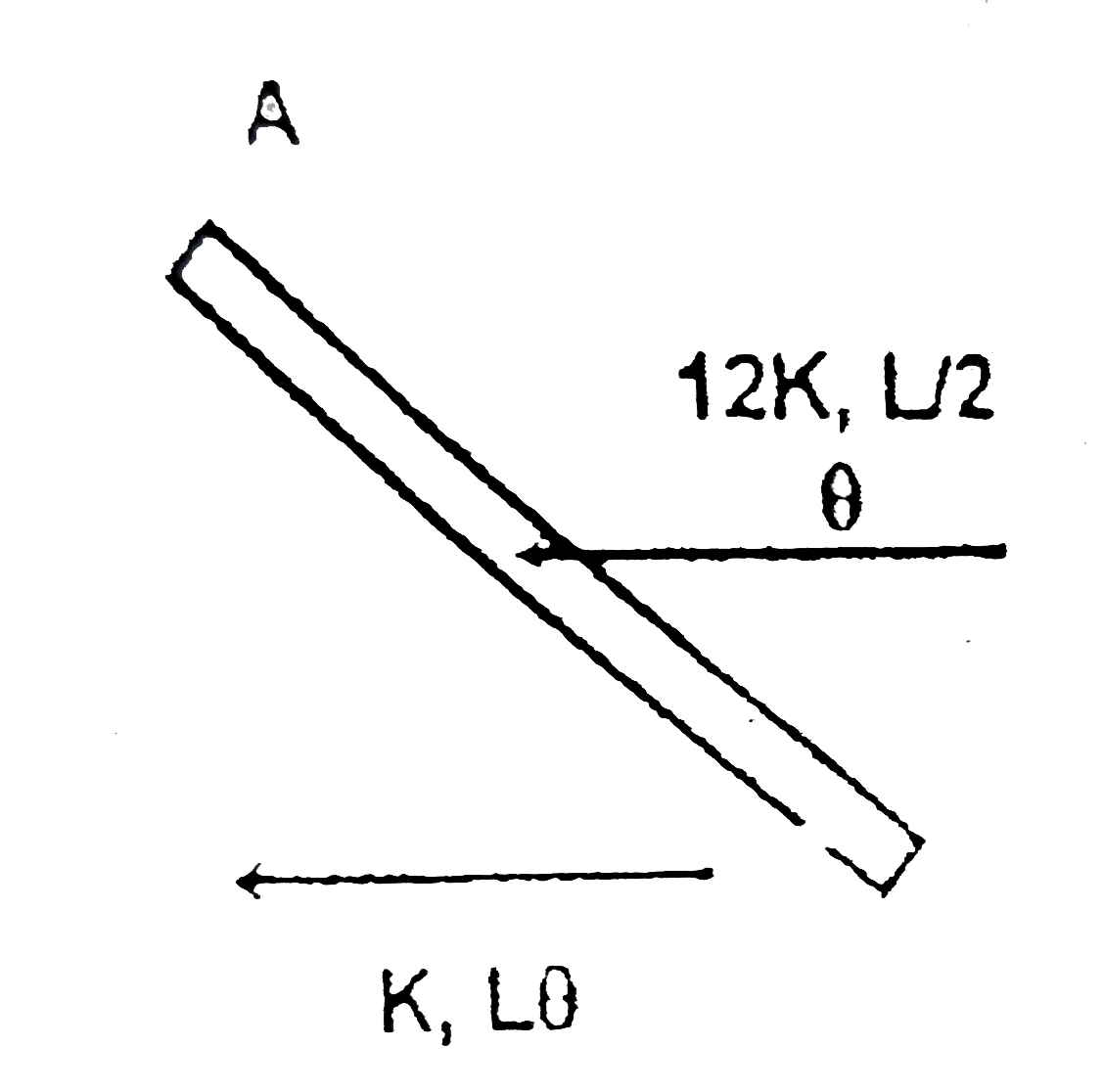
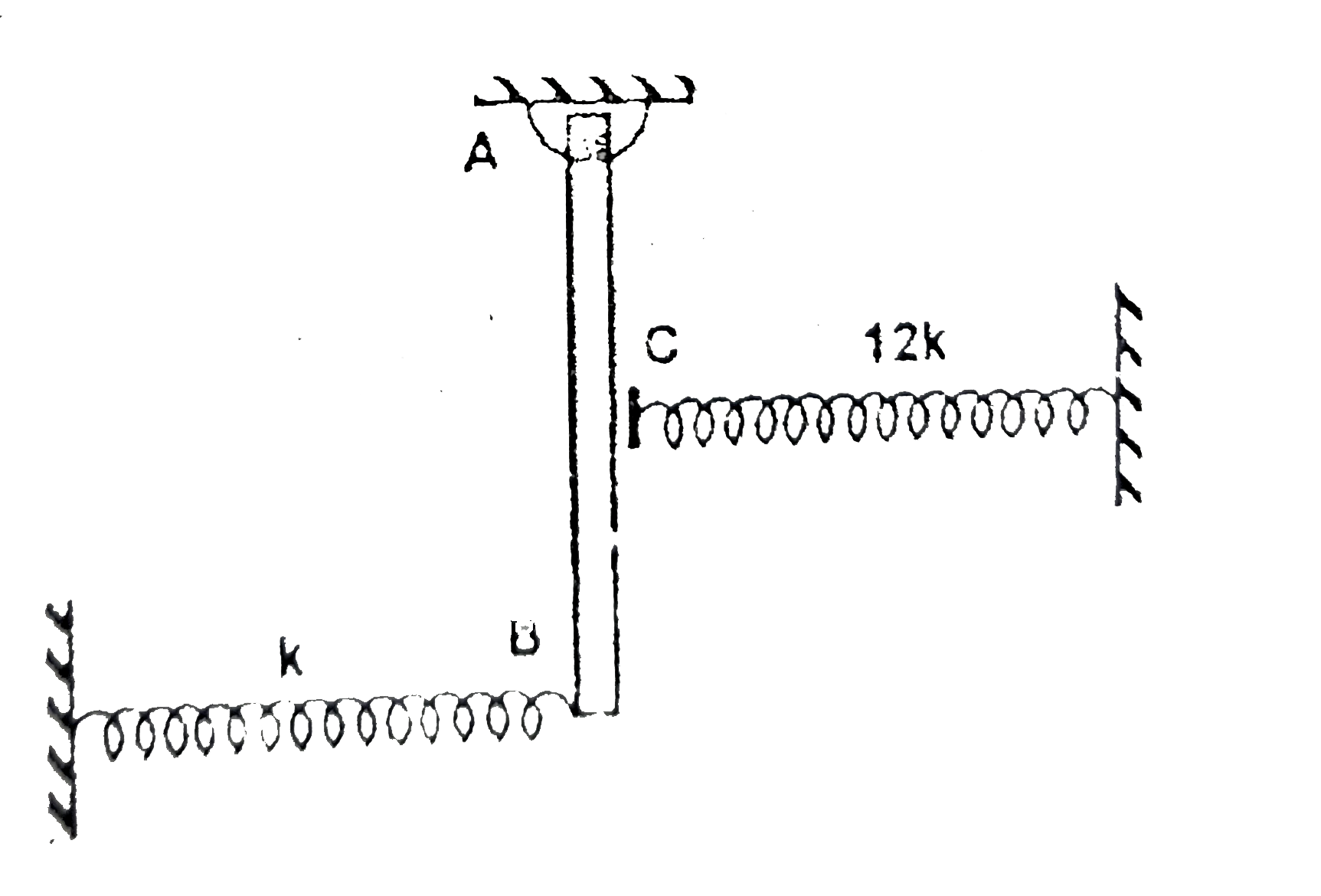
A rod of mass `m` and length `L` is kept on a horizontal smooth surface. The rod is hinged at its one end `A`. There are two springs, perpendicular to the rod, kept in the same horizontal plane. The spring of spring constant `k` is rigidly attached to the lower end of rod and spring of spring constant `12k` just touches the rod at its midpoint `C`, as shown in the figure. If the rod is slightly displaced leftward and released then, the time period for small osciallation of the rod will be

A

`pisqrt((m)/(3k))`

B

`(3pi)/(2)sqrt((m)/(3k))`

C

`pi[sqrt((m)/(3k))+sqrt((3g)/(2L))]`

D

`(3pi)/(2)[sqrt((m)/(3k))+4sqrt((3g)/(2L))]`

Text Solution

Verified by Experts

When rod moves right word to the line `AB`
`tau_(A)=kLthetaLcostheta+12k(L/2)theta(L//2)costheta`
Hence, `theta to 0 rArr costheta=1`
`tau_(A)=[(4kL^(2)+12kL^(2))/(4)]thetarArr(mL^(2))/(3)alpha=((4k+12k)L^(2))/(4)theta`
`rArralpha=(3(4k+12k)theta)/(4m)=(12k)/(m)theta`
`rArr (d^(2)theta)/(dt^(2))+(12k)/(m)theta=0rArr`Equation of SHM
`omega= 2sqrt((3k)/(m))rArrT_(1)=pisqrt((m)/(3k))`

When the rod moves leftward of line `AB`, spring of spring constant `k_(2)` will no play any role in the motion of the rod, so
`(mL^(2)alpha)/(3)=kL^(2)thetarArralpha=(3k)/(m)thetarArr(d^2)theta)/(dt^(2))+(3k)/(m)theta=0`
`rArr T_(2)=pisqrt((m)/(3k))`
`T=(1)/(2)(T_(1)+T_(2))=(3pi)/(2)sqrt((m)/(3k))`
(##FIT_JEE_PHY_GMP_ASS_E01_281_S02##)
Promotional Banner

Similar Questions

Explore conceptually related problems

A uniform rod of mass m , length l rests on a smooth horizontal surface. Rod is given a sharp horizontal impulse p perpendicular to the rod at a distance l//4 from the centre. The angular velocity of the rod will be

A rod AB of mass M and length L is shown in figure. End A of rod is hinged and end B is lying on the ground. Find the Normal reaction by ground on the rod

The ends of a rod of length l and mass m are attached to two identical springs as shown in the figure. The rod is free to rotate about its centre O . The rod is depressed slightly at end A and released . The time period of the oscillation is

A uniform rod of mass m and length L is kept on a horizontal table with L/4 length on the table as shown in figure. As the string attached to the end B is cut, the angular acceleration of the rod about point C will be

A straight rod of light L and mass m is pivoted freely from a point of the roof. Its lower end is connected to an ideal spring of spring constant K. The other end of the spring is connected to the wall as shown in the figure. Find the frequency of small oscillation of the system.

A uniform rod of mass m=2 kg and length l is kept on a smooth horizontal plane. If the ends A and B of the rod move with speeds v and 2v respectively perpendicular to the rod, find the: a. angulr velocity of CM of the rod. b. Kinetic energy of the rod (in Joule).

A rod AB of mass m and length L is rotating in horizontal plane about one of its ends which is pivoted. The constant angular speed with which the rod is rotating is omega . The force applied on the rod by the pivot is

A weightless spring of length 60 cm and force constant 100 N m^(-1) is kept straight and unstretched on a smooth horizontal table and its ends are rigidly fixed. A mass of 0.25 kg is attached at the middle of the spring and is slightly displaced along the length. The time period of the oscillation of the mass is

A body of mass M is moving on a smooth surface with speed v_(0) . Another body of same mass M attached to a spring is kept on the same surface as shown. The moving mas makes an impact with the spring of spring constant k and starts compressing it. What is the maximum compression in the spring ?

Two springs of spring constant (mg)/l each are attached to the end of a uniform rod of mass m and length l=5/3 m which is hinged in vertical plane as shown in figure. As the rod is rotated slightly about the hinge, it undergoes SHM with angular frequency omega . Find omega in rad/s.) Take g =10m/s^(2) .