Home
Class 12
PHYSICS
A bar of mass m is suspended horizontall...

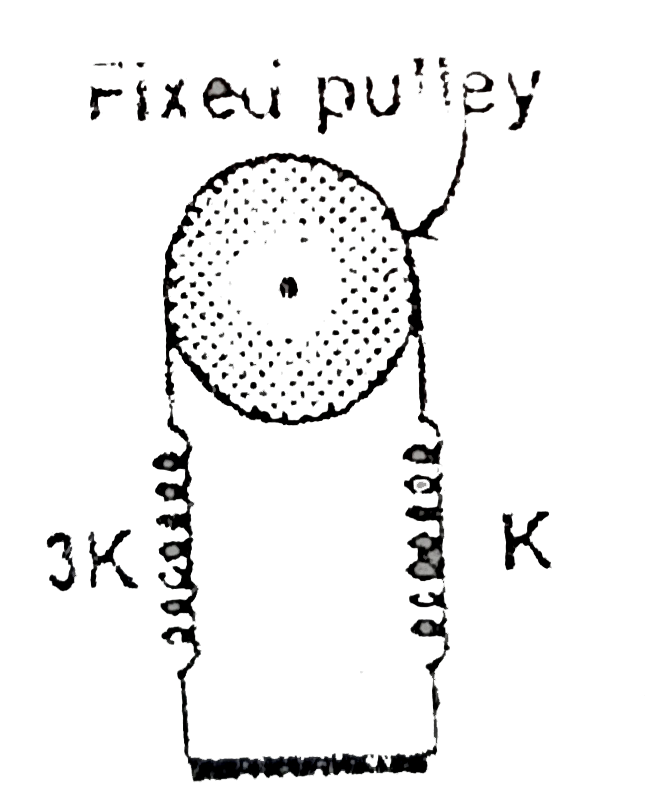
A bar of mass `m` is suspended horizontally on two vertical springs of spring constant `k` and `3k`. The bar bounces up and down while remaining horizontal. Find the time period of oscillation of the bar neglect mass of springs and friction everywhere

A

`2pisqrt((m)/(k))`

B

`2pisqrt((m)/(3k))`

C

`pisqrt((2m)/(3k))`

D

`pisqrt((3m)/(4k))`

Text Solution

Verified by Experts

`x=` distance moved by rod
`x_(1)=` extension in the spring of spring constant `3k`.
`x_(2)=`extension in the spring of spring constant `k`.
`x_(1)+x_(2)=2x` (constant relation)
`3kx_(1)=kx_(2)`(tension in string is same)
`-(3kx_(1)+kx_(2))=m(d^(2)x)/(dt^(2))`
solving above `3` equations
`rArr T=2pisqrt((m)/(3k))`
Promotional Banner

Similar Questions

Explore conceptually related problems

Two identical springs of spring constant k are attached to a block of mass m and to fixed supports as shown in the figure. The time period of oscillation is

A block of mass m hangs from a vertical spring of spring constant k. If it is displaced from its equilibrium position, find the time period of oscillations.

Find the time period of oscillation of block of mass m. Spring, and pulley are ideal. Spring constant is k.

A block of mass m suspended from a spring of spring constant k . Find the amplitude of S.H.M.

A mass m is suspended from a spring of force constant k and just touches another identical spring fixed to the floor as shown in the fig. The time period of small oscillations is

A block of mass m is attached to a cart of mass 4m through spring of spring constant k as shown in the figure. Friction is absent everywhere. The time period of oscillations of the system, when spring is compressed and then released, is

Write down the expression for the period of oscillation of a mass attached to (i) a horizontal spring and (ii) a vertical spring.

A mass is suspended separately by two springs of spring constants k_(1) and k_(2) in successive order. The time periods of oscillations in the two cases are T_(1) and T_(2) respectively. If the same mass be suspended by connecting the two springs in parallel, (as shown in figure) then the time period of oscillations is T. The correct relations is

A light pulley is suspended at the lower end of a spring of constant k_(1) , as shown in figure. An inextensible string passes over the pulley. At one end of string a mass m is suspended, the other end of the string is attached to another spring of constant k_(2) . The other ends of both the springs are attached to rigid supports, as shown. Neglecting masses of springs and any friction, find the time period of small oscillations of mass m about equilibrium position.

A block of mass m hangs from three springs having same spring constant k. If the mass is slightly displaced downwards, the time period of oscillation will be

