Home
Class 12
PHYSICS
A conducting movable rod AB lies across ...

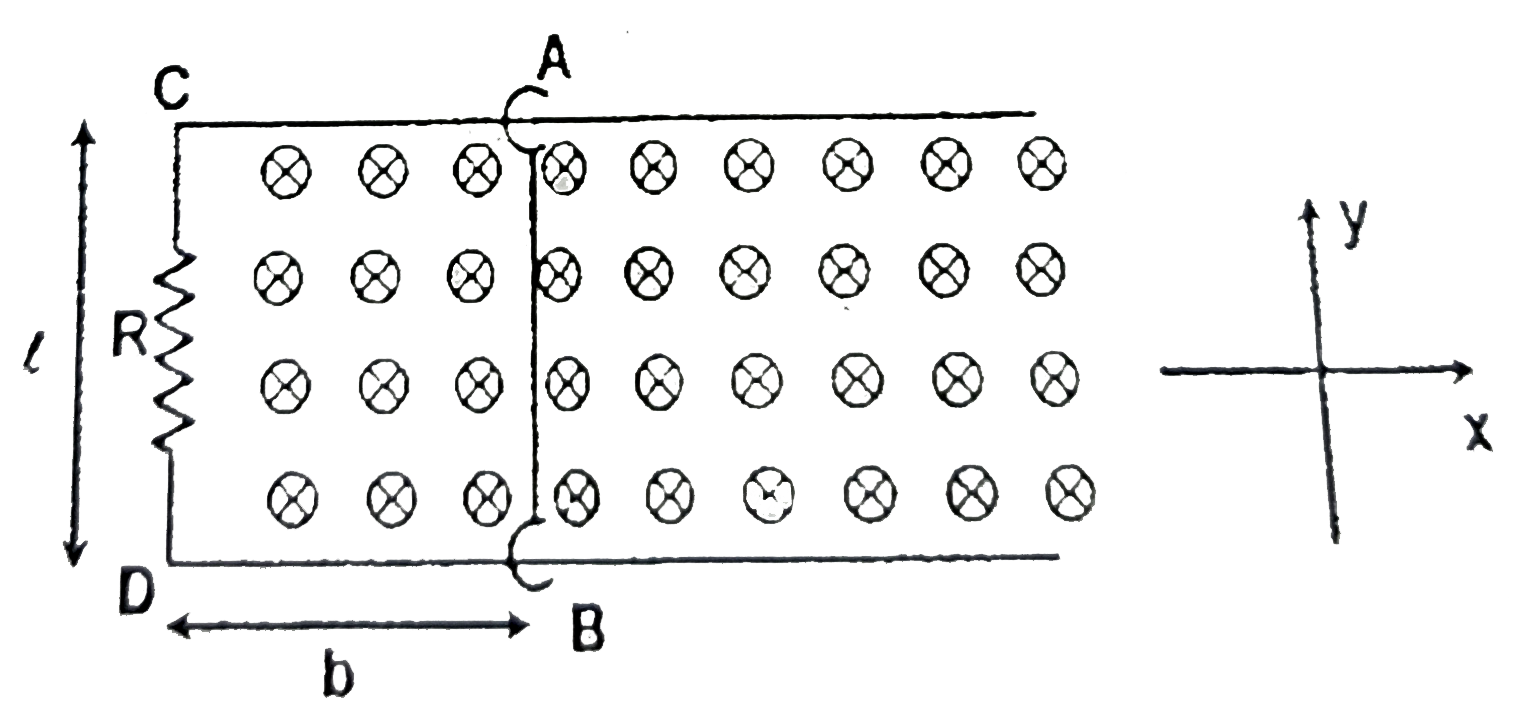
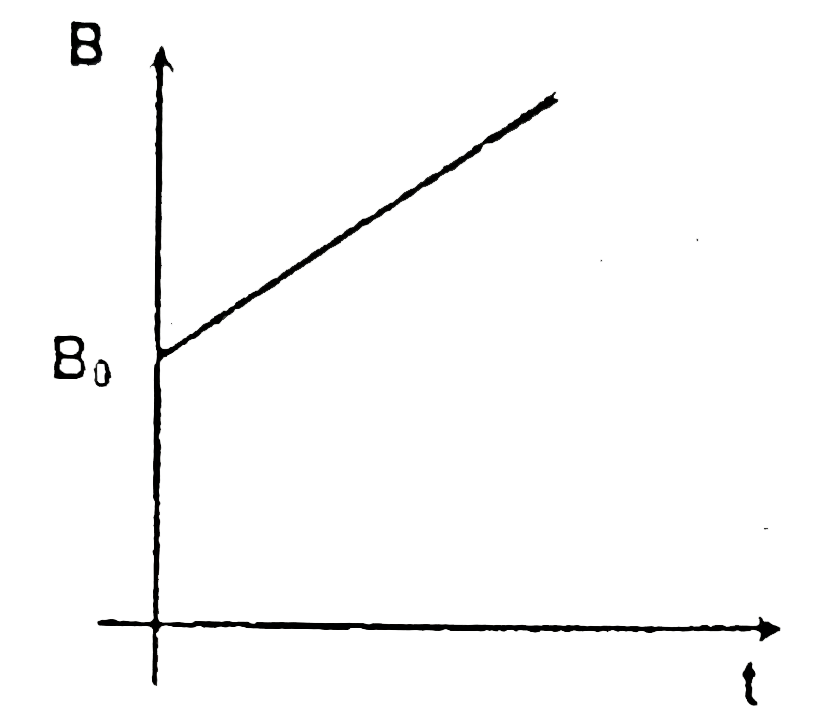
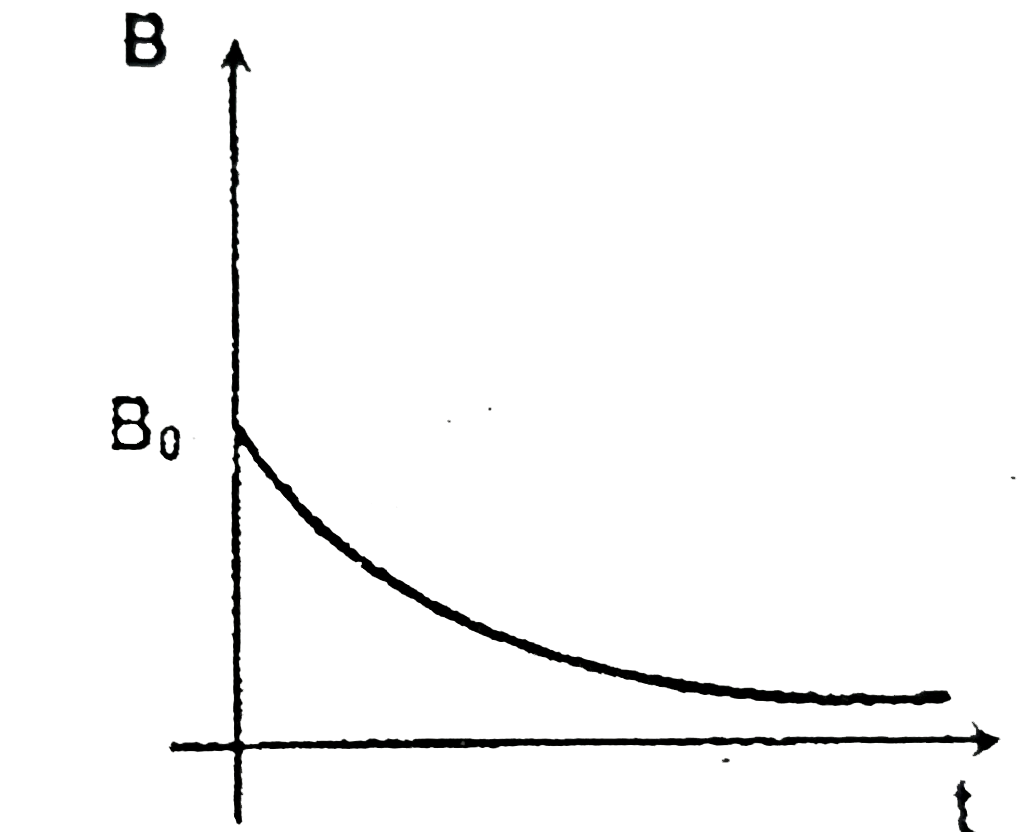
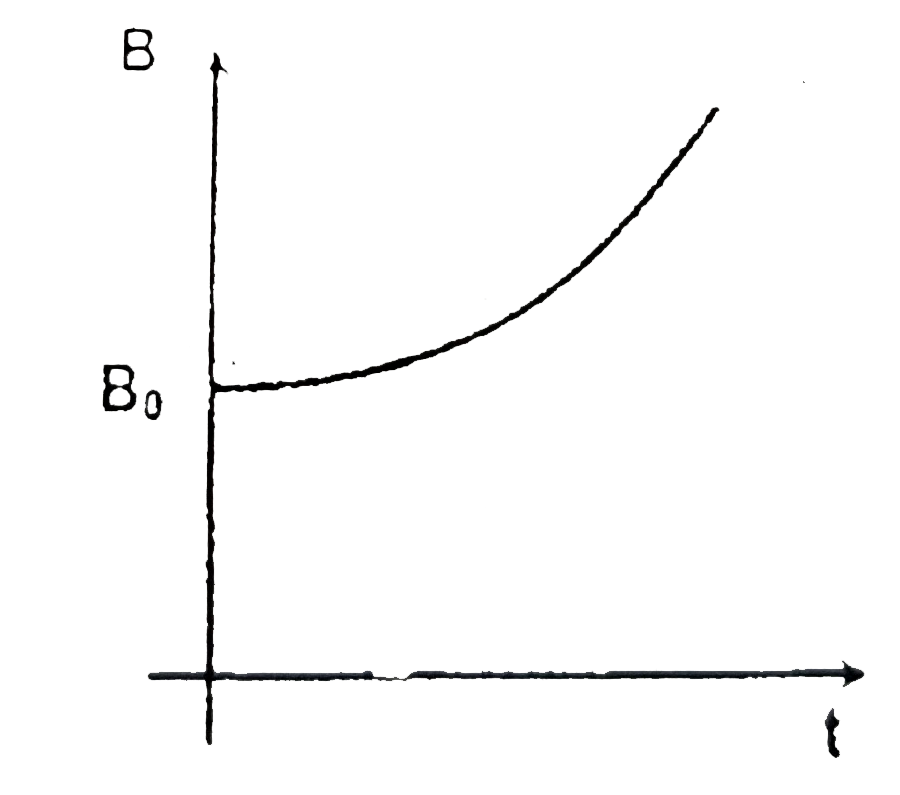
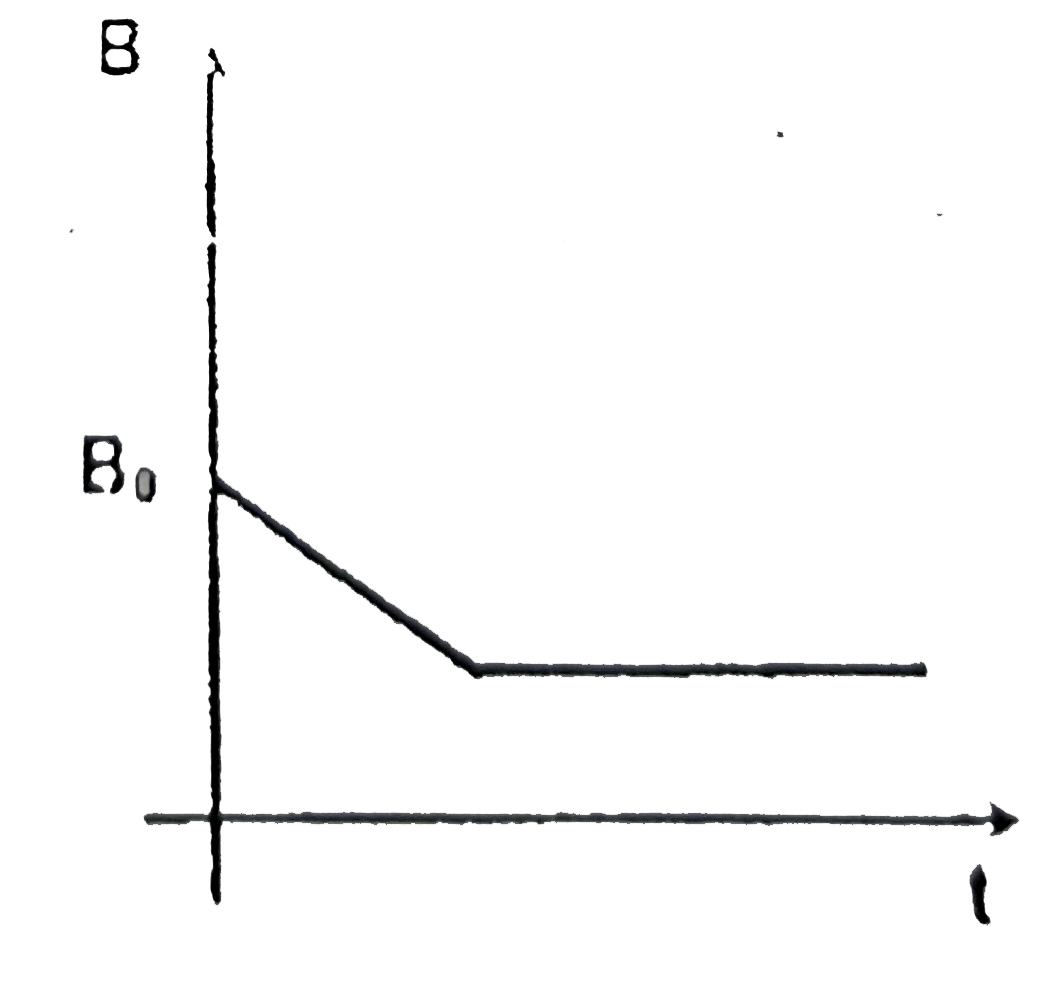
A conducting movable rod `AB` lies across the frictionless parallel conducting rails in a uniform magnetic field `vecB` whose magnitude at `t=0` is `B_(0)`. The rod `AB` is given velocity `v` right ward and it continues to move with same velocity through out the motion [The acceleration due to gravity is along negative `z-`axis, i.e. `vecg=10m//s^(2)(-hatk)`, mass of rod `=m`.] Which of the following graphs will be the best representation of magnitude of magnetic field versus time.

A

B

C

D

Text Solution

Verified by Experts

Since speed is constant, it means there is no induced `emf phi=l(b+vt)B`
`e=lBv+l(b+vt)(dB)/(dt)=0`
`rArr (b+vt)(dB)/(dt)=-Bv`
`rArr int_(B_(0))^(B)(dB)/(B)=-vint_(0)^(t)(dt)/(b+vt)`
`rArrlnB//B_(0)=-v[(1)/(v)ln((b+vt)/(b))]=ln((b)/(b+vt))`
`rArr B=(B_(0)b)/(b+vt)`
Second Method :
So flux does not change with time, so
`phi(1)=phi(t+dt)`
`rArrBl(b+vt)=(B+dB)l[b+v(t+dt)]`
`rArr (b+vt)dB+Bvdt=0`
`rArr (dB)/(B)=-V(dt)/(b+vt)rArrB=(B_(0)b)/(b+vt)`
Promotional Banner

Similar Questions

Explore conceptually related problems

A rod lies across frictionless rails in a uniform magnetic field vec(B) as shown in figure. The rod moves to the right with speed V . In order to make the induced emf in the circuit to be zero, the magnitude of the magnetic field should

A small conducting rod of length l, moves with a uniform velocity v in a uniform magnetic field B as shown in fig __

A rod AB moves with a uniform velocity v in a uniform magnetic field as shown in figure

A conductor rod AB moves parallel to X-axis in a uniform magnetic field, pointing in the positive Z-direction. The end A of the rod gets-

A glass rod of length l moves with velocity v in a uniform magnetic field B. What is the e.m.f induced in the rod?

A conducting rod of length L slides at a constant velocity V on two parallel conducting rails as shown in figure. The mechanical power required to pull the rod at constant velocity is

A conducting rod of resistance r moves uniformly with a constant speed v in a uniform magnetic field. If the rod keeps moving uniformly, then the amount of force required is

A conducting rod AB moves parallel to the x-axis (see Fig.) in a uniform magnetic field pointing in the positive z-direction. The end A of the rod gets positively charged. .

A conducting rod shown in figure of mass m and length l moves on two frictionless horizontal parallel rails in the presence of a unifom magnetic field directed into the page., The rod is given an initial velocity v_0 to the right and is released at t=0 . Find s a function of time a. the volocity of the rod b. the induced current and c. the magntitude of the induced emf.

A rod of mass m is supported by string AB and friction due to wall. Then friction force on rod due to wall is : (g= acceleration due to gravity )
