Home
Class 12
PHYSICS
A gas took part in three thermal process...

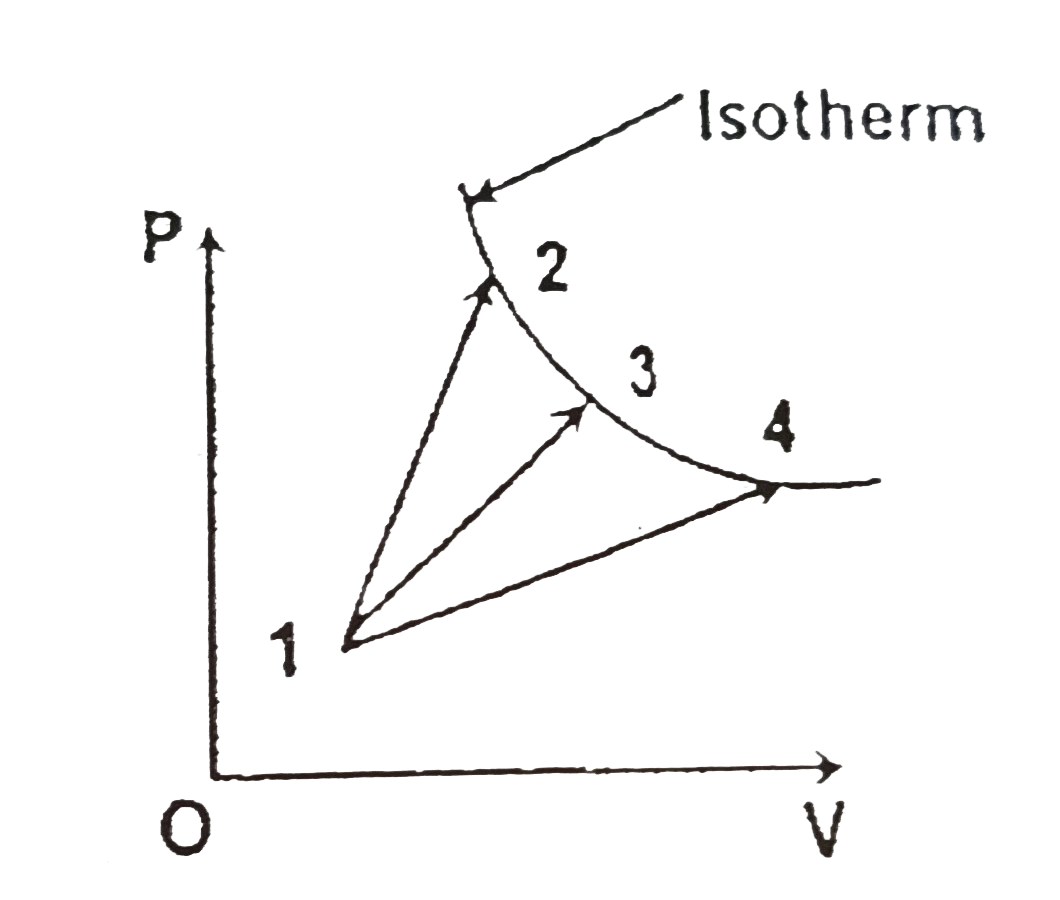
A gas took part in three thermal processes in which it is heated from the same initial state to the same final temperature. The process are shown in the `P-V` diagram by straight lines `1-2`, `1-3` and `1-4`. `Q_(1)`, `Q_(2)` and `Q_(3)` are amount of heat supplied to the gas in the process `1 to 2`, `1 to 3`, `1 to 4`. respectively.

A

`Q_(3) gt Q_(2)`

B

`Q_(1) lt Q_(2)`

C

`Q_(3) gt Q_(1)`

D

`Q_(3) gt Q_(2) gt Q_(1)`

Text Solution

Verified by Experts

Promotional Banner

Similar Questions

Explore conceptually related problems

A gas take part in two thermal processes in which it is heated from the same initial state to the same final temperature. The processes are shown on the P-V diagram by straight lines 1 rarr 3 and 1 rarr 2

A gas take part in two thermal processes in which it is heated from the same initial state to the same final temperature. The processes are shown on the P-V diagram by straight lines 1 rarr 3 and 1 rarr 2

A gas takes part in two processes in which it is heated from the same initial state 1 to the same final temperature. The processes are shown on the p-V diagram by the straight lines 1-3 and 1-2. 2 and 3 are the points on the same isothermal curve. Q_1 and Q_2 are the heat transfer along the two processes. Then,

Consider two processes on a system as shown in figure. The volumes in the initial states are the same in the two processes and the volume in the final states are also the same.Let DeltaW_(1) and DeltaW_(2) be the work done by the system in the processes A and B respectively.

Consider two processes on a system as shown in figure. The volumes in the initial states are the same in the two processes and the volume in the final states are also the same.Let DeltaW_(1) and DeltaW_(2) be the work done by the system in the processes A and B respectively.

consider two processes on a system as shown in fig the volumes in the initial stage are the same in the two processes and the volume in the final stage are also the same.Let DeltaW_(1) and DeltaW_(2) be the work done by the system in the processes A and B respectively.

An ideal gas of mass m in a state A goes to another state B via three different processes as shown in Fig. If Q_(1), Q_(2) and Q_(3) denote the heat absorbed by the gas along the three paths, then

An ideal gas goes from state A to state B via three different processes as indicated in the P-V diagram - If Q_(1),Q_(2),Q_(3) indicate the heat absorbed by the gas along the three process and DeltaU_(1),DeltaU_(2),DeltaU_(3) , indicate the change in internal energy along the three processes respectively, then -

An ideal gas undergoes for different processes from the same initial state (figure). Four processes are adiabatic, isothermal, isobaric and isochoric. Out of 1, 2, 3 and 4 which one is adiabatic ?

An ideal gas undergoes for different processes from the same initial state (figure). Four processes are adiabatic, isothermal, isobaric and isochoric. Out of 1, 2, 3 and 4 which one is adiabatic ?

