Home
Class 12
PHYSICS
A Cs plate is irradiated with a light of...


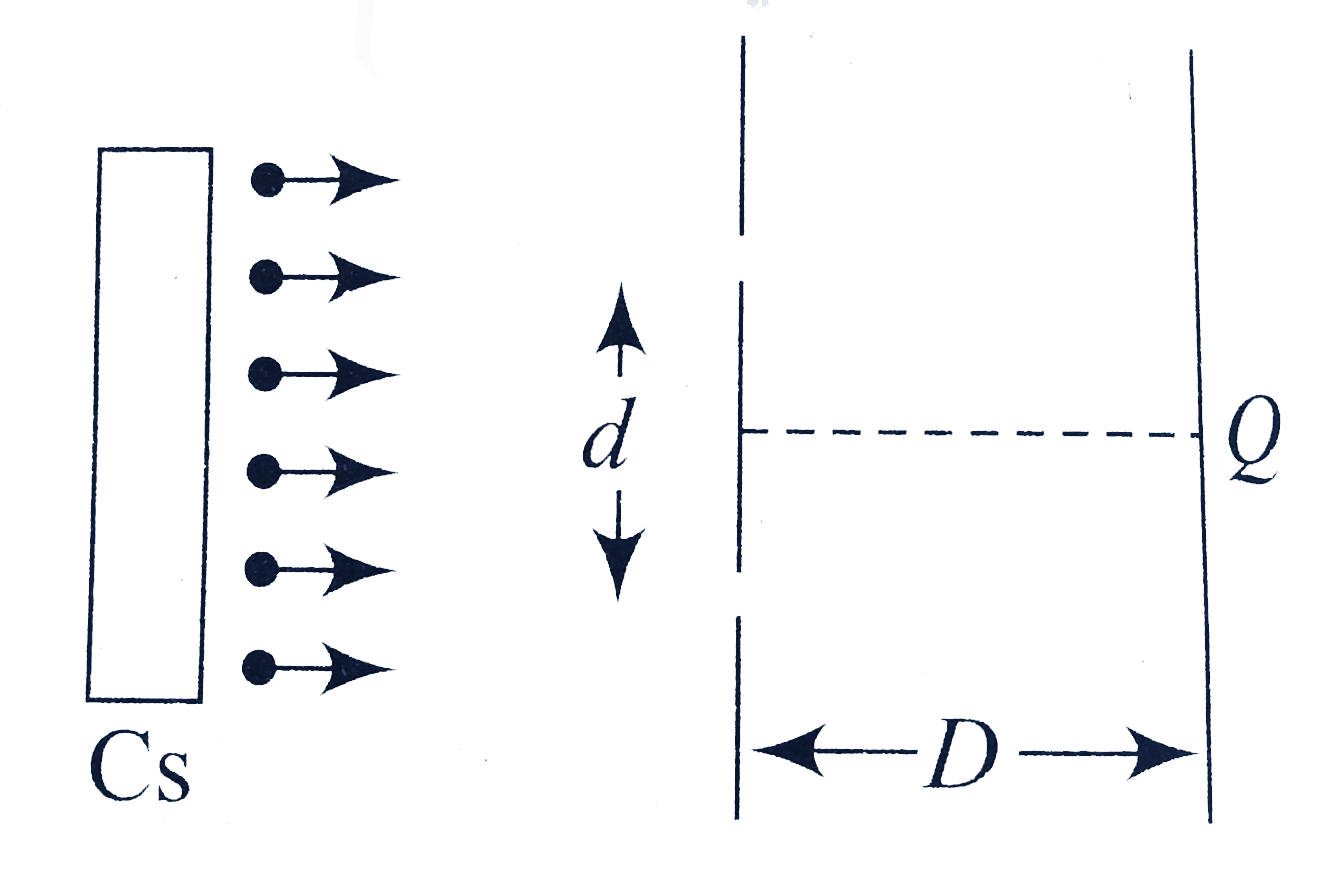
A Cs plate is irradiated with a light of wavelength `lamda=(hc)/(phi)`,`phi` being the work function of the plate, h Plank's constant, and c the velocity of light in vacuum. Assume all the photoelectron are moving perpendicular to the plate toward a YDSE setup when accelerated through a potential difference V. Take charge on a proton `=e` and moss of an electron `=m`. Read the paragraph carefully and answer the following question:
Q. If the wavelength of light used in photoemission is less that `lamda`, then the fringe width will

A

upward

B

downward

C

no shift

D

no frings will be formed

Text Solution

Verified by Experts

Promotional Banner

Similar Questions

Explore conceptually related problems

A Cs plate is irradiated with a light of wavelength lamda=(hc)/(phi) , phi being the work function of the plate, h Plank's constant, and c the velocity of light in vacuum. Assume all the photoelectron are moving perpendicular to the plate toward a YDSE setup when accelerated through a potential difference V. Take charge on a proton =e and moss of an electron =m . Read the paragraph carefully and answer the following question:The fringe width due to the electron beam is

An electron of mass m and charge e is accelerated from rest through a potential difference V in vacuum. The final speed of the electron will be

An electron of mass m and charge e is accelerated from rest through a potential difference V in vacuum. The final speed of the electron will be

The de Broglie wavelength lamda of an electron accelerated through a potential V in volts is

The mass of an electron is m, charge is e and it is accelerated form rest through a potential difference of V volts. The velocity acquired by electron will be :

A proton when accelerated through a potential difference of V volt has a wavelength lamda associated with it. An alpha-particle in order to have the same lamda must be accelerated through a potential difference of

The dimension of the quantity 1/epsilon_0 e^2/(hc) is (e charge of electron,h Planck's constant and c=velocity of light)

The mass of an electron is m, its charge is e and it is accelerated from rest through a potential difference, V. The velocity of electron can be calculated by formula:

If the work function of a metal is 'phi' and the frequency of the incident light is 'v' , there is no emission of photoelectron if

The wavelength lambda of de Broglie waves associated with an electron (mass m , charge) accelerated through a potential difference of V is given by ( h is plank's constant):

