Home
Class 12
PHYSICS
Three spheres, each of mass m, can slide...

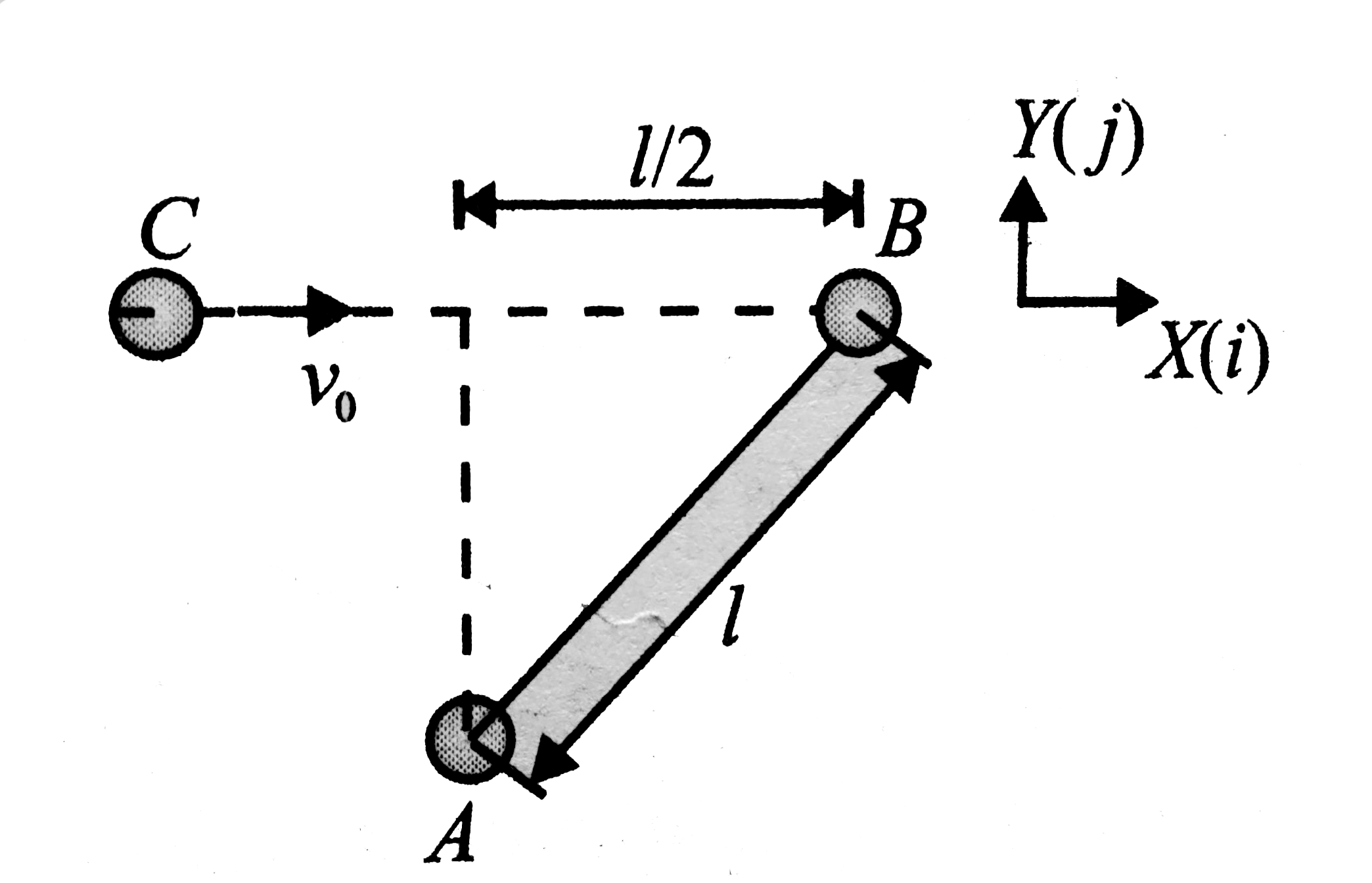
Three spheres, each of mass `m`, can slide freely on a frictionless, horizontal surface. Spheres `A` and `B` are attached to an inextensible, inelastic cord of length `l` and are at rest in the position shown where sphere `B` is struck by sphere `C` which is moving to the right with a velocity `v_(0)`. Knowing that the cord is taut where sphere `B` is struck by sphere `C` and assuming 'head on' inelastic impact between `B` and `C`, we cannot conserve kinetic energy of the entire system.
The velocity of `B` immediately after collision is along unit vector

A

`hati`

B

`(hati+hatj)/(sqrt(2))`

C

`(sqrt(3))/(2)hati+(1)/(2)hatj`

D

Cant't predict

Text Solution

Verified by Experts

Hint : Use impulse-momentum theorem along the rope and conservation of momentum perpendicular to the rope.
Promotional Banner

Similar Questions

Explore conceptually related problems

Three spheres, each of mass m , can slide freely on a frictionless, horizontal surface. Spheres A and B are attached to an inextensible, inelastic cord of length l and are at rest in the position shown where sphere B is struck by sphere C which is moving to the right with a velocity v_(0) . Knowing that the cord is taut where sphere B is struck by sphere C and assuming 'head on' inelastic impact between B and C , we cannot conserve kinetic energy of the entire system. The magnitude of velocity of A immediately after collision is

Three spheres, each of mass m , can slide freely on a frictionless, horizontal surface. Spheres A and B are attached to an inextensible, inelastic cord of length l and are at rest in the position shown where sphere B is struck by sphere C which is moving to the right with a velocity v_(0) . Knowing that the cord is taut where sphere B is struck by sphere C and assuming 'head on' inelastic impact between B and C , we cannot conserve kinetic energy of the entire system. If velocity of C immediately after collision becomes (v_(0))/2 in the initial direction of motion, the impulse due to string on sphere A is

Three spheres, each of mass m , can slide freely on a frictionless, horizontal surface. Spheres A and B are attached to an inextensible, inelastic cord of length "l" and are at rest in the position shown where sphere B is struck by sphere C which is moving to the right with a velocity v_(0) . Knowing that the cord is taut where sphere B is struck by sphere C and assuming "Head on" inelastic impact between B and C , we can 't conserve kinetic energy of entire system. If velocity of C immediately after collision becomes (v_(0))/(2) in the initial direction of motion, the impulse due to string on sphere A is

Three solid spheres each of mass m and radius R are released from the position shown in Fig. What is the speed of any one sphere at the time of collision?

A chain of length l and mass m lies on the surface of a smooth sphere of radius R>l with one end tied to the top of the sphere.

A sphere rolls on a horizontal surface. Is there any point of the sphere which has a vertical velocity?

A sphere of mass m slides with velocity v on as frictionless surface towards a smooth inclined wall as shown in figure. If the collision with the wall is perfectly elastic find a. the impulse imparted by the wall on the sphere b the impulse imparted by the floor on the sphere.

Initially the spheres A and B are at potentials V_A and V_B . Find the potential of A when sphere B is earthed.

Initially the spheres A and B are at potentials V_A and V_B . Find the potential of A when sphere B is earthed.

Three identical spheres each of radius .R. are placed on a horizontal surface touching one another. If one of the spheres is removed, the shift in the centre of mass of the system is

