Home
Class 12
PHYSICS
A spherical ball of mass M moving with i...

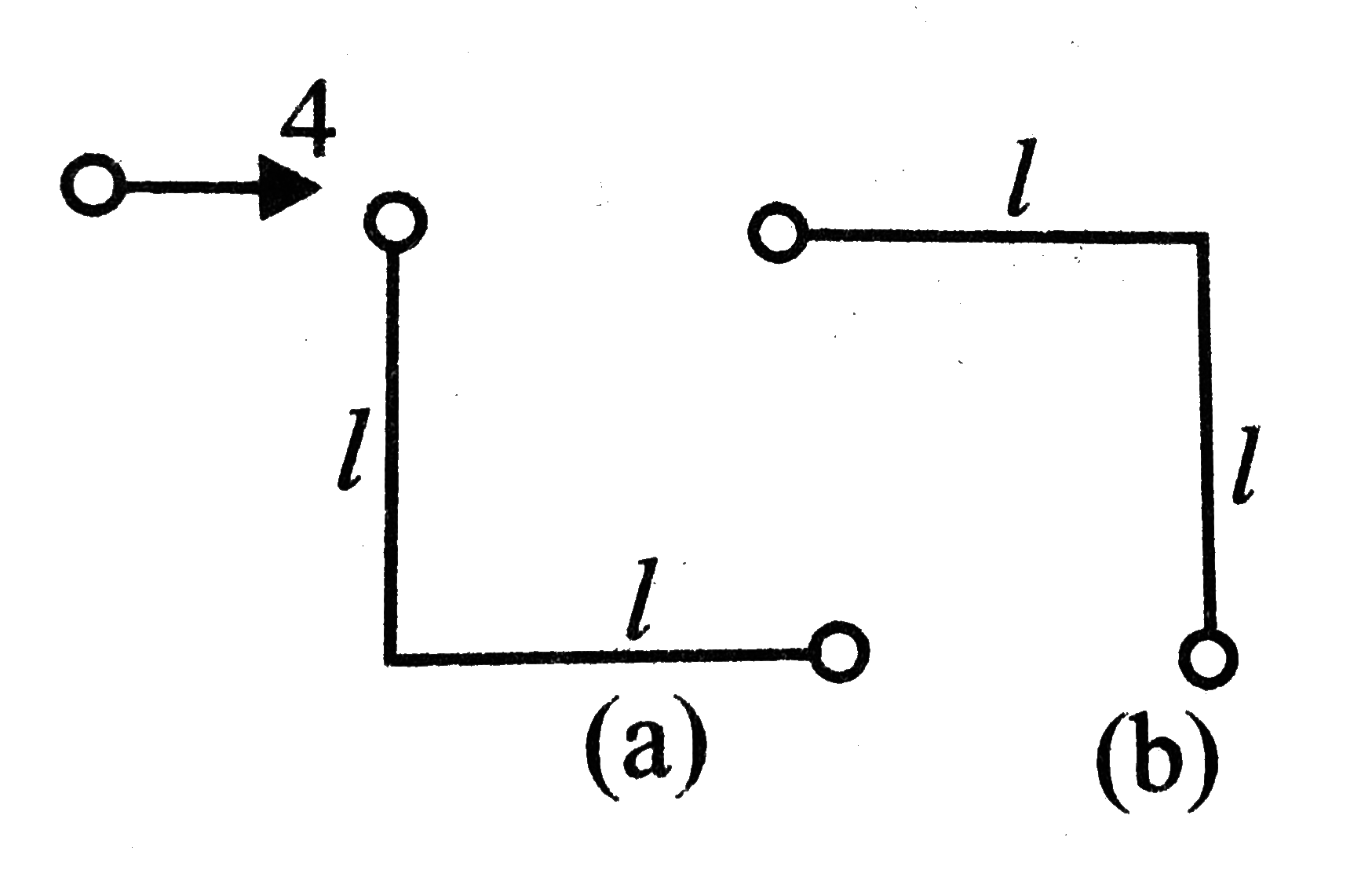
A spherical ball of mass `M` moving with initial velocity `u` collides elastically with another ball of mass `M`, which is fixed at one end of `L` shaped rigid massless frame as shown in Fig. (a). The `L` shaped frame contains another mass `M` connected at the other end.

The speed of the striking mass after collision is

A

`u//7` backwards

B

`u//3` is same direction

C

`0`

D

`u//2` backwards

Text Solution

Verified by Experts

Let `v_(1)` be the velocity of striking mass after collision & `v_(2)` be the velocity of centre of mass of frame after collision by momentum conservation
`mv=mv_(1)+2mv_(2)`……(`1`)
By angular momentum conservation
`mv(L)/(2)=mv_(1)(L)/(2)+mL^(2)omega`.....(`2`)
`c=1rArrv=(v_(2)+(L)/(2)omega)-v_(1)`.....(`3`)
from (`1`). (`2`) and (`3`)
`omega=(4v)/(7L)`, `v_(1)=-(v)/(7)` & `v_(2)=(4v)/(7)`
Promotional Banner

Similar Questions

Explore conceptually related problems

A body of mass m/2 moving with velocity v_0 collides elastically with another mass of m/3 . Find % change in KE of first body

A ball of mass m moving with velocity v collides head on elastically with another identical ball moving with velocity - V. After collision

A particle of mass m moving with speed V collides elastically with another particle of mass 2m. Find speed of smaller mass after head on collision

A ball of mass M moving with speed v collides perfectly inelastically with another ball of mass m at rest. The magnitude of impulse imparted to the first ball is

A ball of mass M moving with speed v collides perfectly inelastically with another ball of mass m at rest. The magnitude of impulse imparted to the first ball is

A ball of mass M moving with speed v collides perfectly inelastically with another ball of mass m at rest. The magnitude of impulse imparted to the first ball is

A ball of mass 1kg moving with 4m^-1 along +x-axis collides elastically with an another ball of mass 2kg moving with 6m//s is opposite direction. Find their velocities after collision.

A particle of mass m moving with speed u collides perfectly inelastically with another particle of mass 3 m at rest. Loss of KE of system in the collision is

A body of mass m moving with velocity v collides head on with another body of mass 2 m which is initially at rest. The ratio of K.E. of colliding body before and after collision will be

A heavy ball of mass 2M moving with a velocity v_(0) collides elastically head on with a cradle of three identical ball each of mass M as shown in figure. Determine the velocity of each ball after collision.

