Home
Class 12
PHYSICS
When we raise the temperature of a body,...

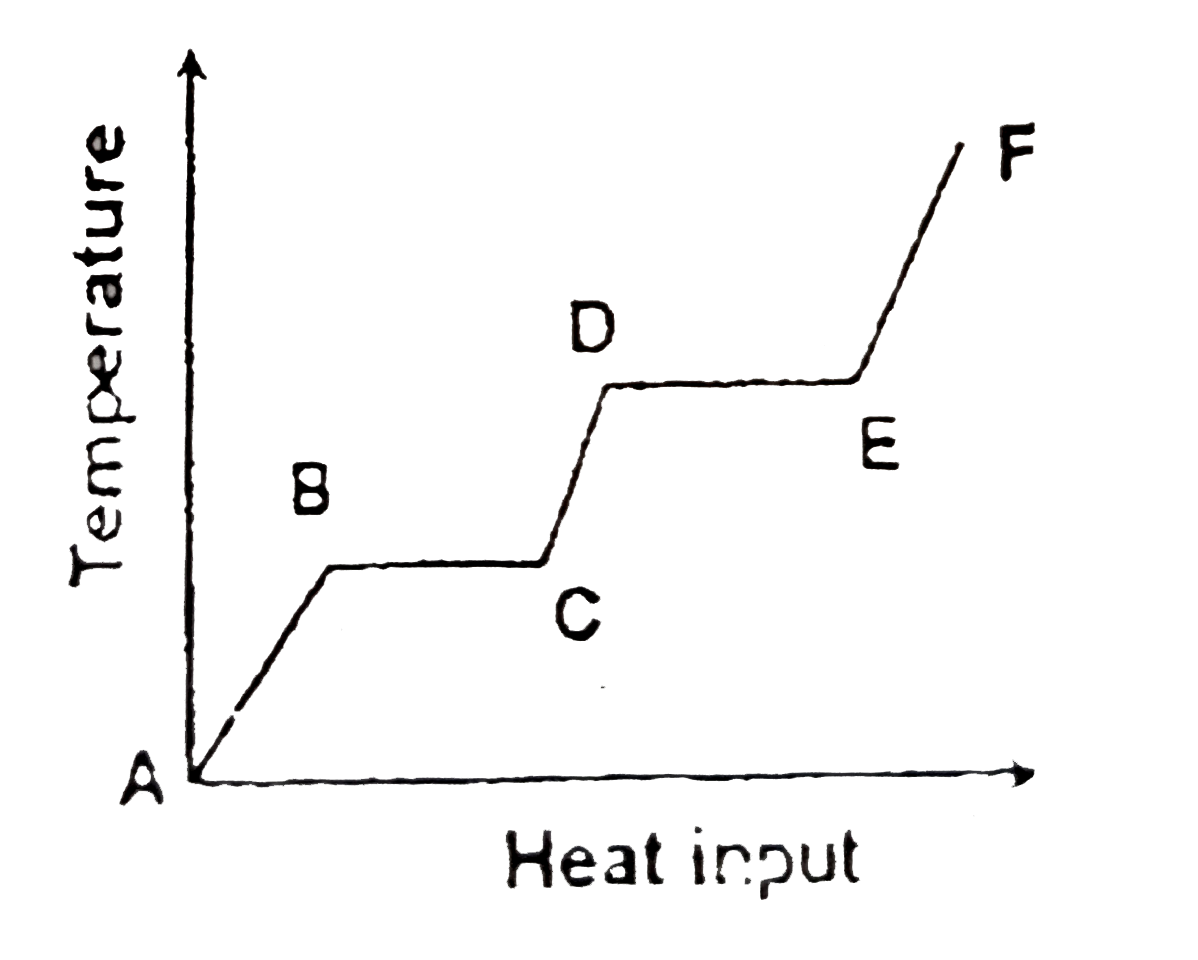
When we raise the temperature of a body, the molecules and atoms move with greater kinetic enery. Assume that "the temperature" is the manifestation of only the kinetic energy is atomic and subatomic levels and no mass change (excess//defect) occurs due to heating. Now a solid material is supplied with heat at a constant rate. The temperature of the material is changing with the heat input as shown in the graph. `BC` and `DE` are parallel to the Heat-input axis
In which of the following phase the assumption made in the above comprehension is most precise ?

A

solid

B

liquid

C

gas

D

not predictable

Text Solution

Verified by Experts

In gases, there is no appreciable molecular interaction.
Promotional Banner

Similar Questions

Explore conceptually related problems

When we raise the temperature of a body, the molecules and atoms move with greater kinetic enery. Assume that "the temperature" is the manifestation of only the kinetic energy is atomic and subatomic levels and no mass change (excess//defect) occurs due to heating. Now a solid material is supplied with heat at a constant rate. The temperature of the material is changing with the heat input as shown in the graph. BC and DE are parallel to the Heat-input axis In BC and DE

When we raise the temperature of a body, the molecules and atoms move with greater kinetic enery. Assume that "the temperature" is the manifestation of only the kinetic energy is atomic and subatomic levels and no mass change (excess//defect) occurs due to heating. Now a solid material is supplied with heat at a constant rate. The temperature of the material is changing with the heat input as shown in the graph. BC and DE are parallel to the Heat-input axis In AB , CD and EF , the energy of the system increases. Here "energy" refers to

A solid material is supplied heat at a constant rate. The temperature of material is changing with heat input as shown in the figure. What does the slope of DE represent ?

Can we define specific heat capacity at constant temperature?

When a ferromagnetic material is heated above its Curie temperature , the material

The heat required to raise the temperature of a body by 1^(@)C is called

If heat a supplied to a solid, its temperature

The variation of temperature of a material as heat is given to it at a constant rate is shown in the figure. The material is in solid state at the point O. The state of the material at the point P is…..

The variation of temperature of a material as heat is given to it at a constant rate is shown in the figure. The material is in solid state at the point O. The state of the material at the point P is…..

The process due to which a solid changes into liquid state at some fixed temperature by absorption of heat energy is known as

