Home
Class 12
PHYSICS
The plates each of area A of a parallel ...

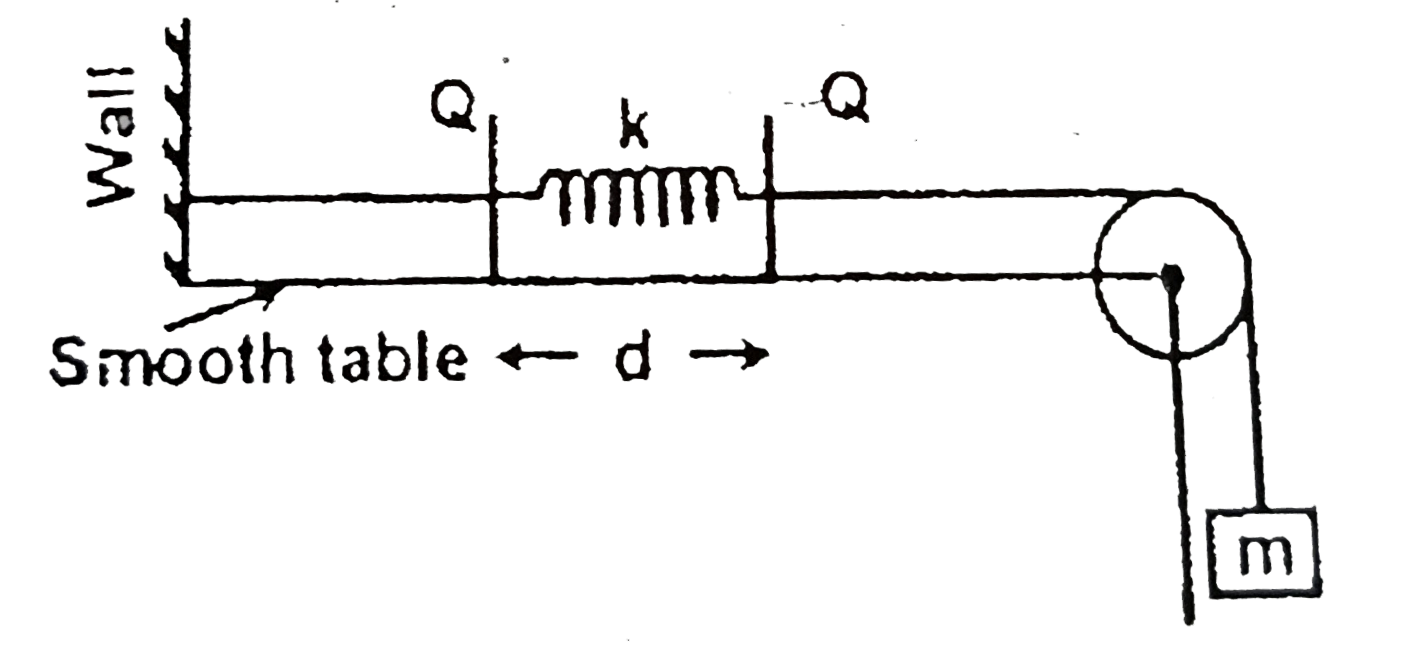
The plates each of area `A` of a parallel plate caoacitor are given charges `Q` and `-Q`. The plates are joined by a non-conducting spring of force constant `k`. The natural length of the spring is `d`, the inital separation between the plates. The left plate is connected to a vertical wall through a massless non-conducting rope and the right plate is connected to a block of mass `m` through similar rope. Assume the pulley to be massless, neglect dielectric effect of the spring and `Q^(2) lt 2mAepsilon_(0)g`
If `T` be the time period of oscillation, then

A

`T gt 2pisqrt((m)/(k))`

B

`T lt 2pisqrt((m)/(k))`

C

`T = 2pisqrt((m)/(k))`

D

`T` will depend on `Q`.

Text Solution

Verified by Experts

`mg` is balanced by the electrostatic force.
Promotional Banner

Similar Questions

Explore conceptually related problems

The plates each of area A of a parallel plate caoacitor are given charges Q and -Q . The plates are joined by a non-conducting spring of force constant k . The natural length of the spring is d , the inital separation between the plates. The left plate is connected to a vertical wall through a massless non-conducting rope and the right plate is connected to a block of mass m through similar rope. Assume the pulley to be massless, neglect dielectric effect of the spring and Q^(2) lt 2mAepsilon_(0)g . If the block is released from rest, the maximum elongation of the string is

The plates each of area A of a parallel plate caoacitor are given charges Q and -Q . The plates are joined by a non-conducting spring of force constant k . The natural length of the spring is d , the inital separation between the plates. The left plate is connected to a vertical wall through a massless non-conducting rope and the right plate is connected to a block of mass m through similar rope. Assume the pulley to be massless, neglect dielectric effect of the spring and Q^(2) lt 2mAepsilon_(0)g If Q^(2)=2mAepsilon_(0)g , the elongation of the string is

The plates of a parallel plate capacitance 1.0 F are separated by a distance d =1 cm. Find the plate area .

Each plate of a parallel plate capacitor has a charge q on it. The capacitor is now connected to a battery. Now,

Find out the capacitance of parallel plate capacitor of plate area A and plate separation d.

Two charged capacitors have their outer plates fixed and inner plates connected by a spring of force constant 'K'. The charge on each capacitor is q. find the extension in the spring at equilibrium

The separation between the plates of a charged parallel-plate capacitor is increased. The force between the plates

The electrostatic force between the metal plate of an isolated parallel plate capacitor C having charge Q and area A , is

Two large conducting plates of a parallel plate capacitor are given charges Q and 3Q respectively. If the electric field in the region between the plates is E_0 , then the force of interaction between the plates is

A parallel plate capacitor has capacitance C. If the charges of the plates are Q and -3Q , find of the i. charges at the inner surfaces of the plates ii. Potential difference between the plates iii. charge flown if the plates are connected iv. energy lost by the capacitor in (iii.) v. charge flown if any plate is earthed.

