Home
Class 12
PHYSICS
There are infinite equipotential lines a...

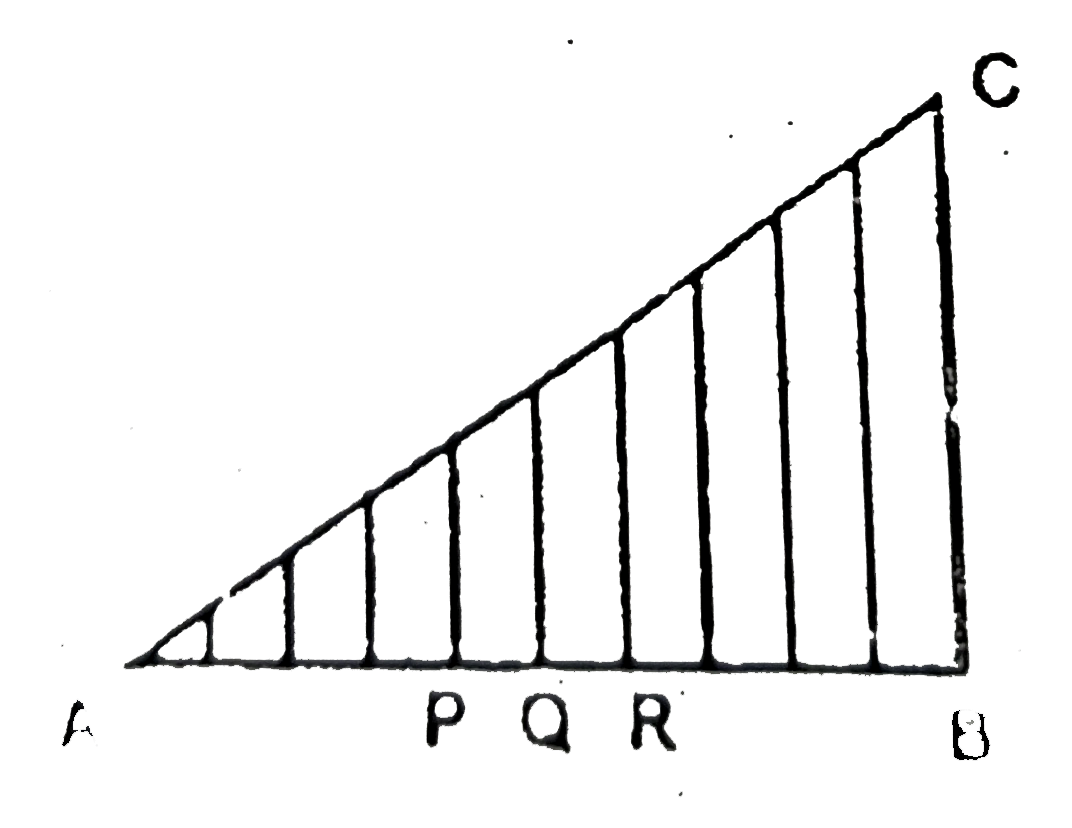
There are infinite equipotential lines all parallel to `BC` in a right angled triangular region `ABC` as shown in the figure. All the points on a line have the same potential proportional to the length of the line.
A positive charge is moved from `A` to `B` and `C` separately to do work. `W_(AtoB)` & `W_(AtoC)`, respectively, then

A

`W_(AtoB)` > `W_(AtoC)`

B

`W_(AtoB)` = `W_(AtoC)`

C

`W_(AtoB)` < `W_(AtoC)`

D

not predictable

Text Solution

Verified by Experts

Electric field is parallel to `-bar(AB)`.
Promotional Banner

Similar Questions

Explore conceptually related problems

There are infinite equipotential lines all parallel to BC in a right angled triangular region ABC as shown in the figure. All the points on a line have the same potential proportional to the length of the line. If E_(P) , E_(Q) & E_(R ) denote the electric field at P , Q and R , respectively, then

Figure shows some equipotential lines distributed in space. A charged object is moved from point A to point B .

An infinitely long line of linear charge density lambda is shown in the figure. The potential difference V_(A)-V_(B) between the two points A and B is

Between two infinitely long wires having linear charge densities lambda and - lambda , there are two points A and B as shown in the figure. The amount of work done by the electric field in moving a point charge q_(0) from A to B is equal to :

A long straight hollow metallic tube carrying a current l has three sections of different area of cross section as shown in figure. Three points A, B and C are on a line parallel to the axis of the tube. If magnetic field at this point are B_1 , B_2 , B_3 respectively, then

Two large parallel sheets charged uniformly with surfasce charge density sigma and -sigma are located as shown in the figure. Which one of the following graphs shows the variation of electric field along a line perpendicular to the sheets as one moves from A to B ?

An infinite line of charge lamda per unit length is placed along the y-axis. The work done in moving a charge q from A(a,0) to B (2a,0) is

A particle P is projected with speed 20 m//s at angle 37^(@) from horizontal as shown in figure, At the some instant Q starts from same point and moves with uniform acceleration towards right. Path of the particle P w.r.t. Q is straight line Acceleration of Q is : .

ABC is a right - angled triangle, where AB and BC are 25 cm and 60 cm , respectively. A metal sphere of 2 cm radius charged to a potential of 9 xx 10^5 V is placed at B as in (Fig. 3.133). Find the amount of work done in carrying a positive charge of 1 coulomb from C to A. .

The distance between the two parallel lines is 1 unit. A point A is chosen to lie between the lines at a distance 'd' from one of them Triangle ABC is equilateral with B on one line and C on the other parallel line. The length of the side of the equilateral triangle is

