Home
Class 12
PHYSICS
In the region between the plane z=0 and ...

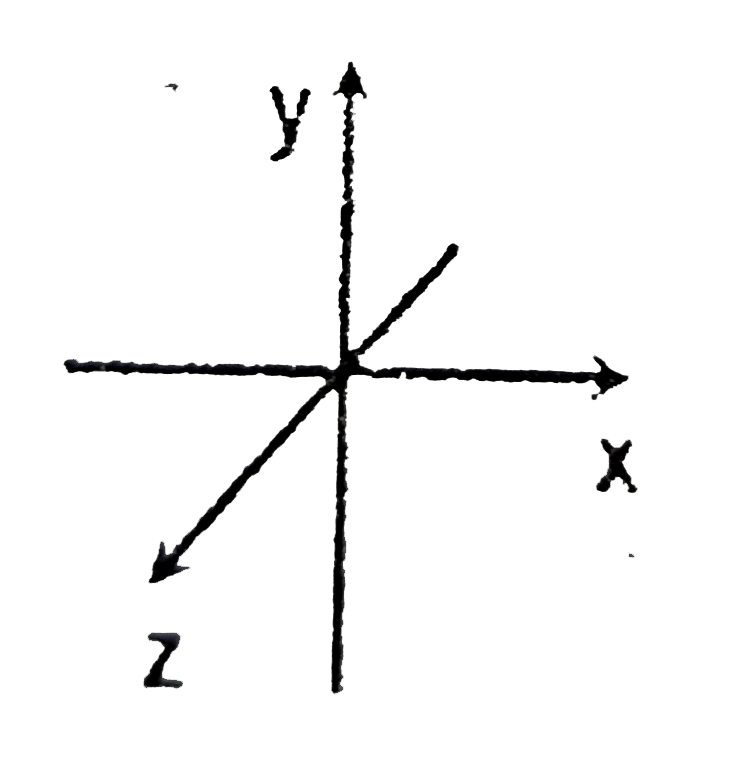
In the region between the plane `z=0` and `z=a (a gt 0)`, the uniform electric and magnetic fields are given by `vecE=E_(0)(hatk-hatj)`, `vecB=B_(0)hati`. The region defined by `a le z le b` contains only magnetic field `vecB= -B_(0)hati`. Beyond `z gt b` no field exits. A positive point charge `q` is projected from the origin with velocity `v_(0)hatk`. Assuming the mass of the particle to be `(2)/(3)(qE_(0)a)/(v_(0)^(2))`.
The minimum value of `b` such that the particle reverses its direction completely is

A

`(4E_(0)a)/(3v_(0)B_(0))`

B

`a(1+(4E_(0))/(3v_(0)B_(0)))`

C

`(2E_(0)a)/(3v_(0)B_(0))`

D

`a(1+(2E_(0))/(3v_(0)B_(0)))`

Text Solution

Verified by Experts

`(b-a)` is the radius of the circle
Promotional Banner

Similar Questions

Explore conceptually related problems

In the region between the plane z=0 and z=a (a gt 0) , the uniform electric and magnetic fields are given by vecE=E_(0)(hatk-hatj) , vecB=B_(0)hati . The region defined by a le z le b contains only magnetic field vecB= -B_(0)hati . Beyond z gt b no field exits. A positive point charge q is projected from the origin with velocity v_(0)hatk . Assuming the mass of the particle to be (2)/(3)(qE_(0)a)/(v_(0)^(2)) . The value of E_(0) such that the particle moves undeviated upto the plane z=a is

Electric field and magnetic field n a region of space is given by E=E_0hatj and B=B_0hatj . A particle of specific charge alpha is released from origin with velocity v=v_0hati . Then path of particle

A charged particle (q.m) released from origin with velocity v=v_(0)hati in a uniform magnetic field B=(B_(0))/(2)hati+(sqrt3B_(0))/(2)hatJ . Maximum z-coordinate of the particle is

A charged particle (q.m) released from origin with velocity v=v_(0)hati in a uniform magnetic field B=(B_(0))/(2)hati+(sqrt3B_(0))/(2)hatJ . Pitch of the helical path described by the particle is

A particle of specific charge alpha is projected from origin with velocity v=v_0hati-v_0hatk in a uniform magnetic field B=-B_0hatk . Find time dependence of velocity and position of the particle.

A particle of charge per unit mass alpha is released from origin with a velocity vecv=v_(0)hati uniform magnetic field vecB=-B_(0)hatk . If the particle passes through (0,y,0) , then y is equal to

A particle of mass m and having a positive charge q is projected from origin with speed v_(0) along the positive X-axis in a magnetic field B = -B_(0)hatK , where B_(0) is a positive constant. If the particle passes through (0,y,0), then y is equal to

A charge particle is moving along positive y-axis in uniform electric and magnetic fields E=E_0hatk and B=B_0hati Here E_0 and B_0 are positive constants.choose the correct options.

Electric field and magnetic field in a region of space are given by (Ē= E_0 hat j) . and (barB = B_0 hat j) . A charge particle is released at origin with velocity (bar v = v_0 hat k) then path of particle is

In region x gt 0 a uniform and constant magnetic field vec(B)_(1) = 2 B_(0) hat(k) exists. Another uniform and constant magnetic field vec(B)_(2) = B_(0) hat(k) exists in region x lt 0 A positively charged particle of mass m and charge q is crossing origin at time t =0 with a velocity bar(u) = u_(0) hat(i) . The particle comes back to its initial position after a time : ( B_(0),u_(0) are positive constants)

