Home
Class 12
PHYSICS
One end of the pile of chain falls verti...

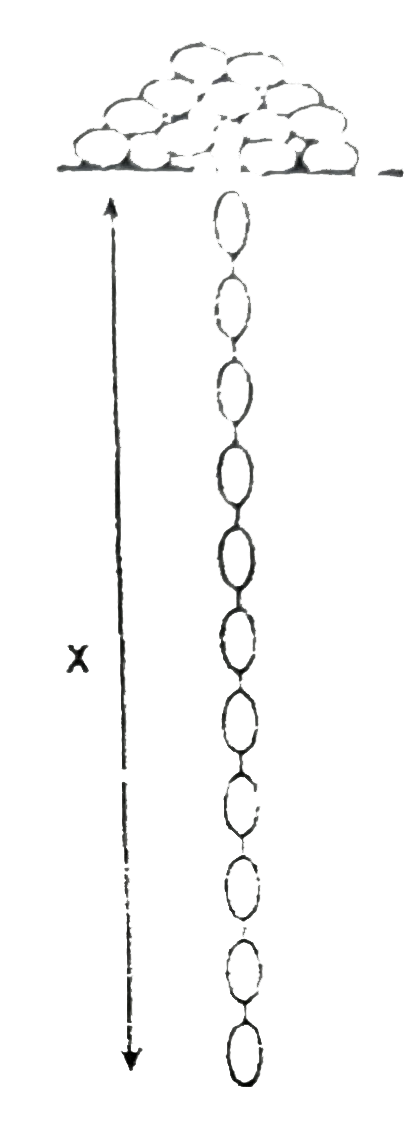
One end of the pile of chain falls vertically through a hole in its support and pull the remaining links steadily. The links which are at rest acquire the velocity of the hanging position suddenly and without loving interaction with the remaining stationery links and with the support. If the acceleration a of the falling chain is `g//k`. Find `k`. Ignore any friction.

Text Solution

Verified by Experts

Let the velocity of the end of the falling chain be `v_(0)` when a length `x` has already fallen. Taking mass per unit length of the chain as `lambda`, we can write,
`lambdaxg-((lambdavdt)v)/(dt)=lambdax*v(dv)/(dx)`
`gx-v^(2)=x(vdx)/(dx)`
or `v (dv)/(dx)+(v^(2))/(x)=g`
This equation may be solved by using Intergrating factor. The solution is
`v^(2)=(2gx)/(3)+(C )/(x^(2))`. where `C` is an arbitary constant.
At `t=0`, `x=0` and `v=0`
`:. C=0` and `v^(2)=(2gx)/(3)`
Promotional Banner

Similar Questions

Explore conceptually related problems

A uniform solid cylinder of mass m rests on two horizontal planks. A thread is wound on the cylinder. The hanging end of the thread is pulled vertically down with a constant force F . Find the maximum magnitude of the force F which may be applied without bringing about any sliding of the cylinder, if the coefficient of friction between the plank and the cylinder is equal to mu . What is the maximum acceleration of the centre of mass over the planks?

A very flexible uniform chain of mass M and length L is suspended vertically so that its lower and just touches the surface of a table. When the upper end of the chain is released it falls with each link coming to rest the instant it strikes the table. Find the force exerted by the chain on the table at the moment when y part of the chain has already rested on the table.

A student tries to raise a chain consisting of three identical links. Each link has a mass of 300g. The three-piece chain is connected to a string and then suspended vertically, with the student holding the upper end of the string and pulling upward. Because of the student's pull, an upward force of 12 N is applied to the chain by the string. (a) Draw a free-body diagram for each of the links in the chain and also for the entire-chain considered a single body. (b) Use the results of part(a) Newton's laws to find (i) the acceleration of the chain and (ii) the force exerted by the top link on the middle link.

The flexible bicycle type chain of length (pir)/2 and mass per unit length rho is released from rest with theta =0^@ In the smooth circular channel and falls through the hole in the supporting surface, Determine the velocity v of the chain as the last link leaves the slot. .

One end a light spring of natural length d and spring constant k ( = mg //d) is fixed on a rigid support and the other end is fixed to a smoth ring of mass m which can slide without friction on a vertical rod fixed at a distance d from the support. Initially , the spring makes an angle of 37^(@) with the horizontal as shown in the figure. The system is released from rest. The speed of the ring at the same angle subtended downward will be

A light rod length L , is hanging from the vertical smooth wall of a vehicle moving with acceleration sqrt(3)g having a small mass attached at its one end is free to rotate about an axis passing through the other end. The minimum velocity given to the mass at its equilibrium position with respect to vehicle so that it can complete vertical circular motion respect to vehical) is sqrt(KgL) . Find the value of K .

A string is wrapped several times on a cylinder of mass M and radius R . the cylinder is pivoted about its adxis of block symmetry. A block of mass m tied to the string rest on a support positioned so that the string has no slack. The block is carefully lifted vertically a distance h , and the support is removed as shown figure. a. just before the string becomes taut evalute the angular velocity omega_(0) of the cylinder ,the speed v_(0) of the falling body, m and the kinetic energy K_(0) of the system. b. Evaluate the corresponding quanitities omega_(1), v_(1) and K_(1) for the instant just after the string becomes taut. c. Why is K_(1) less than K_(0) ? Where does the energy go? d. If M=m , what fraction of the kinetic energy is lost when the string becomes taut?

In the figure (i) a disc of mass M(kg) and radius R(m) is rotating smoothly about a fixed vertical axis AB with angular speed 26 rad//s A rod rod CD of length (R)/(2)(m) and mass M(kg) is hinged at one end at point 'D' on the disc. The rod remains in vertical position and rotates along with the disc about axis AB . At some moment the rod CD gets a very smal impulse at point 'C' due to air due to which the rod falls on the disc along one radius and sticks to the disc as shown in figure (ii) . Now find the angular velocity of the disc in rad//s .
