Home
Class 12
PHYSICS
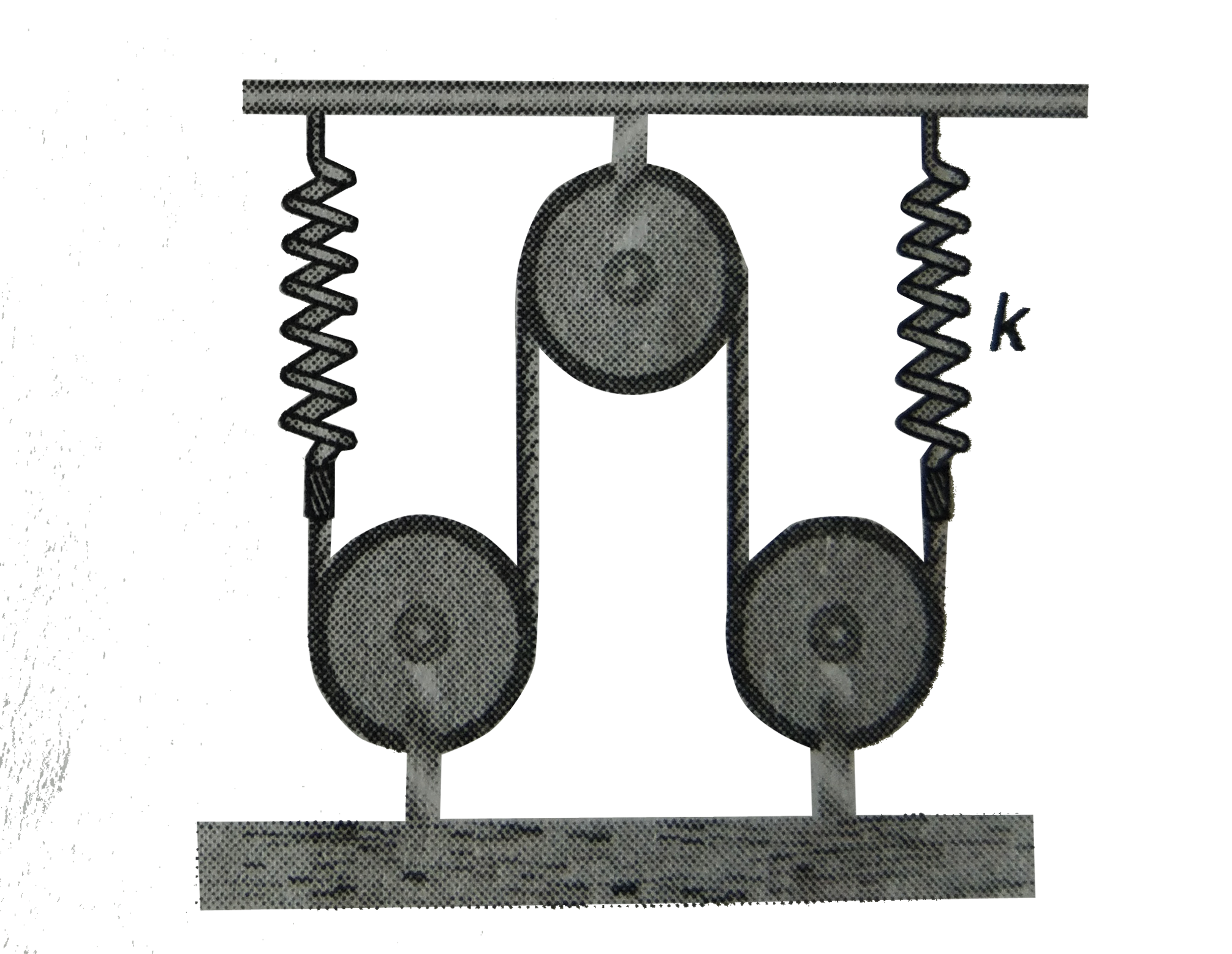
Find the natural frequency of the system...

Find the natural frequency of the system shown in figure. The pulleys are smooth and massless.

Text Solution

Verified by Experts

Let `x` be the downward displacement of the block from the equilibrium position.
Using constant relation, the deformation in the springs will be `x'=2x`
The energy of the system is
`E=2((1)/(2)kx'^(2))+(1)/(2)mv^(2)`or `E=k(2x)^(2)+(1)/(2)mv^(2)=4kx^(2)+(1)/(2)mv^(2)`
differentiating w.r.t. time, we get
`(dE)/(dt)=8kx(dx)/(dt)+mv(dv)/(dt)=0`
or `(d^(2)x)/(dt^(2))+(8k)/(m)x=0`
`:. omega=sqrt((8k)/(m))` or `f=(1)/(pi)sqrt((2k)/(m))`
Promotional Banner

Similar Questions

Explore conceptually related problems

Find the natural frequency of oscillation of the system as shown in figure. Pulleys are massless and frictionless. Spring and string are also massless. (Take pi^(2)=10 )

The natural frequency of the circuit shown in the figure is

Find the capacitance of the system shown in figure.

Find the electric dipole moment of the system shown in figure.

Find the tension T_(2) in the system shown in the figure.

Find the period of oscillation of the system shown in figure.

Find the focal length of equivalent system shown in Figure.

Calculate the angular frequency of the system shown in fingure. Friction is absent everywhere and the threads, spring and pulleys are massless. Given that m_(A) = m_(B) = m .

In the arrangement shown in fig., all pulleys are smooth and massless. When the system is released from the rest, acceleration of block 2 and 3 relative to 1 are 1 ms^(-2) downwards and 5ms^(-2) downwards, respectively. Acceleration of block 3 relative to 4 is zero. Find the absoulte acceleration of block 4.

In the arrangement shown in fig., all pulleys are smooth and massless. When the system is released from the rest, acceleration of block 2 and 3 relative to 1 are 1 ms^(-2) downwards and 5ms^(-2) downwards, respectively. Acceleration of block 3 relative to 4 is zero. Find the absolute acceleration of block 1.
