Home
Class 12
PHYSICS
A photon with energy of 4.9 eV ejects ph...

A photon with energy of `4.9 eV` ejects photoelectrons from tungsten.When the ejected electron enters a constant magnetic field of strength `B=2.5 mT` at an angle of `60^@` with the field direction, the maximum pitch of the helix described by the electron is found to be `2.7 mm`. Find the work function of the metal in electron volt. Given that specific charge of electron is `1.76xx10^11 C/(kg)`.

Text Solution

Verified by Experts
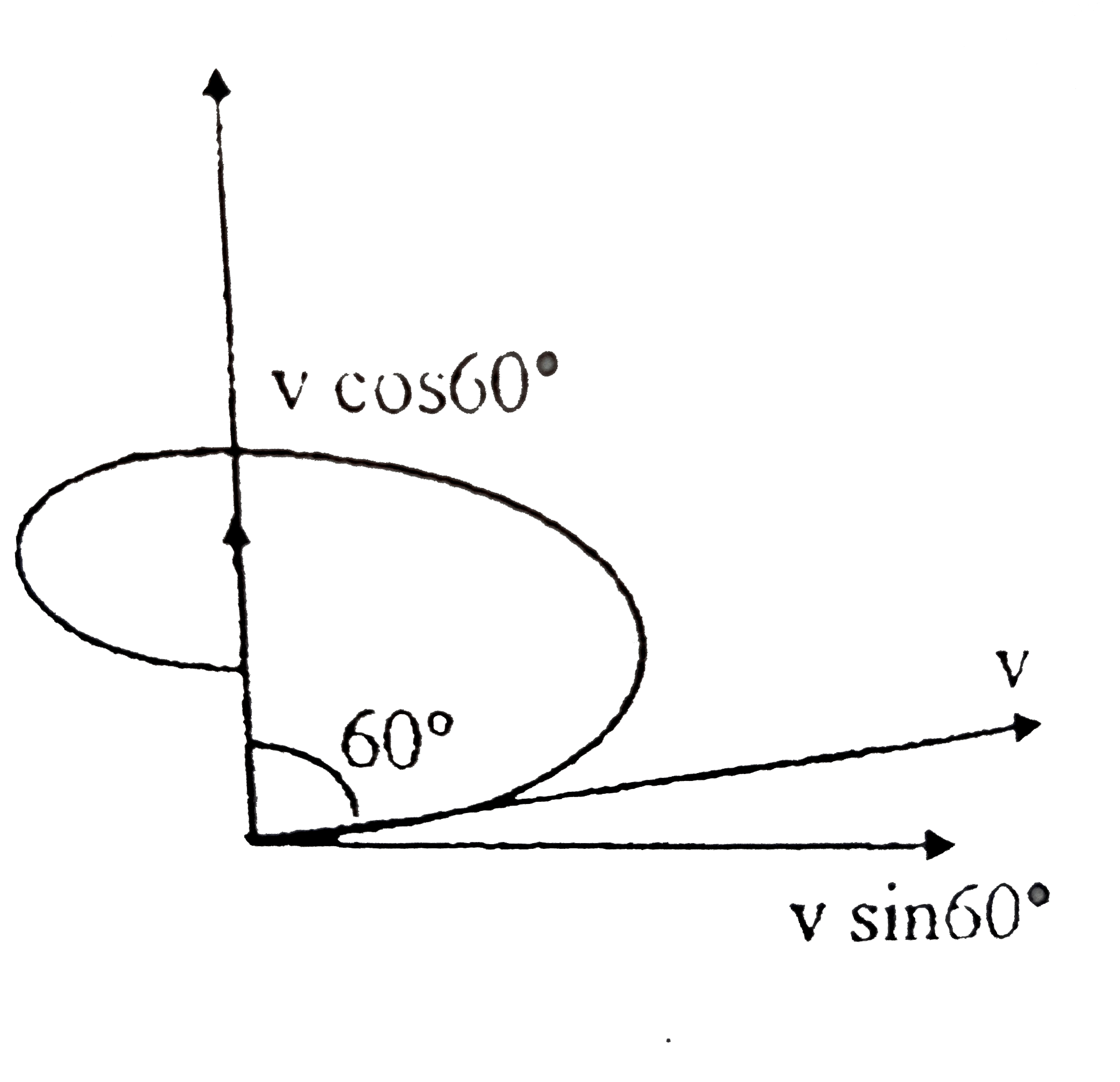
Pitch of the helix is given by
`y=(vcostheta).T=v(cos60)T=vT//2`
Where time period of circular motion
`T=(2pim)/(eB)`
Pitch `y=((v2pim)/(Be))vcos60^(@)=(pimv//Be)`
`:. KE=(1)/(2)mv^(2)=(1)/(2)m((Bey)/(pim))^(2)`
Using Einstein 's equation
`(1)/(2)mv^(2)=hv-phi`
`phi=hv-(1)/(2)m((Bey)/(pim))^(2)=[4.9-(1)/(2)((m)/(e))((Bey)/(pim))^(2)]`electron-volts
`=[4.9-(1)/(2)(B^(2)y^(2))/(4pi^(2))((e)/(m))]"electron-volt"=(4.9-0.4)eV=4.5eV`
Promotional Banner

Similar Questions

Explore conceptually related problems

A photon with energy of 4.9 eV ejects photoelectrons from tungsten. When the ejcect phototelectrons from tungsten. When the ejected electron enters a cnstant magnetic field of strangth B=2.5 mT at an angle of 60^@ with the field direction, the maximum pitch fo the helix described by the electron is found to be 2.7 mm. Find the work function of the metal in electron volt. Given that specific charge of electron is 1.76xx10^11 C/kg.

A photon of energy E ejects a photoelectron from a metel surface whose work function is phi_(0) . If this electron enters into a unifrom magnetic field of induction B in a direction perpendicular to the field and describes a circular path of radius r, then the radius r, is given by, (in the usual notation)

Light quanta with energy 4.9 eV eject photoelectrons from metal with work function 4.5 eV. Find the maximum impulse transmitted to the surface of the metal when each electron flies out.

Light having photon energy hupsilon is incident on a metallic plate having work function phi to eject the electrons. The most energetic enectrons are then allowed to enter in a region of uniform magnetic field B as shown in Fig. The electrons are projected In X-Z plane making an angle theta with X-axis and magnetic field is vecB=B_0hati along X-axis maximum pitch of the helix described by an electron is found to be p. Take mass of electron as m and charge as q. Based on the above information, answer the following questions: Q. The plot between X-coordinate of the location of electron as a function of time for different frequencies upsilon of the incident light is

Light having photon energy hupsilon is incident on a metallic plate having work function phi to eject the electrons. The most energetic enectrons are then allowed to enter in a region of uniform magnetic field B as shown in Fig. The electrons are projected In X-Z plane making an angle theta with X-axis and magnetic field is vecB=B_0hati along X-axis maximum pitch of the helix described by an electron is found to be p. Take mass of electron as m and charge as q. Based on the above information, answer the following questions: Q. Considering the instant of crossing origin at t=0 ,the Z-coordinate of the location of electron as a function of time is

Light having photon energy hupsilon is incident on a metallic plate having work function phi to eject the electrons. The most energetic enectrons are then allowed to enter in a region of uniform magnetic field B as shown in Fig. The electrons are projected In X-Z plane making an angle theta with X-axis and magnetic field is vecB=B_0hati along X-axis maximum pitch of the helix described by an electron is found to be p. Take mass of electron as m and charge as q. Based on the above information, answer the following questions: Q. The correct relation between p and B_0 is

A photon of wavelength 4 xx 10^(-7)m strikes on metal surface, The work function of the metal is 2.13eV . The velocity of the photo electron is

Radiation, with wavelenght 6561 Å falls on a metal surface to produce photoelectrons. The electrons are made to enter a uniform magnetic field of 3 xx 10^(-4) T. If the radius of the largest circular path followed by the electrons is 10 mm, the work function of the metal is close to:

Energy required to stop the ejection of electrons from certain metal plate was found to be 0.2 eV when an electromagnetic radiation of 330 nm was made to fall on it the work function of the metal is

The radiation corresponding to 3 rarr 2 transition of hydrogen atom falls on a metal surface to produce photoelectrons . These electrons are made to enter circuit a magnetic field 3 xx 10^(-4) T if the ratio of the largest circular path follow by these electron is 10.0 mm , the work function of the metal is close to

