Home
Class 11
PHYSICS
If block A is moving horizontally with v...

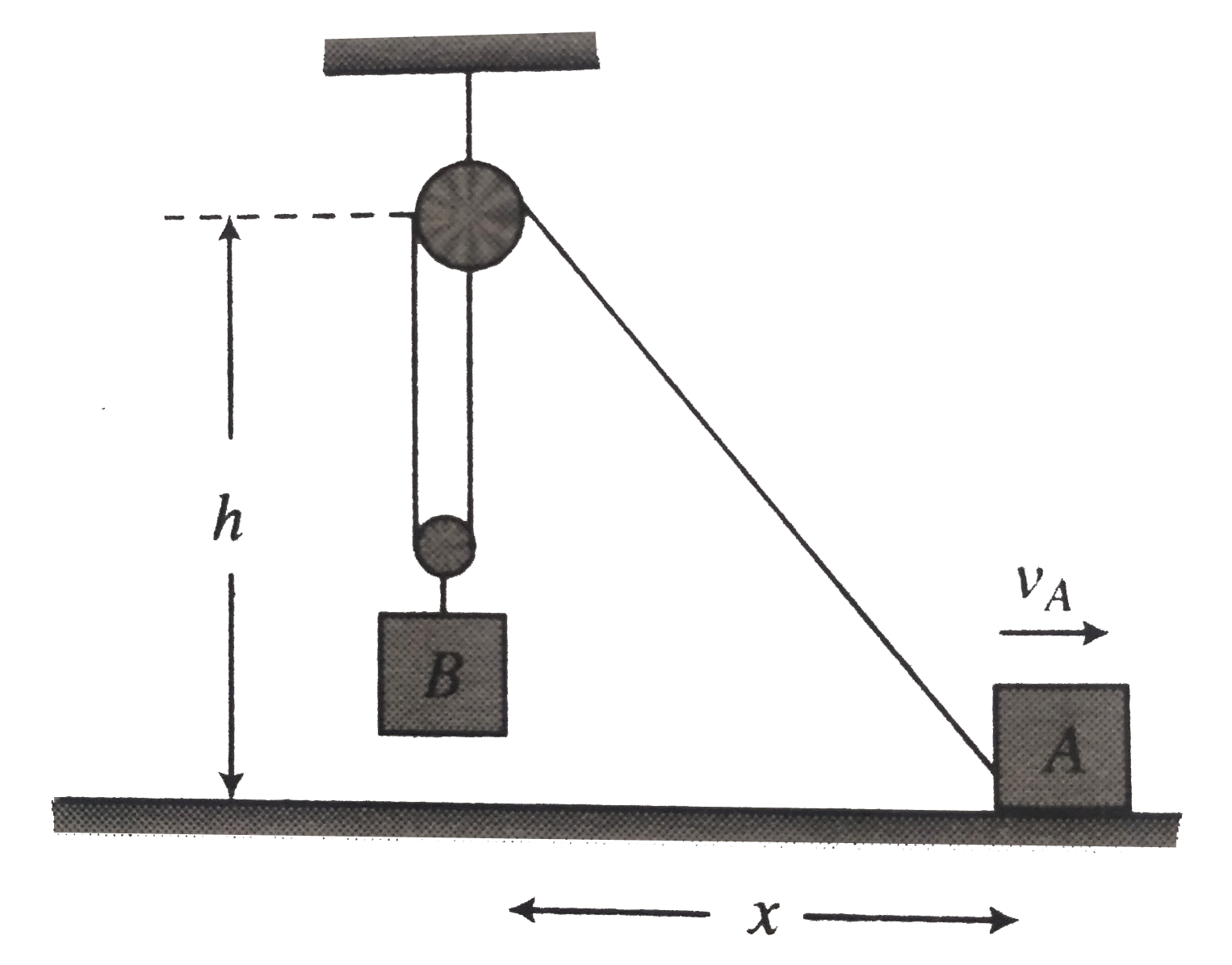
If block A is moving horizontally with velocity `v_(A)`, then find the velocity of block B at the instant as shown in fig.

Text Solution

Verified by Experts
(`a`) Position vectors of the block and the stone are
`vecr_(B)=(2t)hati+(40)hatj`
`vecr_(S)=v_(1)thati+v_(2)thatj+(20t-(1)/(2)"gt"^(2))hatk`
When the stone hits the block
`2t=v_(1) t` , `40 m=v_(2) t` , `20 t-(1)/(2)"gt"^(2)=0`
`v_(1)=2m//s` , `v_(2)=(40)/(t)m//s` , `t=4 s`
` rArr v_(2)=10m//s`.
(`b`) For the same speed of throw, the maximum range
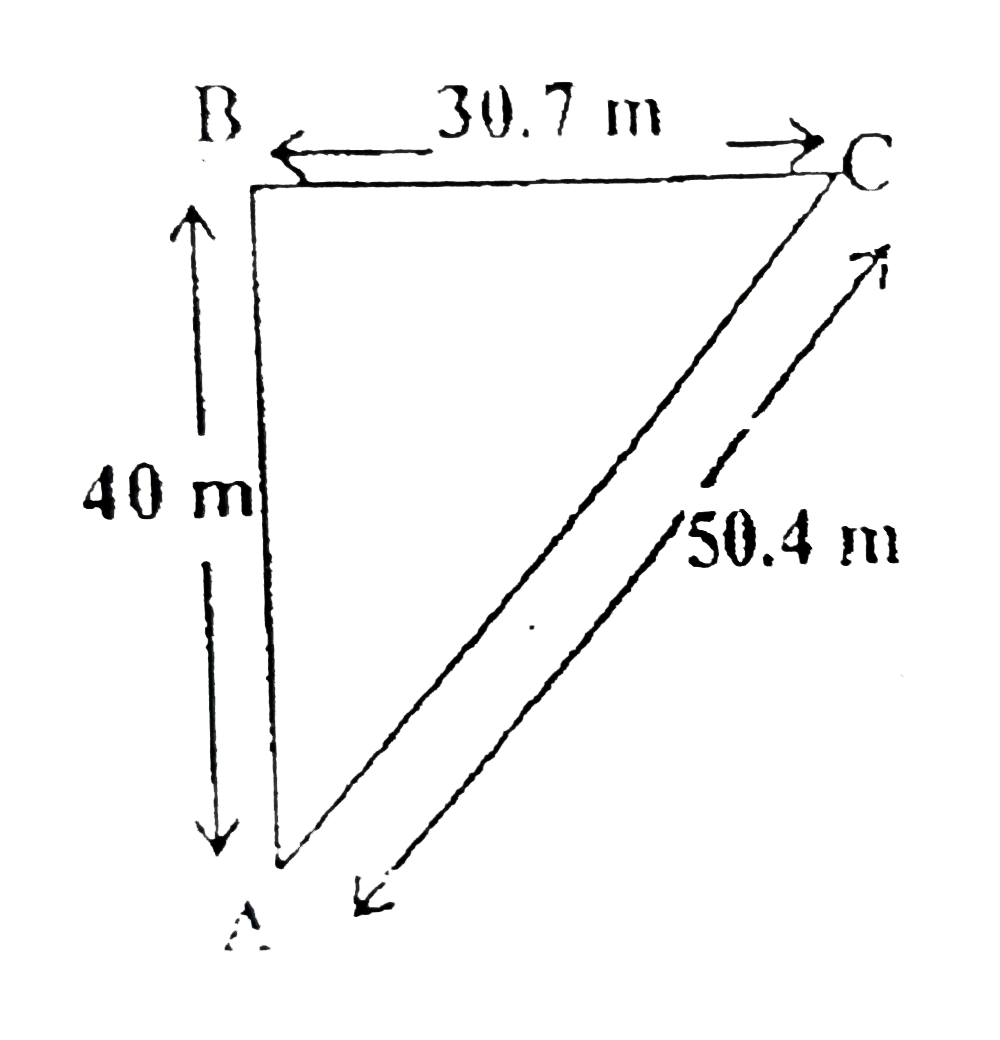
`R_(max)=(v^(2))/(g)=(v_(1)^(2)+v_(2)^(2)+20^(2))/(g)=(504)/(10)=50.4m`
` rArr BC=30.7m`.
Time taken by the stone to reach `C=(30.7)/(2)=15.35 s`
Time of fligh' of the stone `=(2(v//sqrt(2)))/(g)=(sqrt(2)sqrt(504))/(10)=3.17s`
Maximum value of `t=15.35-3.17=12.18 s`.
Promotional Banner

Topper's Solved these Questions

Similar Questions

Explore conceptually related problems

The velocity of the block B is:

The block A is moving downward with constant velocity v_(0.) Find the velocity of the block B. When the string makes an angle theta with the horizontal

A rod AB is shown in figure. End A of the rod is fixed on the ground. Block is moving with velocity 2 ms^-1 towards right. The velocity of end B of rod at the instant shown in figure is

An inextensible string AB is tied to a block B of negligible dimensions and passes over a small pulley C so that free end A hangs h unit above the ground on which the block B rests. In this initial position shown in fig. The free end A is h unit below C. if now end A moves horizontally with a velocity v_(0) , obtain an expression for the velocity of the block at any time t.

A disc of radius R is moving on a rough horizontal surface with velocity v and angular speed omega at an instant as shown in figure. Choose the correct statement.

Block B moves to the right with a constant velocity v_(0) . The velocity of body a relative to b is

Find the angular velocity of A with respect to O at the instant shown in (Fig. 5.165). .

The block shown is moving with constant velocity. Find mu_(k) between the block and the surface.

A block of mass m moving with velocity v_(0) on a smooth horizontal surface hits the spring of constant k as shown. The maximum compression in spring is

In the system shown, the block A is moving down eith velocity v_(1) and C is moving up with velocity v_(3) . Express velocity of the block B in terms of velocities of the blocks a and C.

FIITJEE-KINEMATICS-Example
  1. An aeroplane is flying horizontally at a height of 2/3 km with a veloc...

    Text Solution

    |

  2. A balloon moves up vertically such that if a stone is projected with a...

    Text Solution

    |

  3. A sailor in a boat, which is going due east with a speed of 8m//s obse...

    Text Solution

    |

  4. Two particles A and B are situated at point (60,0) at t=0. The particl...

    Text Solution

    |

  5. If block A is moving horizontally with velocity v(A), then find the ve...

    Text Solution

    |

  6. A driver applies the brakes on seeing traffic signal 400m ahead. At th...

    Text Solution

    |

  7. A particle is moving along the path given by y=(C )/(6)t^(6) (where C ...

    Text Solution

    |

  8. Which of the following statements can be possible cases in one//two di...

    Text Solution

    |

  9. A motor boat is to reach at a point 30^@ upstream on the outer side of...

    Text Solution

    |

  10. Choose the wrong statement from the following.

    Text Solution

    |

  11. The raindrops are hitting the back of a man walking at a speed of 5km/...

    Text Solution

    |

  12. A particle is thrown at time t = 0 with a velocity of 10 ms^(-1) at an...

    Text Solution

    |

  13. When a body is thrown up in a lift with a velocity u relative to the l...

    Text Solution

    |

  14. A particle of mass 3m is dropped from certain height at t=0 at time t=...

    Text Solution

    |

  15. A box is falling freely. Inside the box, a particle is projected with ...

    Text Solution

    |

  16. The trajectory of a projectile is given by y=x tantheta-(1)/(2)(gx^(2)...

    Text Solution

    |

  17. The trajectory of a projectile is given by y=x tantheta-(1)/(2)(gx^(2)...

    Text Solution

    |

  18. The trajectory of a projectile is given by y=x tantheta-(1)/(2)(gx^(2)...

    Text Solution

    |

