Home
Class 11
PHYSICS
Shown in the diagram is a system of two ...

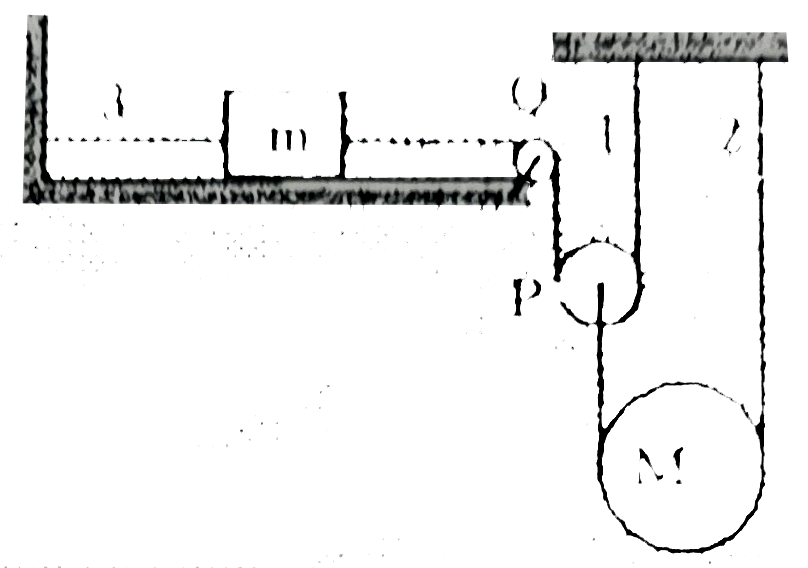
Shown in the diagram is a system of two bodies, a block of mas `m` and a disc of mass `M`, held in equilibrium. If the string `3` is burnt, find the acceleration of the disc. Neglect the masses of the pulleys `P` and `Q`. (The coefficient of friction between the block and horizontal surface is `mu`)

Text Solution

Verified by Experts
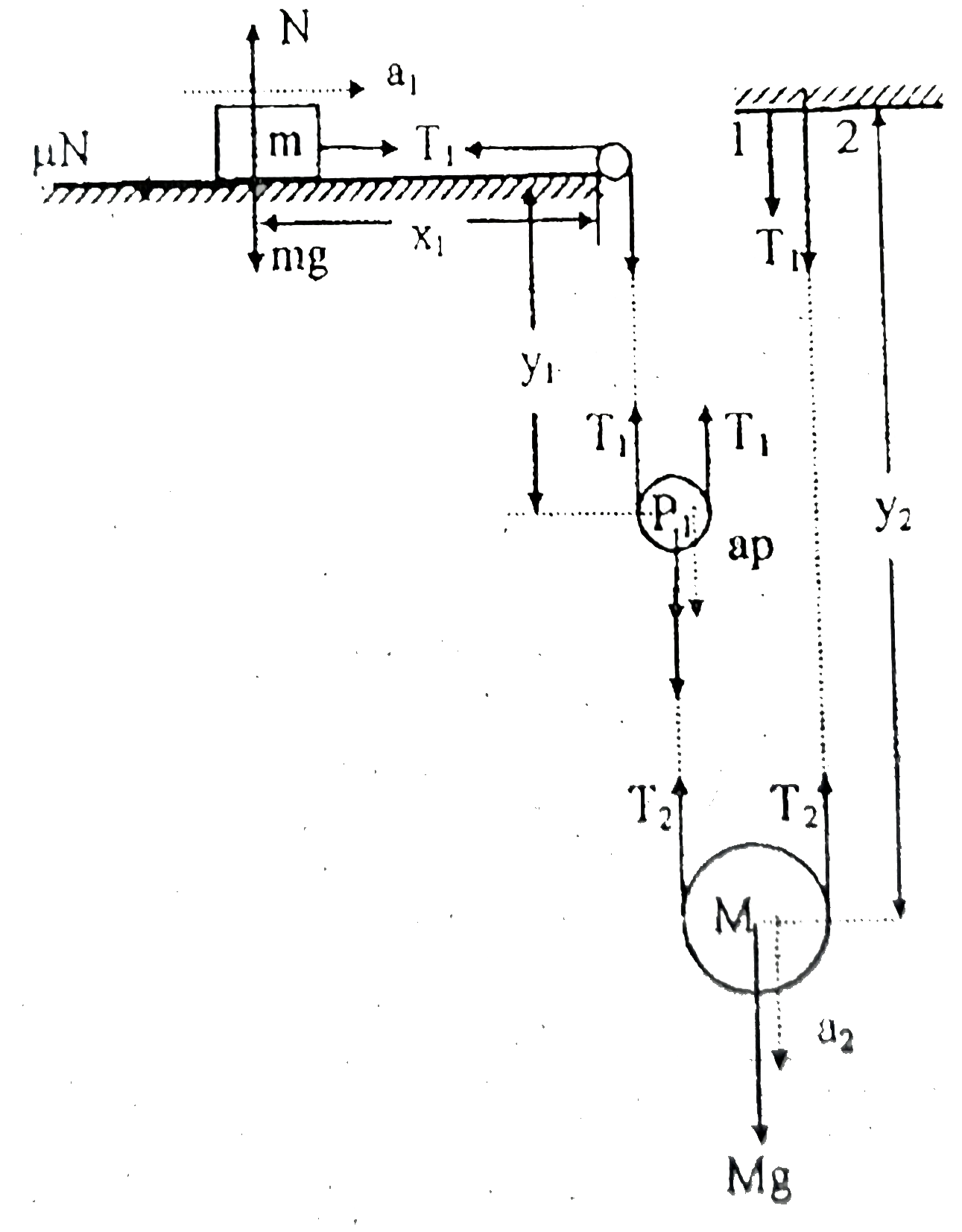
Referring to the free-body diagram we write the equation of motion.
For the block `m` :
`T_(1)-muN=ma_(1)`……(`1`)
and `N-mg=0`…(`2`)
For pulley `P` :
`m_(p)g+T_(2)-2T_(1)=m_(p)a_(p)`
Since the pulley is light,
`:. m_(p)~~0`
`rArr T_(2)=2T_(1)`.....(`3`)
For disc `M`.
`Mg-2T_(2)=Ma_(2)`......(`4`)
From the geometry of the figure the positions of the parts `m`, `P` and `M` are related as `x_(1)+2y_(1)=l_(1)` and `(y_(2)-y_(1))+y_(2)=l_(2)`, where `l_(1)` and `l_(2)` are the lengths of the strings `1` and `2`, respectively. Eliminating `y_(1)` from these two equations, we obtain,
`x_(1)+4y_(2)=l_(1)+2l_(2)` ,
Differntiating both sides twice w.r.t. time, we obtain `(d^(2)x_(1))/(dt^(2))+4(d^(1)y_(2))/(dt^(2))=0`
`rArra_(1)=4a_(2)`.....(`5`)
From Eqs. (`1`) and (`2`), we get
`T_(1)-mumg=ma_(1)`.......(`6`)
From Eqs. (`3`) and (`4`), we get
`Mg-4T_(1)=Ma_(2)`.....(`7`)
Eliminating `T_(1)` from Eqs. (`6`) and (`7`) and putting `a_(1)=4a_(2)`, we obtain
`a_(2)=(M-4mum)/(M+16m)g`.
Promotional Banner

Topper's Solved these Questions

Similar Questions

Explore conceptually related problems

Determine the acceleration of the 5 kg block A . Neglect the mass of the pulley and cords . The block B has a mass of 10 kg , The coefficient of kinetic friction between block B and the surface is mu _(k) = 0.1 (take g = 10 m//s^(2))

Find the minimum value of horizontal force (F) required on the block of mass m to keep it at rest on the wall. Given the coefficient of friction between the surfaces is mu .

Two block of masses m1 and m2 are connected with a massless unstretched spring and placed over a plank moving with an acceleration 'a' as shown in figure. The coefficient of friction between the blocks and platform is mu

In the figure shown a ring of mass M and a block of mass m are in equilibrium. The string is light and pulley P does not offer any friction and coefficient of friction between pole and M is mu. The frictional force offered by the pole to M is

A block of mass m slides over a smooth wedge of mass M which is placed over a rough horizontal surface . The centre of mass of the system will move towards left Here mu = coefficient of friction between the wedge and the ground .

A block of mass m is pulled by a force of constant power P placed on a rough horizontal plane. The friction coefficient between the block and the surface is mu . Then

find the acceleration of the block of mass M in the situation shown in figure. All the surfaces are frictionless and the pulleys and the string are light.

A block of mass m is kept on a horizontal table. If the static friction coefficient is mu ., find the frictional force acting on the block.

Two block of masses M and m are connected to each other by a massless string and spring of force constant k as shown in the figure. The spring passes over a frictionless pulley connected rigidly to the egde of a stationary block A. The coefficient of friction between block M and plane horizontal surface of A is mu . The block M slides over the horizontal top surface of A and block m slides vertically downward with the same speed. The mass M is equal to

A block of mass m is kept over another block of mass M nd the system rests on a horizontal force F acting on the lower block produces an accelertion F/(2(m+M)) in the system the two blocks always move together. A. Find the coefficient of kinetic frictioin between the bigger block and th horizontal surface. b. find the frictional force acting on the smaller block. c. Find the work done by the force of friction on the smaller block by the bigger block during a displacement d of the system.

