Home
Class 11
PHYSICS
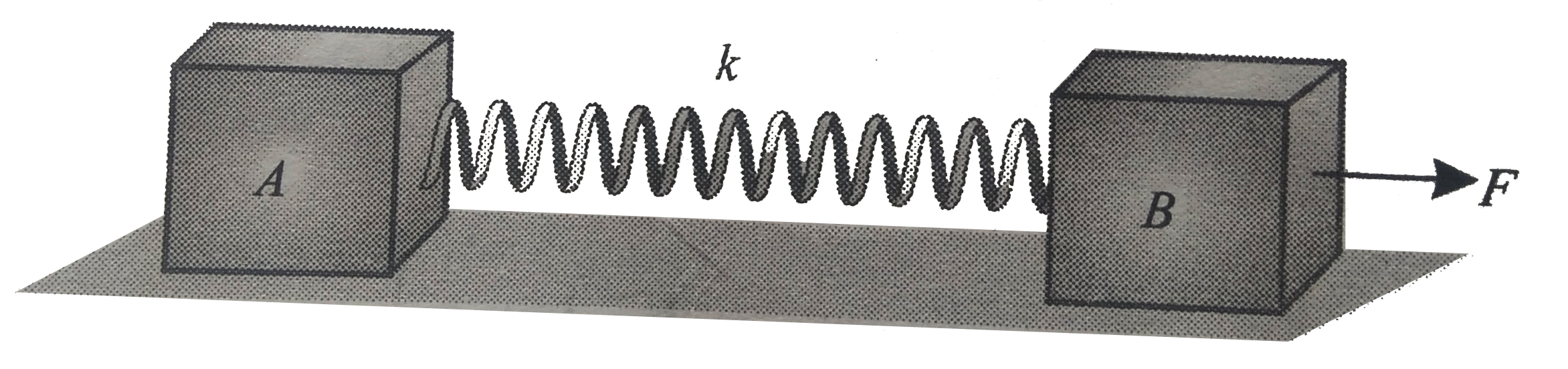
Two identicle particles A and B, each of...

Two identicle particles A and B, each of mass m, are interconnected by a spring of stiffness k. If particle B experiences a forec F and the elongation of the spring is x, the acceleration of particle B relative to particle A is equal to

A

`(F)/(2m)`

B

`(F-kx)/(m)`

C

`(F-2kx)/(m)`

D

`(kx)/(m)`

Text Solution

Verified by Experts

Equation of motion of `A` :
`kx=ma rArr a=(kx)/(m)`
For `B : F-T=ma'`
`rArr a'=(F-kx)/(m)`
`rArr` The relative acceleration `=a_(r)=|a'-a|=(F-2kx)/(m)`
Promotional Banner

Topper's Solved these Questions

Similar Questions

Explore conceptually related problems

Two identical particles each of mass m are connected by a light spring of stiffness K. The initial deformation of the spring when the system was at rest, x_(0) . After releasing the system, if one of the particles has a speed v and the deformation of the spring is x, find the speed of the other particle neglecting friction.

Three particles A,B and C each of mass m are lying at the corners of an equilateral triangle of side L . If the particle A is released keeping the particles B and C fixed , the magnitude of instantaneous acceleration of A is

Two particles of masses m and M(Mgtm) are connected by a cord that passes over a massless, frictionless pulley. The tension T in the string and the acceleration a of the particles is

A particle of mass M and radius of gyration K is rotating with angular acceleration alpha . The torque acting on the particle is

In an ideal pulley particle system, mass m_2 is connected with a vertical spring of stiffness k . If mass m_2 is released from rest, when the spring is underformed, find the maximum compression of the spring.

A sand bag of mass m is hanging from a light spring of stiffness k. Find the elongation of the spring. If we pull the sand bag down by an additional distance x and release it, find its acceleration and maximum velocity of block.

A spring connects two particles of masses m_1 and m_2 A horizontal force F acts on m_1 Ignoring friction, when the elongation of the spring is x then:

When a force F acts on a particle of mass m, the acceleration of particle becomes a. now if two forces of magnitude 3F and 4F acts on the particle simultaneously as shown in figure, then the acceleration of the particle is

Two particles A and B starts from rest and move for equal time on a straight line. The particle A has an acceleration a for the first half of the total time and 2a for the second half. The particle B has an acceleration 2a for the first half and a for the second half. Which particle has covered larger distance?

Two particles, each of mass m, are a distance d apart. To bring a third particle, also having mass m, from far away to the point midway between the two particles an external agent does work given by:


