Home
Class 11
PHYSICS
The system shown in fig is in equilibriu...

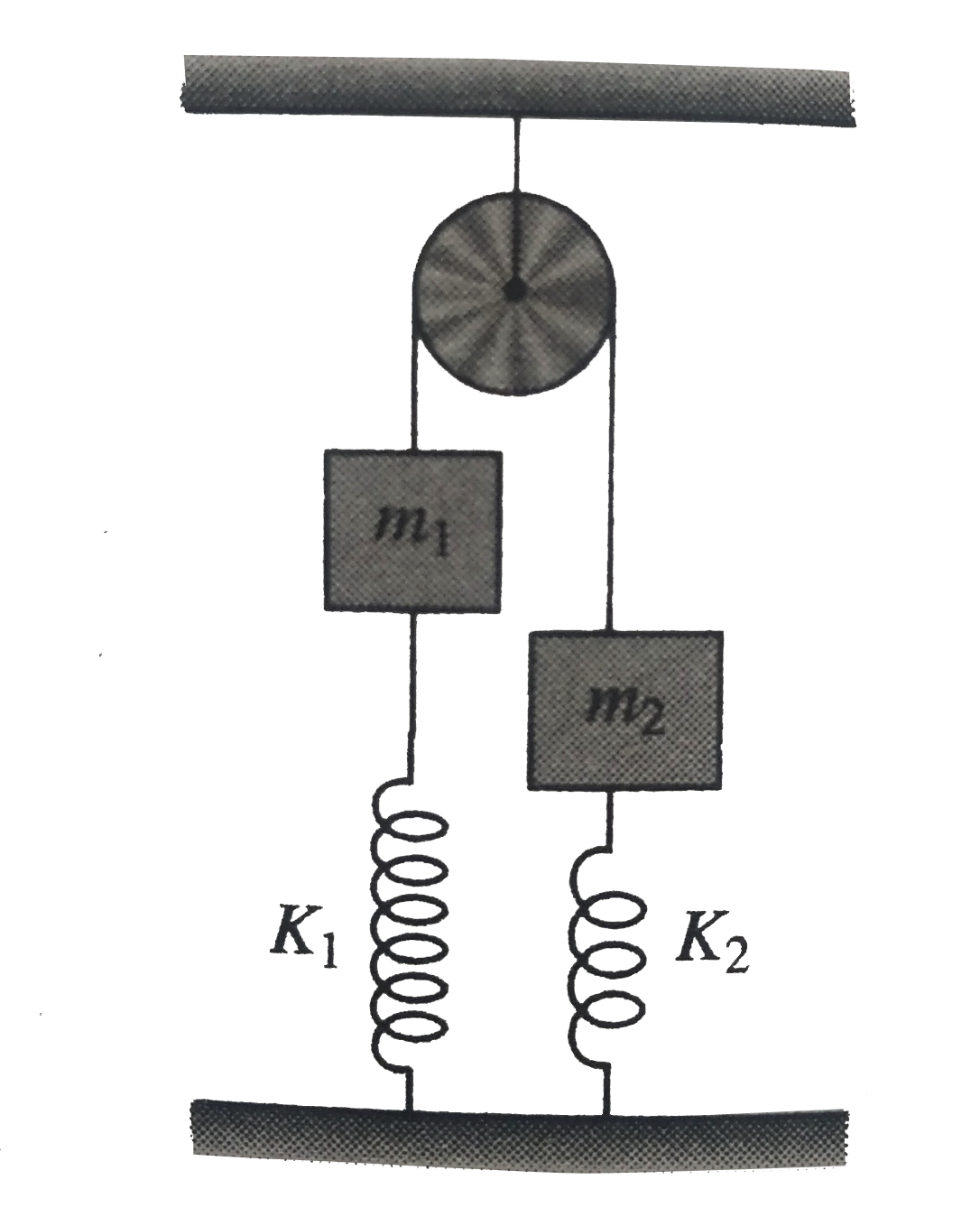
The system shown in fig is in equilibrium . Masses `m_(1) and m_(2)` are 2kg and 8kg, Respectively. Spring constants `k_(1) and k_(2)` ro `50Nm^(-1) and 70Nm^(-1)`, respectively. If the compression in second spring is 0.5m. What is the compression in first spring?

A

`1.3m`

B

`-0.5m`

C

`0.5m`

D

`0.9m`

Text Solution

Verified by Experts

As the springs are fixed to the horizontal and have the same natural length, hence if one spring is compressed, the other must be expanded. Hence, the compression will be negative.
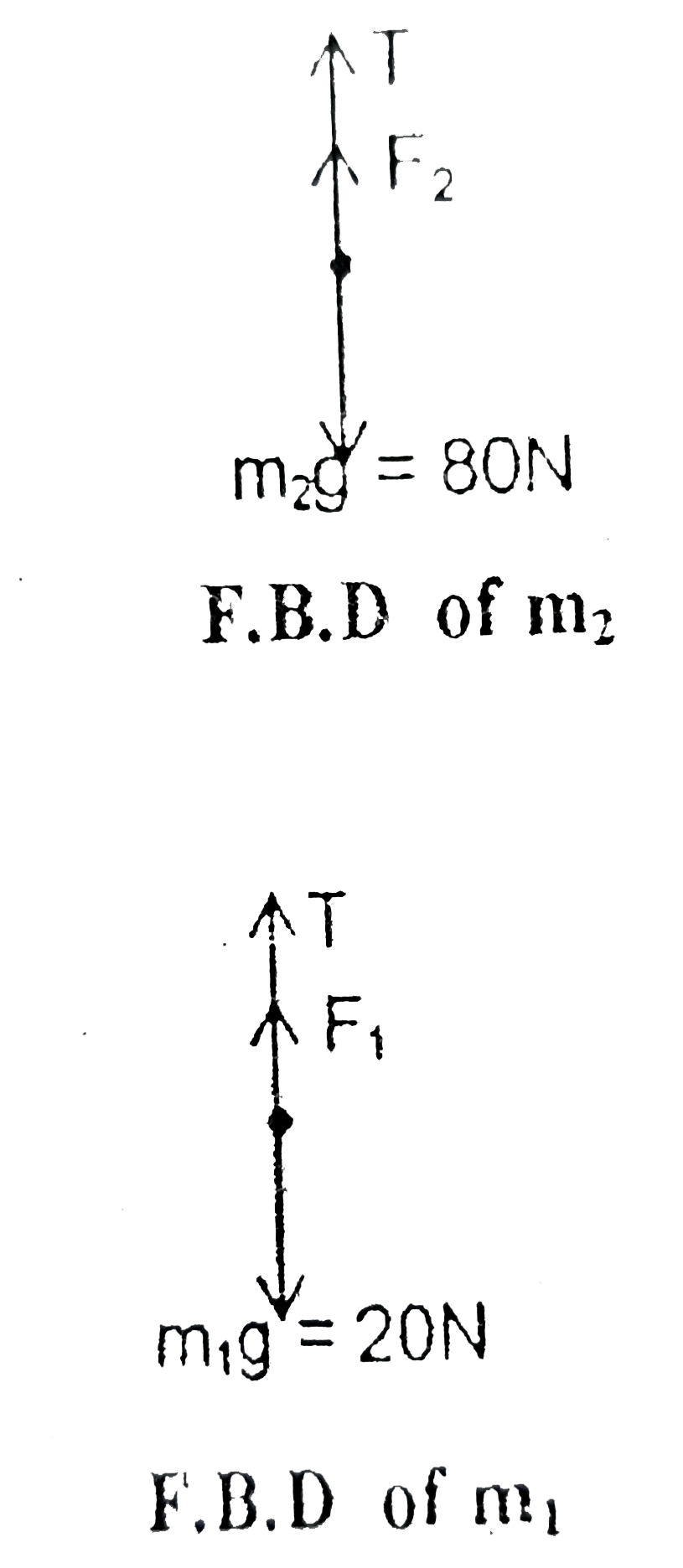
`F.B.D` of `m_(2)` `T+F_(2)=80N`
and `F_(2)=70xx0.5=35N`
`:. T=80-35=45N`
`F.B.D` of `m_(1)`
`T+F_(1)=mg`
or `45+F_(1)=mg`
`rArr F_(1)= -45+20= -25N`
`:. x_(1)=(-25)/(50)=-0.5m`
`:. ` Compression in first spring `= -0.5m`
Promotional Banner

Topper's Solved these Questions

Similar Questions

Explore conceptually related problems

Two smooth blocks of mases m_(1) and m_(2) attached with an ideal spring of stiffness k and kept on hrozontal surface. If m_(1) is projected with a horizontal velocity v_(0) . Find the maximum compression of the spring.

The system is in equilibrium and at rest. Now mass m_(1) is removed from m_(2) . Find the time period and amplituded of resultant motion. Spring constant is K .

A particle of mass m collides elastically with the pan of mass (M = 2m) of a spring balance, as shown in figure. Pan is in equillibrium before collision. Spring constant is k and speed of the particle before collision is v_(0) . Answer the following three questions regarding this collision. Maximum compression in the spring after the collision the

In an elevator a system is arranged as shown in figure. Initially elevator is at rest and the system is in equilibrium with middle spring unstretched. When the elevator accelerated upwards, it was found that for the new equilibrium position (with respect to lift), the further extension i the top spring is 1.5 times that of the further compression in the bottom spring, irrespective of the value of acceleration (a) Find the value of (m_1)/(m_2) in terms of spring constants for this happen. (b) if k_1=k_2=k_3=500(N)/(m) and m_1=2 kg and acceleration of the elevator is 2.5(m)/(s^2) , find the tension in the middle spring in the final equilibrium with respect to lift.

The masses in figure slide on a frictionless table. m_(1) but not m_(2) , is fastened to the spring. If now m_(1) and m_(2) are pushed to the left , so that the spring is compressed a distance d , what will be the amplitude of the oscillation of m_(1) after the spring system is released ?

A block of mass m is suddenly released from the top of a spring of stiffness constant k. a. Find the acceleration of block just after release. b. What is the compression in the spring at equilibrium. c. What is the maximum compression in the spring. d. Find the acceleration of block at maximum compression in the spring.

A body of mass 0.1 g moving with a velocity of 10 m/s hits a spring (fixed at the other end) of force constant 1000 N/m and comes to rest after compressing the spring. The compression of the spring is

In an ideal pulley particle system, mass m_2 is connected with a vertical spring of stiffness k . If mass m_2 is released from rest, when the spring is underformed, find the maximum compression of the spring.

A spring of length 'l' has spring constant 'k' is cut into two parts of length l_(1) and l_(2) . If their respective spring constahnt are K_(1) and k_(2) , then (K_(1))/(K_(2)) is:

As shown in the figure, two light springs of force constant k_(1) and k_(2) oscillate a block of mass m. Its effective force constant will be