Home
Class 11
PHYSICS
An iron ball of mass m, suspended by a l...

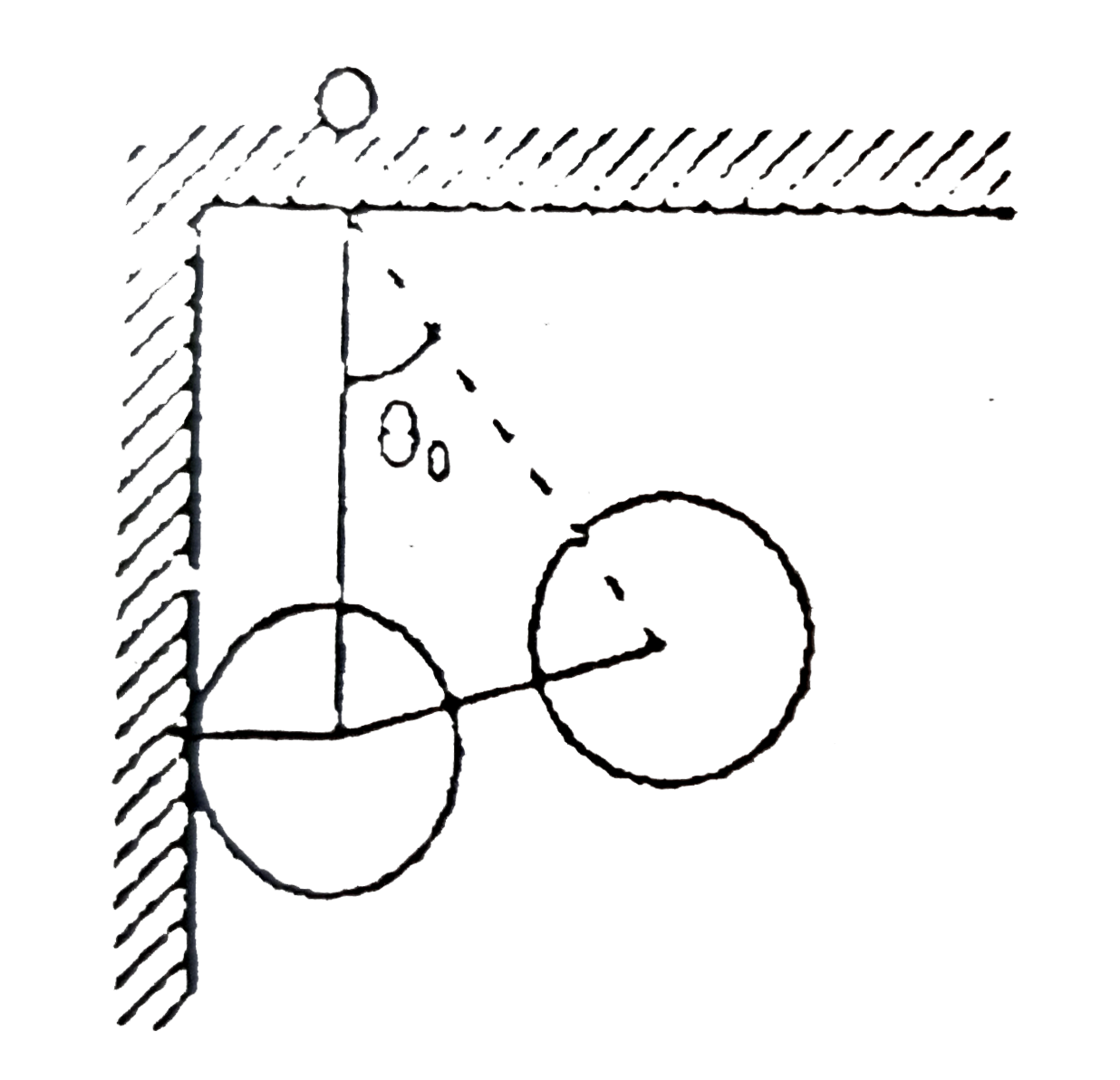
An iron ball of mass `m`, suspended by a light inextensible string of length `l` from a fixed point `O`, is shifted by `theta_(0)` as shown so as to strike the vertical wail perpendicularly.The maximum angle made by the string with vertical after the first collision, if `e` is the coefficient of restitution, is

A

`sin^(-1){1-e^(2)(1-costheta_(0))}`

B

`cos^(-1){1-e^(2)(1-costheta_(0))}`

C

`tan^(-1){1-e^(2)(1-costheta_(0))}`

D

zero

Text Solution

Verified by Experts

Speed just before collision `=sqrt(2gl(1-costheta_(0)))`
Speed just after collision`=esqrt(2gl(1-costheta_(0)))`
From `COE`,
`(1)/(2)me^(2)[2gl(1-costheta_(0))]=mgl(1-costheta)`
`:. theta=cos^(-1){1-e^(2)(1-costheta_(0))}`
Promotional Banner

Topper's Solved these Questions

  • ELASTICITY & WAVES

    FIITJEE|Exercise Example|18 Videos

Similar Questions

Explore conceptually related problems

A steel ball is suspended by a light in extensible string of length l from a fixed point O . When the ball is in equilibrium it just touches a vertical wall as shown in the figure. The ball is first taken aside such that string becomes horizontal and then released from rest. If coefficient of restitution is e, then find the maximum deflection of the string after nth collision.

A bob of mass m suspended by a light inextensible string of length 'l' from a fixed point. The bob is given a speed of sqrt(6gl) . Find the tension in the string when string deflects through an angle 120^@ from the vertical.

A particle of mass m is attached to one end of a light inextensible string and the other end of the string is fixed in vertical plane as shown. Particle is given a horizontal velocity u = sqrt((5)/(2)gl) The maximum angle made by the string with downward vertical is

A particle of mass m is suspended by a string of length l from a fixed rigid support. A sufficient horizontal velocity =sqrt(3gl) is imparted to it suddenly. Calculate the angle made by the string with the vertical when the accekleration of the particle is inclined to the string by 45^(@) .

A heavy particle hanging from a fixed point by a light inextensible string of length l is projected horizontally with speed (gl) . Then the speed of the particle and the inclination of the string to the vertical at the instant of the motion when the tension in the string equal the weight of the particle-

A small ball is suspended from a fixed point 'O' by means of a light and inextensible string of length 'l'. The ball is first taken aside such that string becomes horizontal and then released from rest. At the borrom it collides with a fixed obstacle. The co-efficient of restitution is 'e'. Find the maximum angular deflection of the string after n^(th) collision.

A pendulum consisting of a small sphere of mass m, suspended by a inextensible and massless string of length 1 , is made to swing in a vertical plane. If the breaking strength of the string is 2 mg, then the maximum angular amplitude of the displacement from the vertical can be

A pendulum consisting of a small sphere of mass m, suspended by a inextensible and massless string of length 1 , is made to swing in a verticle plane. If the breaking strength of the string is 2 mg, then the maximum angular amplitude of the displacement from the verticle can be

A heavy particle hanging from a fixed point by a light inextensible string of length l is projected horizonally with speed sqrt(gl) . Find the speed of the particle and the inclination of the string to the vertical at the instant of the motion when the tension in the string is equal to the weight of the particle.

A uniform rod of mass m and length l is suspended by means of two light inextensible strings as shown in figure. Tension in one string immediately after the other string is cut is

