

Home
Class 11
PHYSICS
A particle of mass m is released from he...

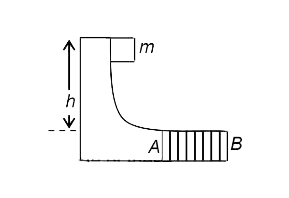
A particle of mass m is released from height ‘h’ on smooth quarter circular fixed wedge. The horizontal surface AB following the circular path at bottom of wedge is rough with coefficient of friction `mu` between surface and m. Find the distance from A where the mass will stop.

A

`(2h)/(mu)`

B

`(h)/(mu)`

C

`(h)/(mug)`

D

none of these

Text Solution

Verified by Experts

By work energy theorem,
`mgh-mu mgs=0`
`rArrs=(h)/(mu)`
Promotional Banner

Topper's Solved these Questions

  • ELASTICITY & WAVES

    FIITJEE|Exercise Example|18 Videos

Similar Questions

Explore conceptually related problems

A particle of mass m is released from height h on smooth quarter circular fixed wedge. The horizontal surface AB following the circular path at bottom of wedge is rough with coefficient of friction mu between surface and m . Find the distance from bottom of wedge where the mass will stop.

A body of mass m is released from a height h on a smooth inclined plane that is shown in the figure. The following can be true about the velocity of the block knowing that the wedge is fixed. .

A body of mass m is released from a height h on a smooth inclined plane that is shown in the figure. The following can be true about the velocity of the block knowing that the wedge is fixed. .

A block of mass m = 0.1 kg is released from a height of 4m on a curved smooth surface. On the horizontal surface, path AB is smooth and path BC offers coefficient of friction mu = 01. If the impact of block with the vertical wall at C be elastic, the total distance covered by the block on the horizontal surface before coming to rest will be (take g = 10 m//s^(2) )

A block of mass m = 0.1 kg is released from a height of 4 m on a curved smooth surface. On the horizontal surface, path AB is smooth and path BC offers coefficient of friction mu = 0.1 . If the impact of block with the vertical wall at C be perfectely elastic, the total distance covered by the block on the horizontal surface before coming to rest will be (take g = 10 ms^(–2) ) -

A body of mass m is placed on a rough surface with coefficient of friction mu inclined at theta . If the mass is in equilibrium , then

A body of mass m is placed on a rough surface with coefficient of friction mu inclined at theta . If the mass is in equilibrium , then

A block of mass m slides over a smooth wedge of mass M which is placed over a rough horizontal surface . The centre of mass of the system will move towards left Here mu = coefficient of friction between the wedge and the ground .

A block of mass m is placed at rest on a smooth wedge of mass M placed at rest on a smooth horizontal surface. As the system is released

A block of mass m is released from the top of a wedge of mass M as shown in figure. Find the displacement of wedges on the horizontal ground when the block reaches the bottom of the wedges. Neglect friction everywhere.