

Home
Class 11
PHYSICS
An infinite number of bricks are placed ...

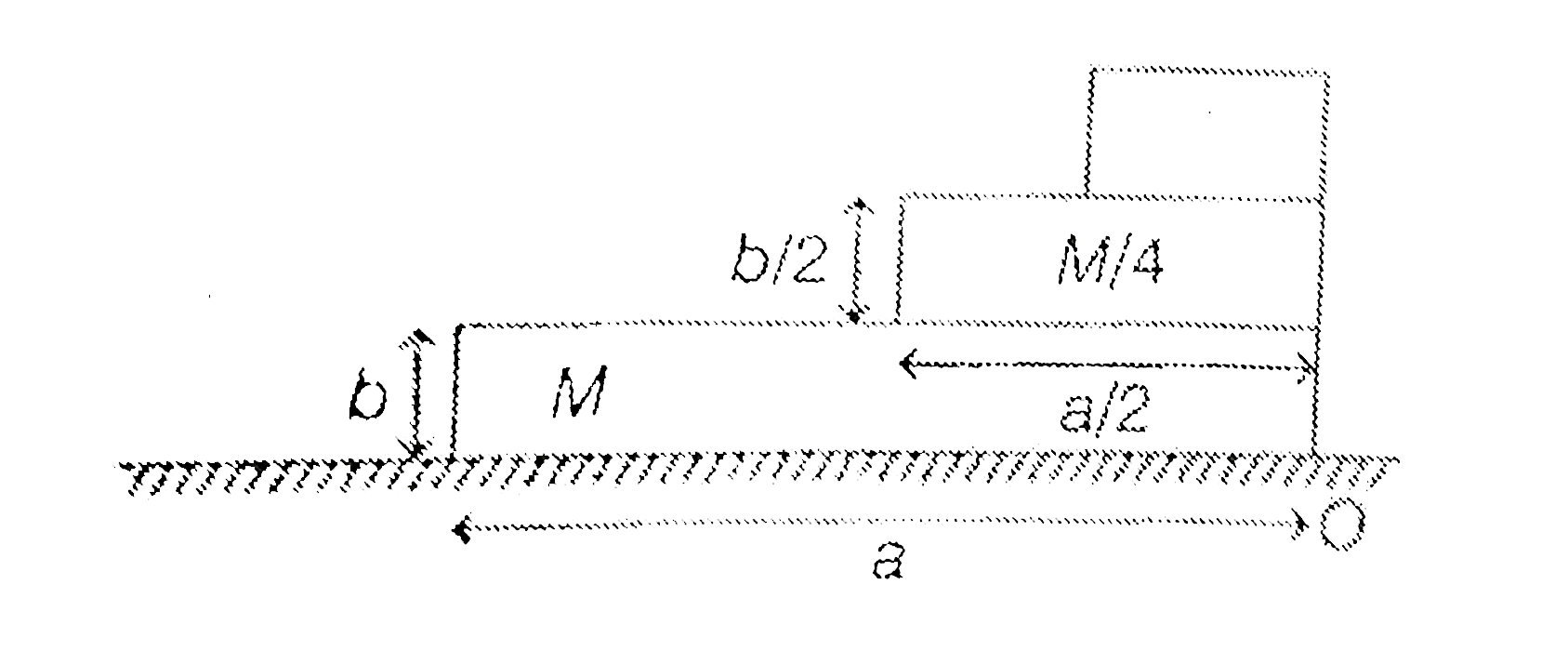
An infinite number of bricks are placed one over the other as shown in the figure . Each succeeding brick having half the length and breadth of its preceding brick and the mass of each succeeding bricks being `(1)/(4)` th of the preceding one . Take 'O' as the origin . The x -coordinate of centre of mass of the system of bricks is :

A

`-a//7`

B

`3a//7`

C

`-3a//7`

D

`-2a//7`

Text Solution

Verified by Experts

`X_(com)=([Mxx(a)/(2)+(M)/(2)xx(a)/(4)+(M)/(16)xx(a)/(8)+.....oo])/(M+(M)/(4)+(M)/(16)+......oo)=-(3a)/(7)`
Promotional Banner

Topper's Solved these Questions

  • ELASTICITY & WAVES

    FIITJEE|Exercise Example|18 Videos

Similar Questions

Explore conceptually related problems

Infinite number of bricks are placed one over the other as shown in the figure. Each succeeding brick having half the length and breadth of its preceding brick and the mass of each succeeding bricks being (1//4)^(th) of the preceding one. Taking 'O' as the origin, the x coordinate of centre of mass of the system of bricks is at

Find the x coordinate of the centre of mass of the bricks shown in figure :

Two identical bricks of length L are piled one on top of the other on a table as shown in the figure the maximum distance S the top brick can overhand the table with the system still balanced is:

Seven homogeneous bricks, each of length L are arranged as shown in figure. Each brick is displaced with respect to the one in contact by L/10 . Find the x-coordinate of the centre of mass relative to the origin shown.

Infinite rods of uniform mass density and length L,L/2,L/4….. Are placed one upon another upto infinite as shown in figure. Find the x-coordinate of centre of mass.

An infinite number of particles each of mass m are placed on the positive X-axis of 1m, 2m, 4m, 8m,... from the origin. Find the magnitude of the resultant gravitational force on mass m kept at the origin.

A rod length L and mass M is placed along the x -axis with one end at the origin, as shown in the figure above. The rod has linear mass density lamda=(2M)/(L^(2))x, where x is the distance from the origin. Which of the following gives the x -coordinate of the rod's center of mass?

The Class X students of a secondary school in Krishinagar have been allotted a rectangular plot of land for their gardening activity. Sapling of Gulmohar are planted on the boundary at a distance of 1 m from each other. There is a triangular grassy lawn in the plot as shown in the Figure. The students are to sow seeds of flowering plants on the remaining area of the plot. (i) Taking A as origin, find the coordinates of the vertices of the triangle. (ii) What will be the coordinates of the vertices of DPQR if C is the origin? Also calculate the areas of the triangles in these cases. What do you observe?

Two blocks each of mass m, connected by an un-stretched spring are kept at rest on a frictionless horizontal surface. A constant force F is applied on one of the blocks pulling it away from the other as shown in figure. (a)Find accelaration of the mass center. (b) Find the displacement of the centre of mass as function of time t. (c) If the extension of the spring is X_(0) at an instant t, find the displacements of the two blocks relative to the ground at this instant.

Three thin rods each of length Land mass M are placed along x, y and z-axes such that one end of each rod is at origin. The moment of inertia of this system about z-axis is