Home
Class 11
PHYSICS
A spaceship is sent to investigate a pla...

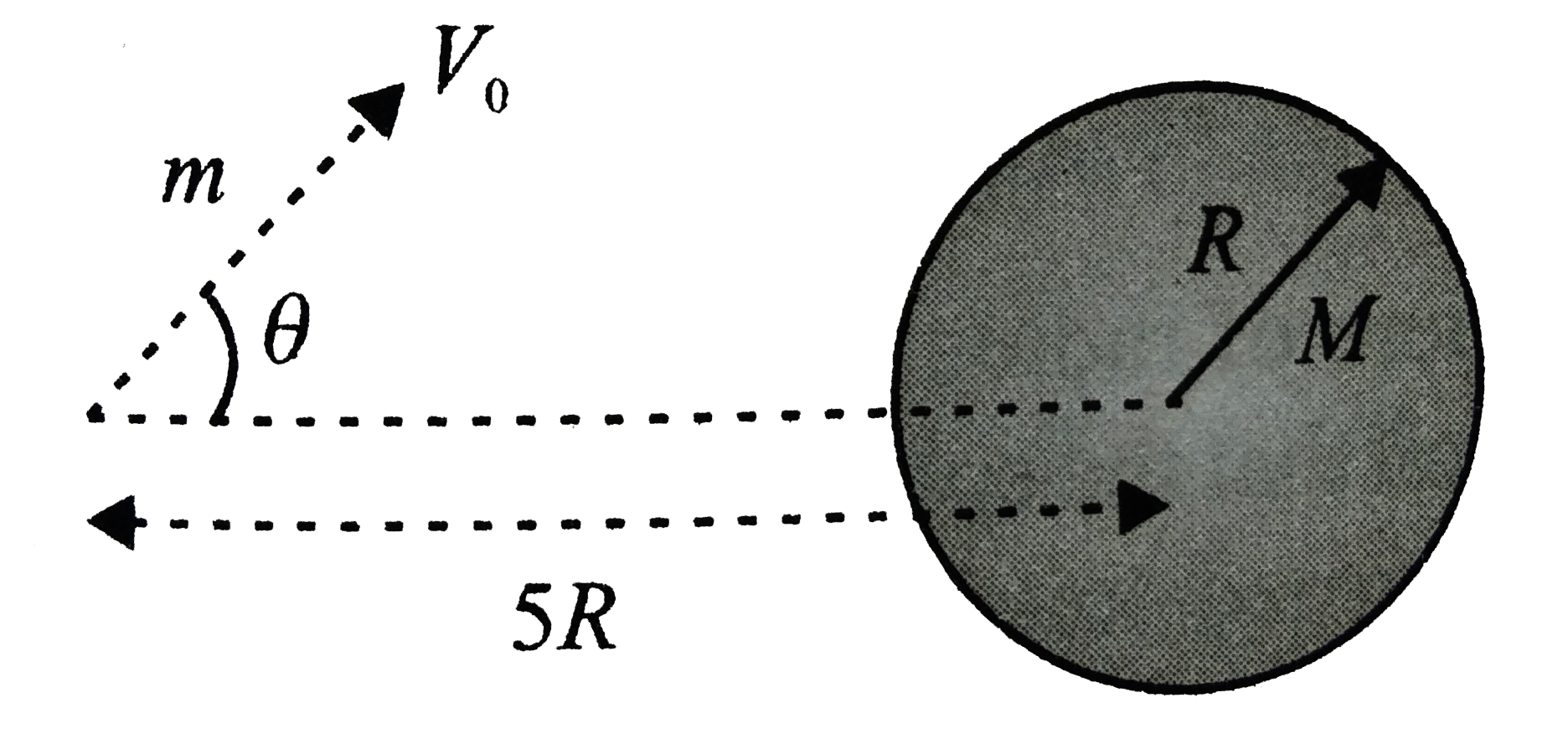
A spaceship is sent to investigate a planet of mass `M` and radius `R`. While hanging motionless in space at a distance `5R` from the centre of the planet, the spaceship fires an instrument package of mass `m`, which is much smaller than the mass of the spaceship. For what angle `theta` will the package just graze the surface of the planet?

Text Solution

Verified by Experts

Let the speed of the instruement package is `v` when it grazes the surface of the planet.
Conserving angular momentum of the package about the centre of the planet
`mv_(0)xx5Rsin(pi-theta)=mvRsin90^(@)`
Conserving mechanical energy,
`-(GMm)/(5R)+(1)/(2)mv_(0)^(2)=-(GMm)/(R )+(1)/(2)mv^(2)`
`rArr (1)/(2)m(v^(2)-v_(0)^(2))=(4GMm)/(5R)`
`v^(2)-v_(0)^(2)=(8GM)/(5R)`
Subsituting the value of `v` from Eq. `(1)` in Eq. `(2)`
`25v_(0)^(2)sin^(2)theta-v_(0)^(2)=(8GM)/(5R)`
`rArr sintheta=(1)/(5)sqrt(1+(8GM)/(5v_(0)^(2)R))`
or `theta=sin^(-1)[(1)/(5)sqrt((1+(8GM)/(5v_(0)^(2)R)))]`
Promotional Banner

Topper's Solved these Questions

  • FLUID MECHANICS

    FIITJEE|Exercise Example|15 Videos
  • HEAT & THERMODYNAMICS

    FIITJEE|Exercise Example|14 Videos

Similar Questions

Explore conceptually related problems

A space vehicle approaching a planet has a speed v when it is very far from the planet At that moment tangent of its trajectory would miss the centre of the planet by distance R if the planet has mass M and radius r what is the smallest value of R in order that the resulting orbit of the space vehicle will just miss the surface of the planet?

A body of mass m at inifnity is approaching the centre of a hypothetical hollow planet of mass M and radius R . The speed of the body when it passes the centre of the planet through a diametrical tunnel is

A mass m is placed at point P lies on the axis of a ring of mass M and radius R at a distance R from its centre. The gravitational force on mass m is

A solid spherical planet of mass 2m and radius 'R' has a very small tunnel along its diameter. A small cosmic particle of mass m is at a distance 2R from the centre of the planet as shown. Both are initially at rest, and due to gravitational attraction, both start moving toward each other. After some time, the cosmic particle passes through the centre of the planet. (Assume the planet and the cosmic particle are isolated from other planets)

A particle of mass m and velocity v_(0) is fired at a solid cylinder of mass M and radius R. The cylinder is initially at rest and is mounted on a fixed horizontal axle that runs through the centre of mass. The line of motion of the particle is perpendicular to the axle and at a distance d, less than R, from the centre and the particle sticks to the surface of the cylinder, then

A solid sphere of mass M and radius R has a spherical cavity of radius R/2 such that the centre of cavity is at a distance R/2 from the centre of the sphere. A point mass m is placed inside the cavity at a distance R/4 from the centre of sphere. The gravitational force on mass m is

A solid sphere of mass M and radius R has a spherical cavity of radius R/2 such that the centre of cavity is at a distance R/2 from the centre of the sphere. A point mass m is placed inside the cavity at a distanace R/4 from the centre of sphere. The gravitational force on mass m is

A fixed spherical shell of inner radius R and outer radius 2R has mass M, A particle of mass m is held at rest at a distance 2R from the surface of the body. If the particle is released from that point, with what speed will it hit surface of the spherical body ?

The gravitational potential energy at a body of mass m at a distance r from the centre of the earth is U. What is the weight of the body at this distance ?

The escape velocity corresponding to a planet of mass M and radius R is 50 km s^(-1) . If the planet's mass and radius were 4M and R , respectively, then the corresponding escape velocity would be

