Home
Class 11
PHYSICS
A bent tube is lowered into a water stre...

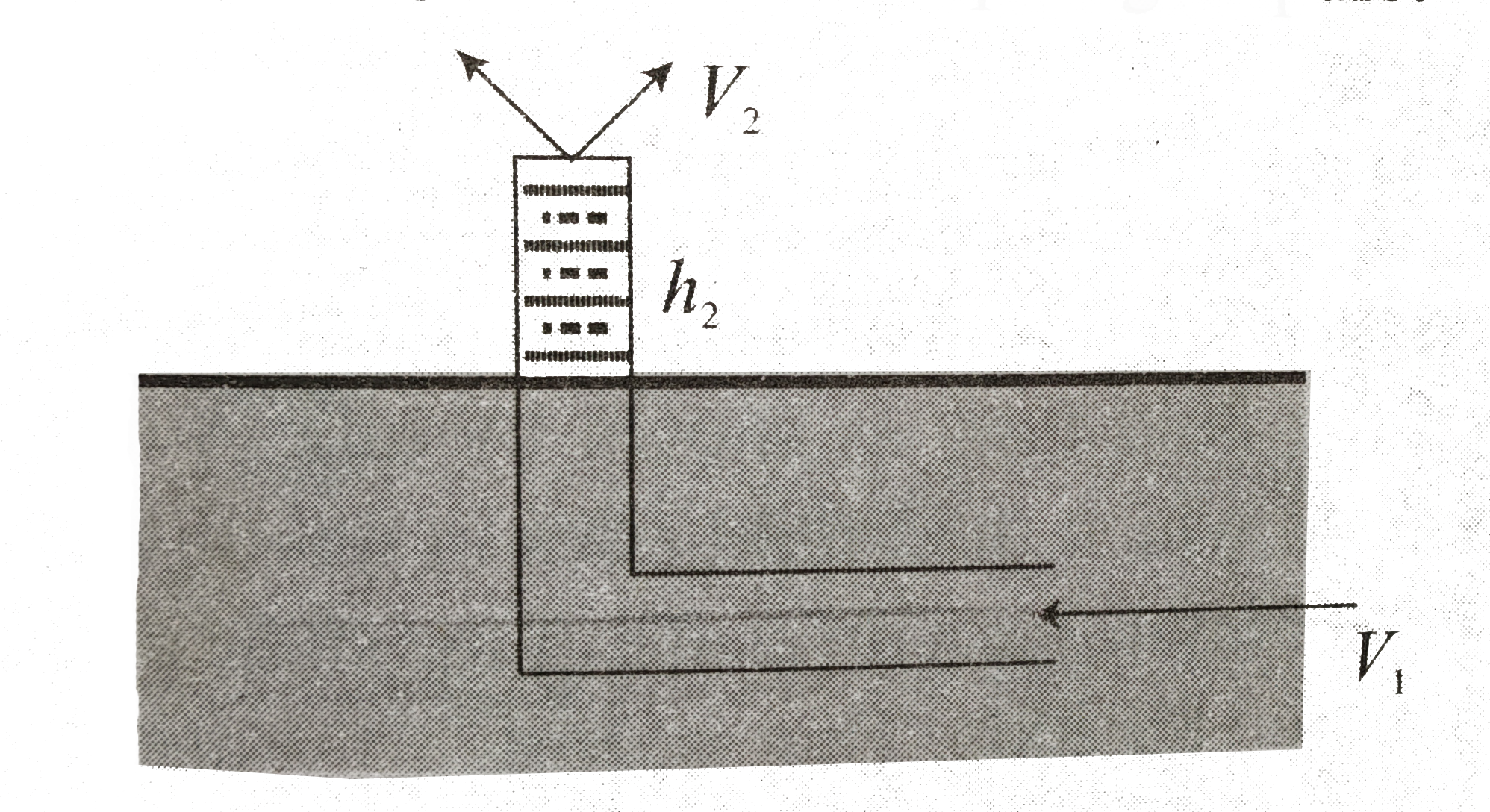
A bent tube is lowered into a water stream as shown in figure. The velocity of the stream is `V_(1)`. The closed upper end is located at a height `h_(0) ` and has a small orifice. To what height `h` will the liquid get spurt?

Text Solution

Verified by Experts

At maximum height total energy will be potential,
Apply Bernoulli's theorem, we have
`(1)/(2)rhov^(2)=(h+h_(@))rhog`
`rArr h=(v^(2))/(2g)-h_(@)=((2.5)^(2))/(2xx10)-0.12` [`g=9.8m//s^(2)`]
`~~20cm` (approximately)
Promotional Banner

Topper's Solved these Questions

Similar Questions

Explore conceptually related problems

A bent tube is lowered into a water stream as shown in figure. The velocity of the stream relative to the tube is equal to v=5 ms^(-1) . The closed upper end of the tube located at the height h_(0) =12 cm has a small orifice.To what height h will the water jet spurt? (g=10 ms^(-1)) A. 1.5 m B. 0.25 m C. 1.13 m D. 1 m

Water rises to a height h in a capillary tube lowered vertically into water to a depth l as shown in the figure. The lower end of the tube is now closed, the tube is the taken out of the water and opened again. The length of the water column remaining in the tube will be .

A tube of conical bore is dipped into water with apex upwards. The length of the tube is 20cm and radii at the upper and lower ends are 0.1 and 0.3 cm. Find the height to which the liquid rises in the tube ( Surface tension of water = 80 dyne // cm ).

A simple accelerometer (an instrument for measuring acceleration) can be made in the form of a tube filled with a liquid and bent as shown. During motion, the level of the liquid in the left arm will be at a height h_(1) and in the right arm at a height h_(2) . Determine the acceleration a of a carriage in which the accelerometer is installed, assuming that the diameter of the tube is much smaller than h_(1) and h_(2) .

A liquid flows through a horizontal tube as shown in figure. The velocities of the liquid in the two sections, which have areas of cross-section A_(1) and A_(2) and v_(1) and v_(2) respectively. The differnece in the levels of the liquid in the two vertical tubes is h . then

A horizontal oriented tube AB of length 5m rotates with a constant angular velocity 0.5 rad/s about a stationary vertical axis OO' passing through the end A. the tube is filled with ideal fluid. The end of the tube is open, the closed end B has a very small orifice. The velocity with which the liquid comes out from the hole (in m/s) is

An air column closed in a tube sealed at one end by a Hg column having height h. When the tube is placed with open end down, the height of the air column Iis l_(1) . If the tube is turned so that its open end is at the top, the height of the air column is l_(2) . What is the atmospheric pressure (P_0) .

An observer can see through a pin-hole the top end of a thin rod of height h, placed as shown in the figure. The beaker height is 3h and its radius h. When the beaker is filled with a liquid up to a height 2h, he can see the lower end of the rod. Then the refractive index of the liquid is

A small ball of mass m is released in a smooth circular tube as shown in figure. The minimum height h such that bead can complete the circle is

A small particle of mass m moving inside a heavy, hollow and straight tube along the tube axis undergoes elastic collision at two ends. The tube has no friction and it is closed at one end by a flat surface while the other end is fitted with a heavy movable flat piston as shown in figure. When the distance of the piston from closed end is L = L_0 the particle speed is v = v_0 The piston is moved inward at a very low speed V such that V

