


FIITJEE-SIMPLE HARMONIC MOTION-Example
- Find the natural frequency of the system as shown in the figure. The p...
Text Solution
|
- The system shown is figure consists of 3 springs and two rods. If the ...
Text Solution
|
- Find the angular frequency of small oscillation of block m in the arra...
Text Solution
|
- A hemispherical sheli of mass M and radius R made to vibrate as shown ...
Text Solution
|
- The period of a particle executing SHM is T. There is a point P at a ...
Text Solution
|
- A pendulum has time period T in air when it is made to oscillate in wa...
Text Solution
|
- A spring is loaded with two blocks m(1) and m(2) where m(1) is rigidly...
Text Solution
|
- A particle of mass m is executing oscillations about the origin on the...
Text Solution
|
- One end of a spring of force constant k is fixed to a vertical wall an...
Text Solution
|
- A particle moves on the X-axis according to the equation x=x0 sin^2ome...
Text Solution
|
- A disc of radius R and mass M is pivoted at the rim and is set for sma...
Text Solution
|
- A block of mass m compresses a spring of stiffness k through a distanc...
Text Solution
|
- A block of mass m rigidly attached with a spring k is compressed throu...
Text Solution
|
- Time period of a block when suspended from the upper plate of a parall...
Text Solution
|
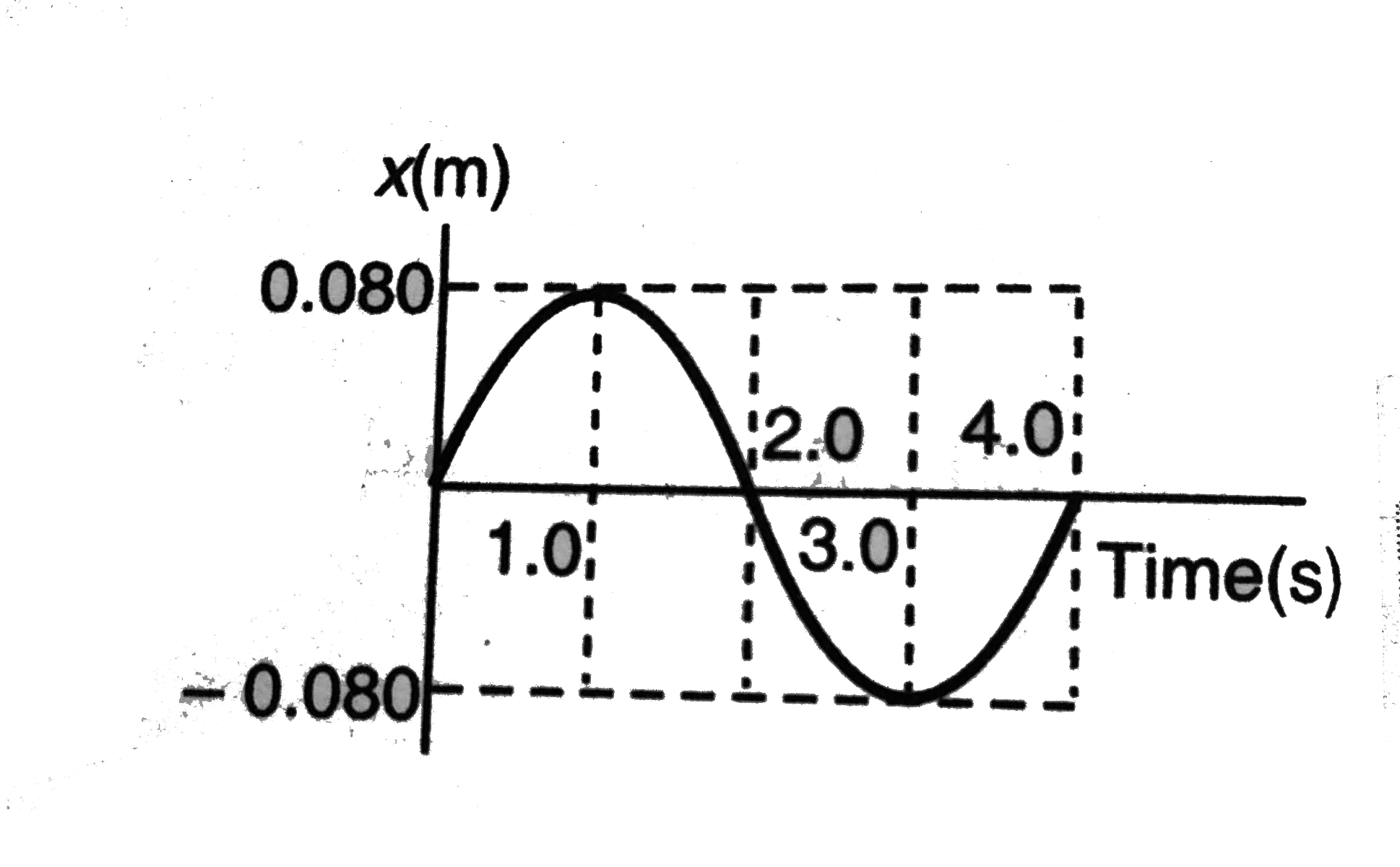
- An object of mass 0.8kg is attached to one end of a spring and the sys...
Text Solution
|