

Home
Class 11
PHYSICS
Three rods AB, BC and BD of same length...

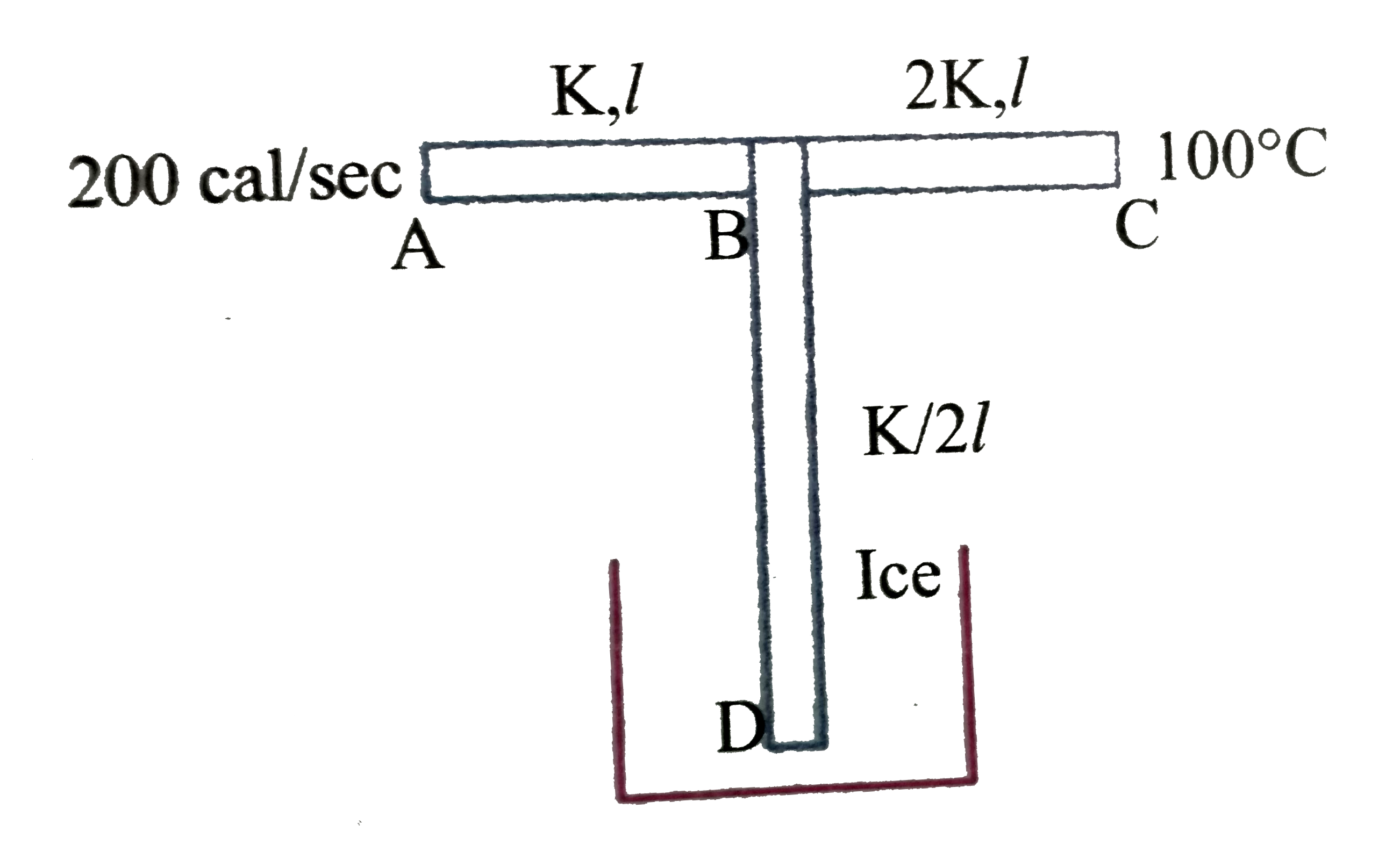
Three rods `AB, BC` and `BD` of same length l and cross-sectionsl area `A` are arranged as shown . The end `D` is immersed in ice whose mass is `440 gm` Heat is being supplied at constant rate of `200cal//sec` from the end Time in which whole ice will melt (Latent heat of fusion of ice is `80cal//gm`
.

A

`(40)/(3)min`

B

`700sec`

C

`20//3min`

D

indefinitely long time

Text Solution

Verified by Experts

If `theta` be temperature of `B`, then
`(2kA(theta-100))/(l)+((k//2)A(theta-0))/(l)=200`
Substituting value `theta=880^(@)C`
`:. Phi_(1)=mL`
`(kA(880-0))/(2l)xxt=440xx80`
`t=(80xx1xx2xx440)/(100xx10xx10^(-4)xx880)=800sec=(40//3)min`
Promotional Banner

Topper's Solved these Questions

Similar Questions

Explore conceptually related problems

Three rods AB,BC and BD of same length l and cross sectional area A are arranged as shown. The end D is immersed in ice whose mass is 440 gm. Heat is being supplied at constant rate of 200 cal /sec from the end A. Find out time (in sec) in which wholeice will melt. (latent heat of fusion of ice is 80 cal/gm) Given k (thermal conductivity) =100 cal/m/sec/ ""^(@)C,A=10cm^(2),l=1 m

Three rods AB, BC and BD of same length l and cross section A are arranged as shown. The end D is immersed in ice whose mass is 440 g and is at 0^@C . The end C is maintained at 100^@C . Heat is supplied at constant rate of 200 cal/s. Thermal conductivities of AB, BC and BD are K, 2K and K//2 , respectively Time after which whole ice will melt is ( K=100 cal//m-s^@C A=10cm^2,l=1cm )

Three rods AB, BC and BD of same length l and cross section A are arranged as shown. The end D is immersed in ice whose mass is 440 g and is at 0^@C . The end C is maintained at 100^@C . Heat is supplied at constant rate of 200 cal/s. Thermal conductivities of AB, BC and BD are K, 2K and K//2 , respectively Time after which whole ice will melt is ( K=100 cal//m-s^@C A=10cm^2,l=1cm )

A coil of water of resistance 50 Omega is embedded in a block of ice and a potential difference of 210 V is applied across it. The amount of ice which melts in 1 second is [ latent heat of fusion of ice = 80 cal g^(-1) ]

Two rods A and B of same area of cross-section are joined together end to end The free end of the rod A is kept in melting ice at 300 K and free end of B rod at 400 K. The rods are of the same length. The conductivity of A is 3 times that of B. Calculate the temperature of the junction of the rods.

One end of a brass rod of length 2.0 m and cross section 1cm^2 is kept in steam at 100^@C and the other end in ice at 0^@C . The lateral surface of the rod is covered by heat insulator. Determine the amount of ice melting per minute. Thermal conductivity of brass is 110 W//m-K and specific latent heat of fusion of ice is 80 cal//g .

Heat is being supplied at a constant rate to the sphere of ice which is melting at the rate of 0.1 gm/s. It melts completely in 100 s. The rate of rise of temperature thereafter will be

Five rods of same material and same cross-section are joined as shown. Lengths of rods ab, ad and bc are l, 2l and 3l respectively. Ends a and c are maintained at temperatures 200^(@)C and 0^(@)C respectivelly. For what length x of rod dc there will be no heat flow through rod bd ?

Three rods AB, BC and AC having thermal resistances of 10 units, 10 units and 20 units, respectively, are connected as shown in the figure. Ends A and C are maintained at constant temperatures of 100^@C and 0^@C , respectively. The rate at which the heat is crossing junction B is

2kg ice at -20"^(@)C is mixed with 5kg water at 20"^(@)C . Then final amount of water in the mixture will be: [specific heat of ice =0.5 cal//gm "^(@)C , Specific heat of water =1 cal//gm"^(@)C , Latent heat of fusion of ice = 80 cal//gm]