Home
Class 12
PHYSICS
An electron is projected from a distance...

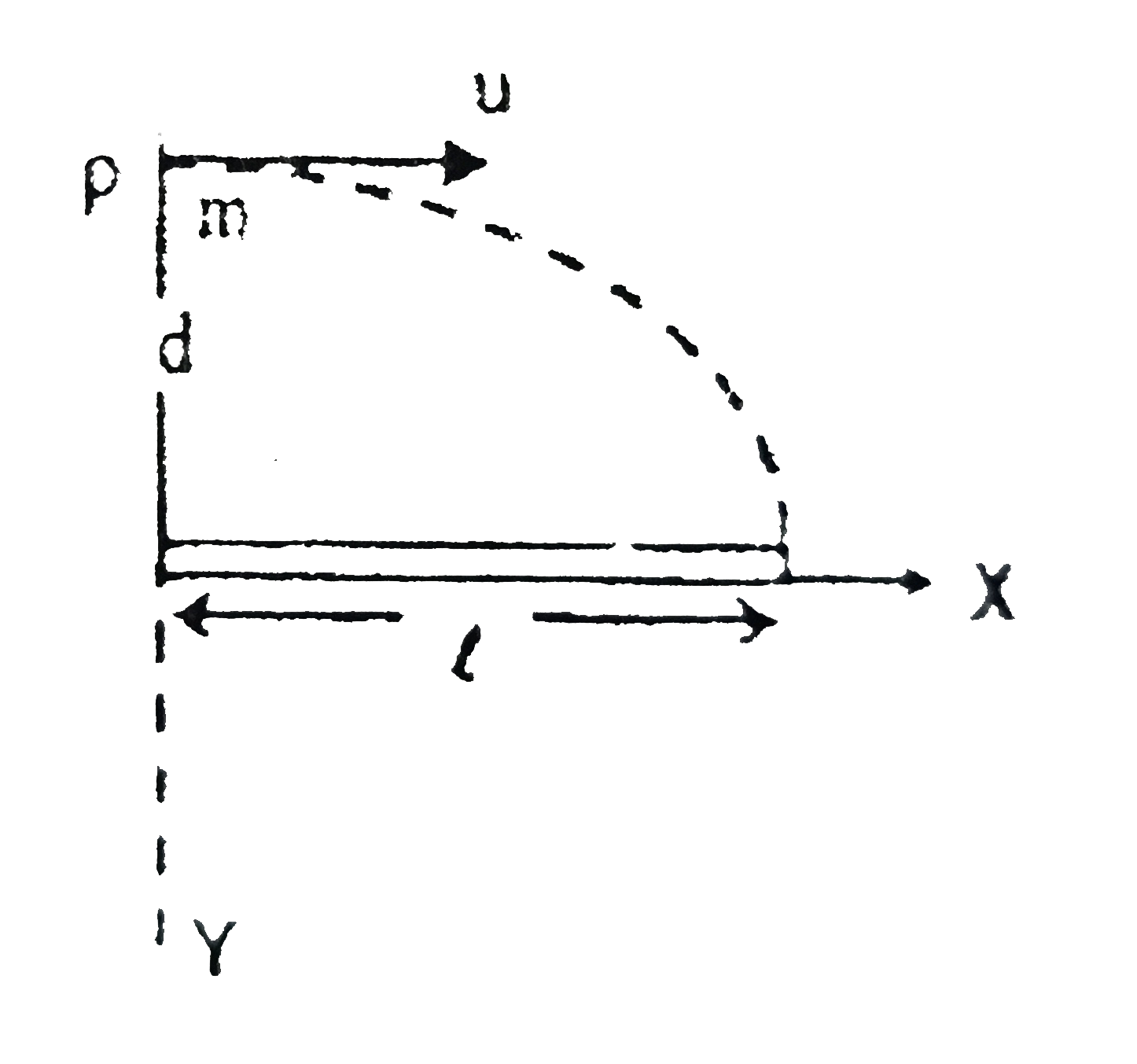
An electron is projected from a distance `d` and with initial velocity `u` parallel to a uniformly charged flat conducting palte as shown. It strikes the plate after travelling a distance `l` along the direction of projection. The surface charge density of the conducting plate is equal to

A

`(2depsilon_(0)"mu"^(2))/(el^(2))`

B

`(2depsilon_(0)"mu")/(el)`

C

`(depsilon_(0)"mu"^(2))/(el)`

D

`(depsilon_(0)"mu")/(el)`

Text Solution

Verified by Experts

The correct Answer is:

A

For the motion of the electron along `Y` axis
`d=(1)/(2)(eE)/(m)*t^(2)`……….`(1)`
where `E` is the electric field due to the charged plate given by
`E=sigma//epsilon_(0)`………`(2)`
where `sigma` is the surface density of charge of the plate.
The time taken by the electron is
`t=(l)/(u)` ........`(3)`
From Eqs. `(1)`, `(2)` and `(3)`, we obtain
`d=(1)/(2)(esigma)/(epsilon_(0)m)((l)/(u))^(2)rArrsigma=(2depsilon_(0)"mu"^(2))/(el^(2))`
`:. (A)`
Promotional Banner

Similar Questions

Explore conceptually related problems

Three charged conducting plates are separated by small distances as shown in figure. The charges on the plates are shown. Find the ratio of charge on right surface and left surface of the middle plate.

If a small sphere of mass m and charge q is hung from a silk thread at an angle theta with the surface of a vertical charged conducting plate, then for equilibrium of sphere, the surface charge density of the plate is

An electron is projected as shown in fig. with kinetic energy K, at an angle theta=45^(@) between two charged plates. Ignore the gravity. At what distance from the starting point will the electron strike the lower plate?

An uncharged conducting large plate is placed as shown. Now an electric field E towards right is applied. Find the induced charge density on the right surface of the plate.

If a small sphere of mass m and charge q is hanged from a silk thread at an angle theta with the surface of a vertical charged conducting plate, then for equilibrium of sphere the surface charge density of the plate -

A point charge q'q is placed at distance 'a' from the centre of an uncharged thin spherical conducting shell of radius R=2a. A point 'P' is located at a distance 4a from the centre of the conducting shell as shown. The electric potential due to induced charge on the inner surface of the conducting shell at point 'P' is

Two conducting plates X and Y, each having large surface aera A (on one side), are placed parallel to each other as show in figure. Find the surface charge density at the inner surface of the plate X.

Electric field due to an infinite non-conducting sheet of surface charge density sigma , at a distance r from it is

There is an infinite line of uniform linear density of charge +lamda . A particle of charge -q & mass m is projected with initial velocity v_(0) at an angle theta with the line of charge from a distance a from it. The point charge moves in plane containing line charge and point of projection The speed of the particle of found to be minimum when it's distance from the line of charge is ae^((npimepsilon_(0)^(2)//qlamda)) . The value of n is (ingnore gravity)

An electric field of magnitude 1000 NC ^(-1) is produced between two parallel platees having a separation of 2.0 cm as shown in figure(29.E4) (a) What is the potential difference between the plates? (b) With what minimum speed should an electron be projected from the lower plate in the direction of the field so that it may reach the upper plate? ( c) Suupose the electron is projected from the lower plate with the speed calculated in part (b) . The direction of projection makes an angle of 60@ with the field. Find the mazimum height reached by the electron.
