Home
Class 12
PHYSICS
Calculate the magnetic field at distance...

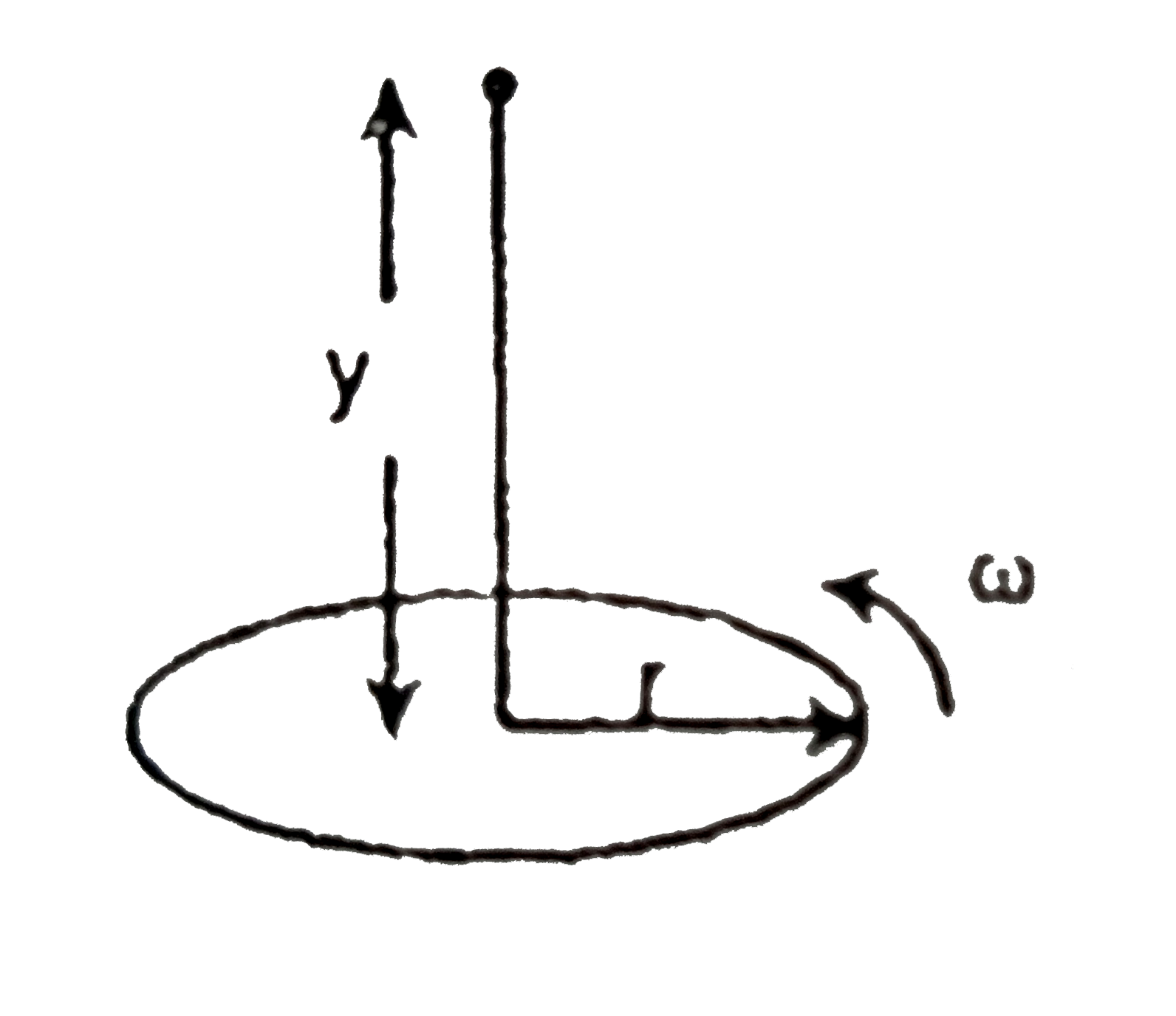
Calculate the magnetic field at distance `y` from the centre of the axis of a disc of radius `r` and unifrom surface charge density `sigma`, If the disc spins with angular velocity `omega` ?

A

`(mu_(0)sigmaomega)/(3)((r^(2)-2y^(2))/(sqrt(r^(2)-y^(2)))+2y)`

B

`(mu_(0)sigmaomega)/(2)((r^(2)+2y^(2))/(sqrt(r^(2)+y^(2))))`

C

`(mu_(0)sigmaomega)/(2)((r^(2)+2y^(2))/(sqrt(r^(2)+y^(2)))-2y)`

D

`(2mu_(0)sigmaomega)/(3)((r^(2)+2y^(2))/(sqrt(r^(2)+y^(2)))-2y)`

Text Solution

Verified by Experts

Charge on a ring of radius `x` and width `dx`
`dq=(2pix dx)sigma`
Current, `dI=(dq)/(dt)=(2pixsigmadx)/(Dt)=omegasigmax dx`
`dB=(mu_(0)dIr^(2))/(2(x^(2)+y^(2))^(3//2))`
`B=(mu_(0)sigmaomega)/(2)((r^(2)+2y^(2))/(sqrt(r^(2)+y^(2)))-2y)`
Promotional Banner

Similar Questions

Explore conceptually related problems

A disc of radius R rotates at an angular velocity omega about the axis perpendicular to its surface and passing through its centre. If the disc has a uniform surface charge density sigma , find the magnetic induction on the axis of rotation at a distance x from the centre. (Given R=3m , x=4m and mu_(0)sigmaomega=20Tesla//m .)

Find the electric field caused by a disc of radius a with a uniform surfce charge density sigma (charge per unit area) at a point along the axis of the disc a distance x from its centre.

A point charge q is placed at a distance d from the centre of a circular disc of radius R. Find electric flux flowing through the disc due to that charge

A man of mass m stands on a horizontal platform in the shape of a disc of mass m and radius R , pivoted on a vertical axis thorugh its centre about which it can freely rotate. The man starts to move aroung the centre of the disc in a circle of radius r with a velocity v relative to the disc. Calculate the angular velocity of the disc.

A charge Q is uniformly distributed over the surface of non - conducting disc of radius R . The disc rotates about an axis perpendicular to its plane and passing through its centre with an angular to its plane and passing through its centre of the disc. If we keep both the amount of charge placed on the disc and its angular velocity to be constant and vary the radius of the disc then the variation of the magnetic induction at the centre of the disc will br represented by the figure:

Moment of inertia of a disc about an axis parallel to diameter and at a distance x from the centre of the disc is same as the moment of inertia of the disc about its centre axis. The radius of disc is R . The value of x is

A cockroach is moving with velocity v in anticlockwise direction on the rim of a disc of radius R of mass m . The moment of inertia of the disc about the axis is I and it is rotating in clockwise direction with an angular velocity omega . If the cockroach stops, the angular velocity of the disc will be

A metal rod of resistance R is fixed along a diameter of a conducting ring of radius r. There is a magnetic field of magnitude B perpendicular to the plane of the loop. The ring spins with an angular velocity omega about its axis. The centre of the ring is joined to its rim by an external wire W. The ring and W have no resistance. The current in W is

We have a disc of neglligible thickness and whose surface mass density varies as radial distance from centre as sigma=sigma_(0)(1+r/R) , where R is the radius of the disc. Specific heat of the material of the disc is C . Disc is given an angular velocity omega_(0) and placed on a horizontal rough surface such that the plane of the disc is parallel to the surface. Coefficient of friction between disc and suface is mu . The temperature of the disc is T_(0) . Answer the following question on the base of information provided in the above paragraph If the kinetic energy lost due to the friction between disc and surface is absorbed by the disc the moment heat is generated, by the mass lying at the point where the energy is lost. Assume that there is no radial heat flow in betwen disc particles. Rate of change in temperature at a point lying at r distance away from centre with time, before disc stops rotating, will be ( alpha -magnitude of angular acceleration of rod)

Two discs of radii R and 2R are pressed against each other. Initially, disc with radius R is rotating with angular velocity omega and other disc is stationary. Both discs are hinged at their respective centres and are free to rotate about them. Moment of inertia of smaller disc is I and of bigger disc is 2I about their respective axis of rotation. Find the angular velocity of bigger disc after long time.

